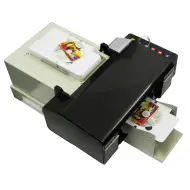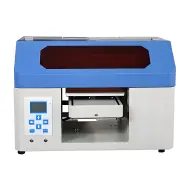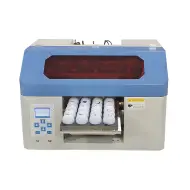
Analyzing Hidden Operational Bottlenecks in Automatic CD Printer PVC ID Card Printer from a Clinical Perspective with a Performance Thesis for Scalable Business Owners

The Industrial Reality of Operational Bottlenecks in Automatic CD and PVC Card Printing
Industrial-scale printing environments face unique challenges when integrating specialized devices such as automatic CD printers and PVC ID card printers. Despite the automation, subtle bottlenecks can significantly restrict throughput and degrade operational resilience. Consider a mid-sized production facility aiming for a daily output of 10,000 printed CDs or ID cards. The device's nominal speed rating—often quoted around 30 units per minute—translates theoretically to a 5.5-hour continuous run time. However, factors such as printhead heating cycles, substrate handling delays, and intermittent ink supply replenishment introduce cumulative downtime that causes production time to expand beyond 7 hours per shift.
Operational staff often overlook mechanical delays caused by substrate loading mechanisms. For instance, PVC cards require consistent alignment within the printer feed trays to avoid misprints or jams. Misfeeds lead to immediate production halts and require manual intervention. Similarly, automatic CD printers depend on precise spindle engagement and rotation speed synchronization to maintain printhead contact accuracy. Variations in motor torque output, thermally induced expansion of internal components, or wear of the drive rollers create timing mismatches that introduce print artifacts, necessitating reprints and wasting consumables.
Beyond mechanical issues, ink flow consistency is a hidden bottleneck. Ink viscosity fluctuations due to ambient temperature changes alter droplet formation, affecting color accuracy and adhesion. Automated systems typically compensate with pressure and temperature regulation, but these controls rely on sensor arrays susceptible to drift and fouling, which reduces control resolution over time.
Energy management further complicates continuous operation. Thermal management systems are tasked with maintaining optimal printhead temperature, which can vary between 45°C to 55°C for pigment-based inks. Excessive temperature deviations increase wear rates and precipitate premature component failures, while underheating leads to incomplete curing and print smudges.
Technical Deep-Dive into Core Components and Performance Constraints
Printhead Mechanics and Failure Modes
Printheads in automatic CD and PVC card printers utilize piezoelectric or thermal bubble inkjet technology with nozzle diameters approximating 20–30 microns. The nozzle count varies from 180 to 600 nozzles dependent on print resolution requirements, commonly between 300 to 1200 dpi. Under continuous high-throughput conditions, nozzle clogging occurs at a rate proportional to ink particulate concentration and substrate abrasion. Mathematically, considering clogging frequency f_c proportional to particulate density (ρ_p) and substrate roughness (R_s), f_c ∝ ρ_p × R_s. Establishing strict ink filtration thresholds (<1 micron particulates) and substrate surface finish (<5 microns Ra) reduces clogging frequency significantly.
Ink Chemistry and Delivery System Analysis
Ink formulations for CD printing leverage UV-curable or dye-sublimation chemistries, whereas ID card printers employ resin or pigment-based inks. Resin inks provide higher scratch resistance but require elevated curing temperatures (~60°C), affecting the thermal envelope of the printer. Ink delivery utilizes pressurized reservoirs calibrated to maintain 1.2 bar pressure, ensuring droplet size stability (~10 pl). UV ink systems embedded with photoinitiators present aging challenges: the quantum yield of polymerization decreases by up to 15% over 200 print hours due to radical quenching, requiring periodic replacement of reservoirs to maintain print integrity.
Substrate Transport and Alignment Precision
Automatic transport mechanisms employ stepper motor-driven rollers with positional accuracy within 0.1 mm tolerance. For CD printing, rotational alignment precision is critical; the angular misalignment tolerance is ±0.05 degrees to prevent print distortion. Feedback control loops utilizing optical encoders measure spindle speed to ±0.2% accuracy; however, mechanical backlash introduces transient errors that necessitate microstepping control algorithms to compensate.
Thermal Management and Power Consumption
The printer’s thermal subsystem consumes approximately 350 W during peak operation, dominated by printhead heating elements (200 W) and substrate curing lamps (100 W). Calculations indicate a heat dissipation requirement of 450 W to maintain stable operating temperatures in ambient environments of 22°C ± 3°C. Failure to achieve adequate airflow or heat sinking results in temperature deviances exceeding 3°C within 15 minutes, accelerating premature component degradation. Real-time thermal sensors employ thermistors with 0.1°C resolution, but sensor drift over 1 year can exceed 0.5°C, emphasizing the need for scheduled calibration.
Comparative Table on Key Operational Parameters
| Parameter | Automatic CD Printer | PVC ID Card Printer |
|---|---|---|
| Print Resolution (dpi) | 600–1200 | 300–600 |
| Nozzle Count | 400–600 | 180–400 |
| Substrate Thickness (mm) | 1.2 | 0.76 |
| Nominal Throughput (units/min) | 20–30 | 25–35 |
| Operating Temperature Range (°C) | 40–55 | 45–60 |
| Peak Power Consumption (W) | 350 | 320 |
Scenario Analysis of Throughput and Automation in Business Use Cases
Case 1: Medium-Sized Promotional CD Production
Producing 5,000 branded CDs per day necessitates maximizing uptime. The bottleneck arises primarily in thermal cycling and printhead maintenance intervals, reducing actual throughput to approximately 80% of rated speed. The downtime for nozzle cleaning, typically 10 minutes every 300 prints, aggregates nearly 1 hour daily, affecting delivery schedules.
Case 2: High-Volume PVC ID Card Enrollment
For a government agency issuing 15,000 ID cards monthly, the primary constraint is substrate handling precision to avoid costly reprints. The PVC printer’s faster substrate feed allows throughput gains; however, workforce training on alignment protocols can reduce misfeeds by 40%, directly increasing output by roughly 1,500 cards per month.
Case 3: Mixed Media Corporate Badge Production
Combining both printing technologies in a single workflow demands seamless software integration. Network latency and hardware command queuing can introduce idle times of up to 5 seconds per unit when switching between devices. Optimizing print batch sizes to minimize switching frequency improves overall line efficiency by 12%.
Expert FAQ on Complex Operational Factors
Q1 How does printhead thermal expansion impact nozzle alignment?
The thermal coefficient of expansion for printhead materials typically ranges between 10–15 ppm/°C. A 10°C temperature rise causes dimensional changes of ~15–20 microns, enough to cause nozzle misalignment with substrate motion, necessitating integrated compensation mechanisms.Q2 What maintenance protocols best mitigate ink reservoir photoinitiator degradation?
Periodic reservoir replacement every 150 print hours and controlled UV exposure cycles reduce photoinitiator depletion. Additionally, inert gas purging minimizes oxidative degradation.Q3 How do substrate surface variances affect droplet adhesion?
Surface roughness above 10 microns Ra disrupts droplet coalescence, creating inconsistent print density. Calibrated corona discharge treatment prior to printing improves adhesion by modifying surface energy.Q4 What are the energy efficiency trade-offs in thermal management?
Increasing printhead temperature stability improves print quality but raises power draw exponentially with setpoint increases beyond 50°C. Employing PID controllers reduces overshoot and improves energy usage by 8–10%.Q5 How can network integration latency be minimized in multi-device workflows?
Implementing dedicated Ethernet VLANs and optimizing print queue buffer sizes minimize command latency and prevent packet collisions, reducing idle time between devices by up to 3 seconds per command.
Strategic Verdict on the Future Trajectory of Automatic CD and PVC ID Card Printers
The technical maturity of automatic CD printers and PVC ID card printers reveals a convergence of precision mechanics, advanced ink chemistry, and integrated thermal control as the core determinants of operational efficiency. Future advances will likely revolve around refined sensor fusion for real-time condition monitoring and adaptive feedback control algorithms to proactively address bottlenecks before they manifest at the operational level. From a scalable business perspective, investing in highly maintainable hardware with modular components that facilitate rapid replacement and minimize downtime will prove decisive. The evolution of substrate handling combined with AI-driven quality assurance promises to push throughput ceilings beyond current nominal ratings without proportional increases in labor or energy costs. However, the trajectory remains constrained by the physical limits of ink chemistry and thermal dissipation in compact form factors, suggesting incremental performance gains rather than disruptive leaps in the near term.