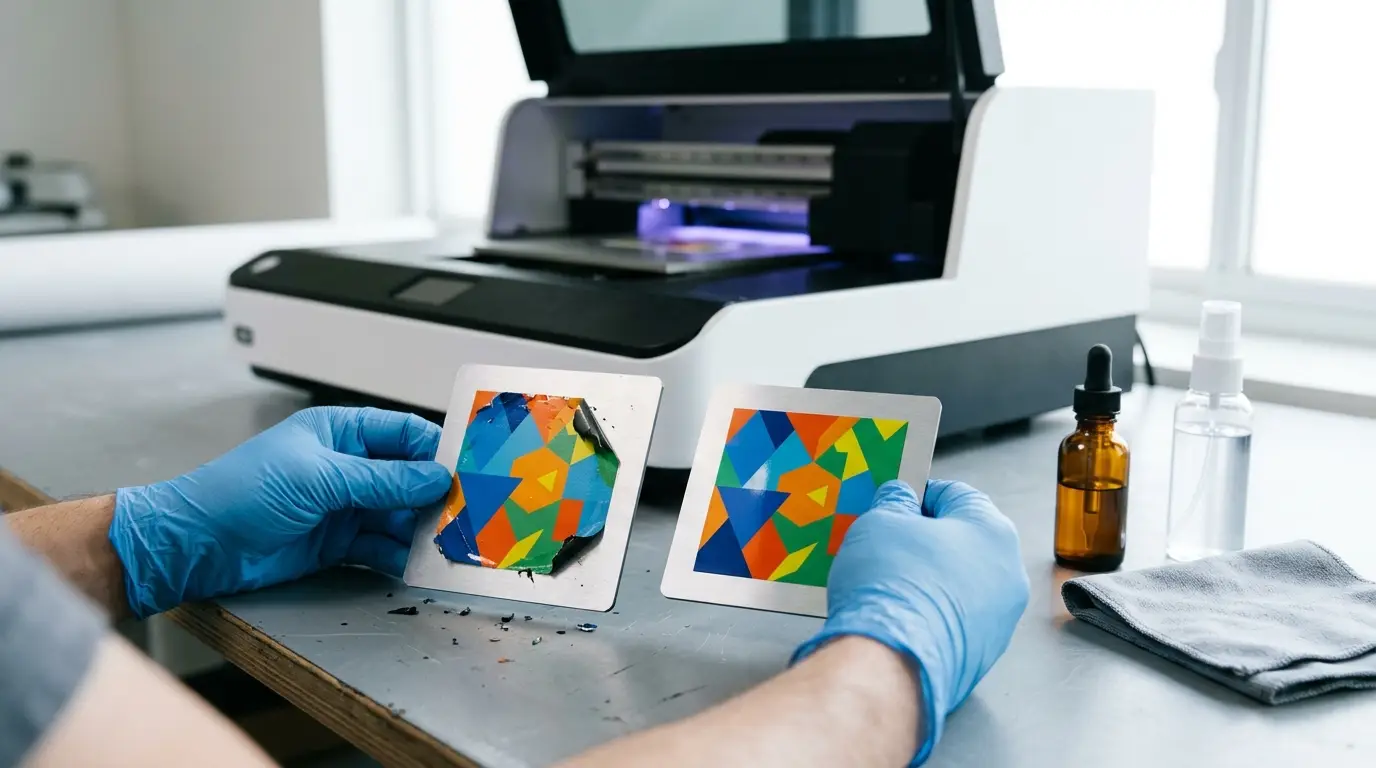
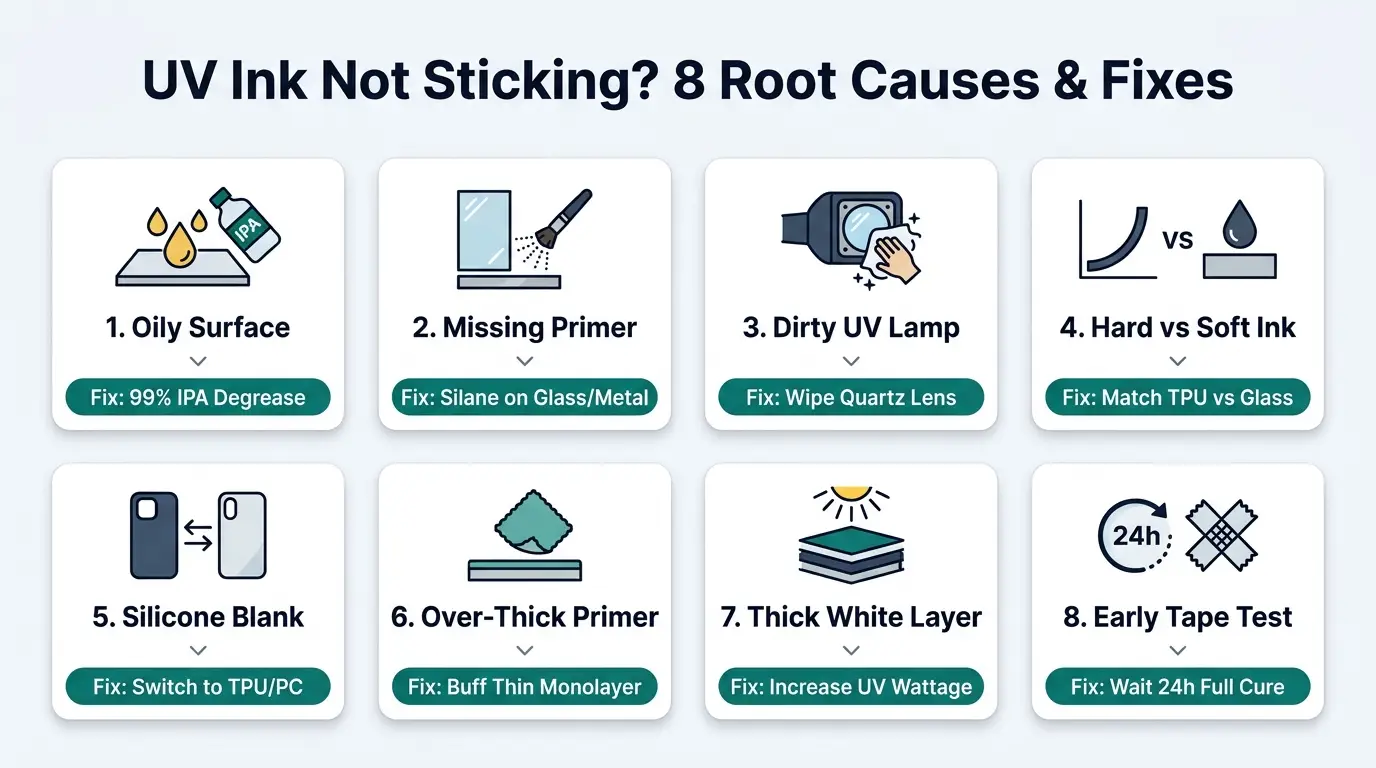
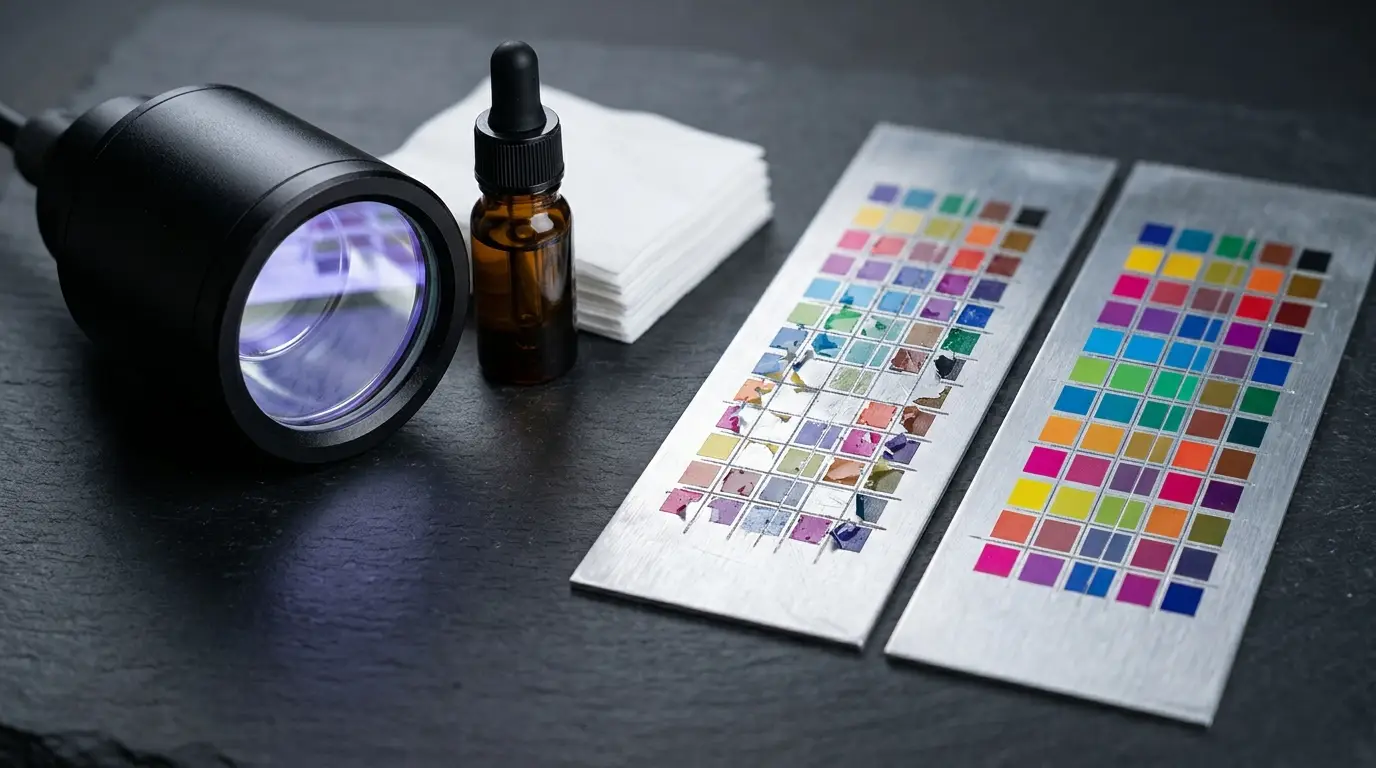
UV printer ink not sticking? 8 causes and fixes for custom signage, tumbler, and promotional gift workshops. When UV-printed graphics scratch off with a fingernail, smear wet off the bed, or peel away in sheets after water exposure, the printer itself is rarely broken—instead, one of eight surface energy, chemical primer, or UV LED curing variables is out of balance. This shop-floor troubleshooting guide diagnoses every adhesion failure step by step: factory mold-release oils, unprimed non-porous glass and stainless steel, overspray-clouded UV LED quartz lenses, hard vs flexible UV ink mismatches, liquid silicone vs TPU confusion, over-applied gummy primer, thick white ink bottom under-curing, and premature tape testing before 24-hour cross-linking.
Troubleshooting GuideAdhesion & Curing
UV Printer Ink Not Sticking? 8 Causes and Fixes
Reading Time: 9 Mins
Written by: GNFEI Engineering Team
Updated: November 2026
30-Second Symptom Triage: First touch the print! 1) If the top surface feels oily, wet, or smears on your finger, your UV LED quartz window is dirty with cured overspray, lamp power is too low, or ink is expired. 2) If the top feels bone-dry and hard, yet lifts off in an intact rubbery/plastic sheet, the bottom interface failed—caused by factory mold-release oil, missing glass/metal/PP adhesion primer, a raw silicone blank, or excessive white ink thickness blocking bottom UV penetration.
1. All 8 Causes of UV Ink Peeling, Scratching & Smearing (With Exact Fixes)
Work through these 8 diagnostic checks in order—over 95% of UV adhesion issues disappear within the first four fixes:
Cause 1: Factory Mold-Release Oil & Windex Residue
Symptom: Ink beads up into "fisheye" pinholes or peels randomly where fingers touched the blank. Fix: Wipe every blank with 99% Isopropyl Alcohol (IPA) on a lint-free wipe. Never use household glass cleaners—ammonia and silicone shine additives repel UV ink!
Cause 2: Unprimed Glass, Bare Steel, or Polyolefin (PP/PE)
Symptom: Print feels firm dry, then peels off cleanly in one piece after overnight humidity or water rinsing. Fix: Match the substrate to its chemical bridge: Silane Glass Primer for glass/ceramic, Metal Promoter for 304 steel/brass, and PP/PE Primer for polypropylene plastics.
Cause 3: Cured Ink Mist Blocking the UV LED Quartz Lens
Symptom: Prints gradually turn tacky, smelly, and easy to smear across all substrates at once. Fix: Inspect the bottom glass window of your UV LED curing lamp! Scrub off baked-on ink haze using UV cleaner so 100% of 395nm irradiance reaches the substrate.
Cause 4: Hard vs Soft UV Ink Mismatch
Symptom: Brittle ink cracks on bent TPU phone cases, OR soft rubbery ink gouges off glass/acrylic with a thumbnail. Fix: Use Hard UV Ink for rigid glass/metal/acrylic awards, Soft UV Ink for leather/TPU, or GNFEI Neutral-Hybrid UV Ink for mixed gift studios.
Cause 5: Raw Liquid Silicone Mistaken for Soft TPU
Symptom: Ink rubs right off a velvety phone case or wristband like dried paint on Teflon. Fix: Liquid silicone rubber exudes dimethyl silicone oil that defeats normal primers. Replace silicone blanks with matte soft-touch TPU—or use specialized flame + 2-part silicone ink.
Cause 6: Over-Applied Wet or Expired Adhesion Primer
Symptom: You applied primer, yet the ink slides off with a greasy smear underneath! Fix: Primer works as a 1-molecule-thick bridge—puddling it creates a weak slip layer! Wipe ultra-thin, wait 90–120s to flash dry, buff clear, and replace opened silane primer bottles every 4–6 months.
Cause 7: 200% White Ink Blocking Deep Bottom Curing
Symptom: CMYK-only prints stick fine, but White + CMYK prints peel off leaving wet white chalk underneath! Fix: Titanium dioxide reflects 395nm UV light! Drop single-pass White RIP ink limit from 200% to 85%–110% and boost UV lamp wattage to 85% so UV rays cure all the way to the base.
Cause 8: Fingernail Scratching 30 Seconds Off the Bed
Symptom: Print fails a fingernail gouge right off the bed, yet leftover samples from yesterday are rock-solid! Fix: Dark-reaction polymerization and silane chemical bonding take 12 to 24 hours at 22°C to reach 100% cross-link density. Always wait 24h before tape testing or shipping.
In polymer physics, UV ink (surface tension ~32–36 dynes/cm) only wets out and anchors onto a substrate whose surface energy exceeds 38–42 dynes/cm. Use cheap 38-dyne test pens ($12) on unknown customer blanks, or check this quick shop chart:
Material Family
Raw Surface Energy
Exact Shop Fix for 5B Adhesion
PVC, ABS, PC, TPU, Wood, Leather
38 – 46 dynes/cm (High)
99% IPA Degrease Wipe Only -> Direct Print
Cast & Extruded Acrylic (PMMA)
38 – 41 dynes/cm
IPA Wipe for Indoor; Acrylic Promoter for Keychains/Outdoor
Float Glass, Crystal & Glazed Tile
Non-Porous Hydrophilic
IPA Wipe -> Silane Glass Primer (Thin Buffed) -> Hard UV Ink
Bare 304 Stainless Steel & Brass
Oily Oxide Passivation
Acetone/IPA Degrease -> Metal UV Promoter -> Clear Varnish Seal
Polypropylene (PP) & Polyethylene (PE)
29 – 31 dynes/cm (Very Low!)
Quick Propane Flame Pass (1 sec) OR Polyolefin PP/PE Primer
High-Irradiance Water-Cooled UV LED System
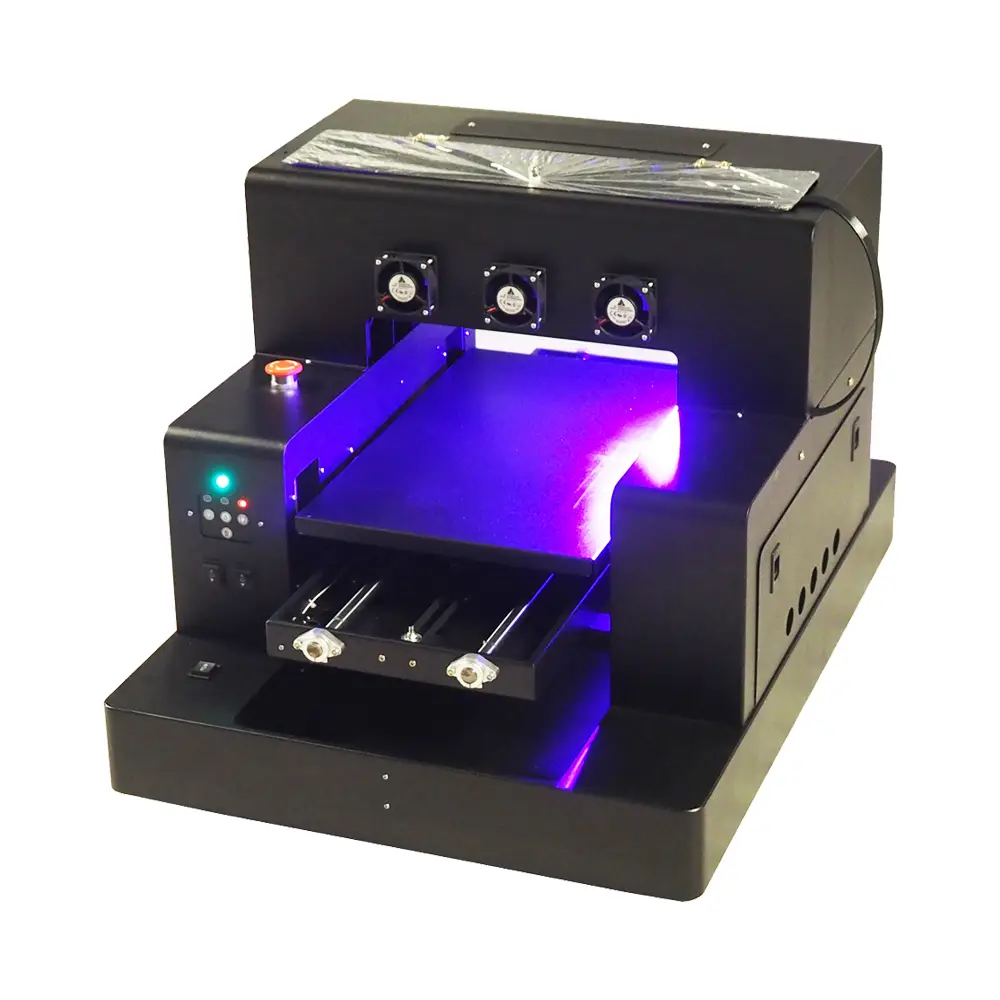
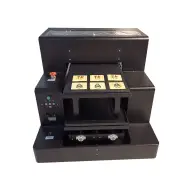
GNFEI F85V3 A3 Spot UV & Varnish Printer ($2,200)
Eliminate weak air-cooled lamp under-curing: every GNFEI F85V3 pairs high-wattage water-cooled 395nm UV LED lamps with matched GNFEI industrial UV inks and pre-calibrated RIP ink limits.
Deep-Cure Water-Cooled UV LED Array: Penetrates dense opaque white underbases cleanly without overheating sensitive plastics
Protective Clear Varnish Channel: Locks printed edges under a scratch-resistant clear coat in the same pass
Matched Ink + Primer Starter Support: Direct engineer guidance for every substrate in your catalog
Q1. Why does CMYK stick fine on my blank, yet White + CMYK peels right off?▼
Opaque white UV ink is packed with reflective titanium dioxide (TiO2) nanoparticles that block 395nm UV rays from reaching the bottom boundary when jetted too thick! Reduce White RIP channel density from 150%–200% down to 80%–100%, slow carriage speed slightly (or switch to unidirectional curing), and verify your UV LED quartz lens is spotless.
Q2. Why does my UV print feel sticky or tacky even at 100% UV lamp power?▼
Nine times out of ten, a hazy crust of cured ink mist is coating the bottom quartz glass of your UV LED lamp, cutting actual light output in half! If cleaning the quartz lens doesn't fix tackiness, check whether your ink is expired (> 12 months old, where photoinitiators degrade) or mismatched in wavelength (e.g., 365nm mercury-vapor ink loaded into a 395nm UV LED printer).
Q3. Can curing UV ink TOO hard (over-curing) actually hurt adhesion?▼
Yes! Extreme 100% UV shock-curing on smooth plastics causes rapid volumetric polymer shrinkage—curling microscopic edges upward and making the base White layer too glass-slick for the upper CMYK layer to grab ("inter-coat delamination"). Running White pinning at 70%–80% power relieves shrinkage stress and improves inter-layer grip.
Q4. How does flame treatment make UV ink stick to polypropylene (PP) and polyethylene (PE)?▼
Polyolefin plastics (PP tumblers, HDPE toolboxes, corrugated yard signs) have non-polar waxy chains (~29 dynes/cm). Sweeping the oxidizing blue tip of a handheld propane torch briskly across the plastic for 0.5 seconds (without melting it!) oxidizes surface C-H bonds into polar C=O hydroxyl/carbonyl groups (> 44 dynes/cm) so UV ink locks on tight!
Q5. Why did UV ink stick to yesterday's batch of acrylic or tumblers, but peel off today's identical blanks?▼
Check two silent shop changes: 1) Blank suppliers frequently change top clear-coat formulas (switching from polyurethane powder coat to slick silicone-modified polyester) without telling buyers, or 2) shop humidity spiked above 75% RH (condensing an invisible moisture film on cold metal blanks brought in from a cold warehouse). Let blanks acclimate to 22°C room temperature before wiping with IPA!
Q6. Can automotive adhesion promoter (like Bulldog) substitute for dedicated UV primer?▼
Chlorinated polyolefin automotive spray promoters help on PP/TPO plastics in an emergency, but they leave orange-peel texture on clear acrylic and fail completely on silicate glass! Dedicated wipe-on UV primers (Silane for glass, Acrylic/Metal ester for metals) cost half as much, dry optically invisible, and cross-link directly with UV acrylates.
Q7. Why does CMYK color rub off the top of my White layer while the White layer stays stuck?▼
If you printed White in Pass 1 at 100% UV lamp cure, waited 10 minutes, and printed CMYK in Pass 2, the White layer was already 100% cross-linked with zero unreacted acrylate bonds left to grab CMYK! Print White + CMYK simultaneously in a single pass—or lower Pass 1 White lamp power to 60% ("pinning") so CMYK bonds chemically into the semi-cured white base.
Q8. Does sanding glossy substrates improve UV ink adhesion?▼
On opaque painted wood, Lacquered MDF, or glossy fiberglass panels where the entire surface will receive full-bleed background ink, scuffing lightly with an 800-grit Scotch-Brite pad + IPA wipe doubles mechanical tooth! On clear glass or clear acrylic where unscuffed areas remain visible, use invisible chemical primer instead.
Q9. Can a heat gun post-cure rescue a batch of slightly under-adhered UV prints?▼
Warming primed glass, ceramic, or metal prints gently to 55°C–65°C for 10 minutes (or running one dry curing-only carriage sweep with printheads disabled) accelerates silane condensation and monomer mobility, noticeably tightening marginal adhesion! (Never overheat thin PVC/acrylic above 65°C or sheets will warp.)
Q10. What should I do when a client brings an unknown mystery plastic blank?▼
Always request 2 extra sacrificial test pieces on every custom job: swipe a 38-dyne test marker on the back (if the purple ink stays a smooth line for 3 seconds, IPA wipe alone works; if it shrinks into droplets, test PP primer vs Acrylic primer on two corners and wait 12 hours before running the full order).
Get Free Substrate Adhesion Advice From GNFEI Engineers
Tell us what materials you want to customize—we will send you live print & scratch-test videos plus factory pricing on matched GNFEI UV printers, inks, and primers.
Find the best dtg printer for small business startups. Compare our competitive dtg printer price and total t shirt printing machine cost. The F85G4 di..
Find the best dtg printer for small business startups. Compare our competitive dtg printer price and total t shirt printing machine cost. The F85G4 di..