Why Does White Ink Clog DTG Printheads So Easily? | GNFEI
Why Does White Ink Clog DTG Printheads So Easily?
Every digital apparel decorator knows the frustration: while CMYK color channels print smoothly after weeks of neglect, the white ink channel can clog, streak, or starve in a single weekend. Explore the chemical physics, fluid dynamics, and micro-mechanical failure points that make white textile ink so challenging—and how modern commercial printers engineer around them.
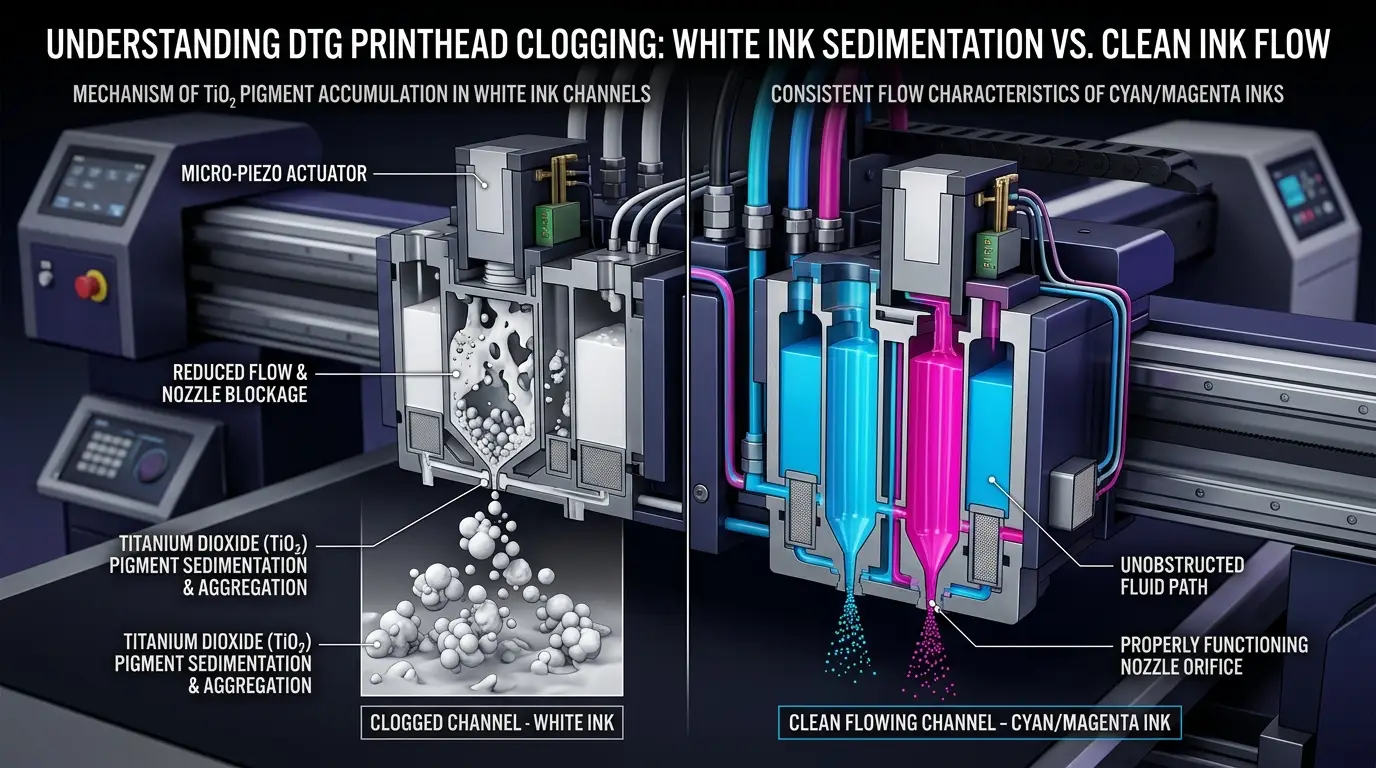
⚠ Executive Summary: The Triad of White Ink Failure
White ink clogging in Direct-to-Garment (DTG) printing is not caused by operator negligence alone—it is the direct consequence of three fundamental physical and chemical forces:
- Gravitational Mass Imbalance: White ink relies on Titanium Dioxide (TiO2), an inorganic mineral pigment with a specific gravity of ~4.2 g/cm3—over 400% heavier than the liquid carrier fluid and CMYK organic pigments.
- Rapid Meniscus Evaporation & Film Polymerization: Water-based textile binders (acrylic and polyurethane polymers) must dry rapidly on hot garments, meaning exposed ink at the open nozzle meniscus skins over in under 20 minutes without humidity control.
- Micro-Nozzle Physical Constraints: Micro-piezo printheads fire ink droplets through orifices as narrow as 15 to 25 microns—meaning pigment clusters only a few microns across will instantly starve or deflect nozzle firing.
1. The Chemical Physics of White Ink: Why TiO2 is a Dual-Edged Sword
In CMYK inkjet printing, colorants are either soluble organic dyes or finely ground synthetic organic pigments (such as quinacridone for magenta or copper phthalocyanine for cyan). These organic pigment molecules have specific gravities ranging between 1.05 and 1.35 g/cm3—virtually identical to the density of the water and glycol carrier fluids in which they are suspended. Because their density matches the solvent, thermal Brownian motion easily counters gravitational pull, allowing CMYK inks to remain in stable suspension for months without stirring.
White ink, however, cannot use organic dyes because no transparent or soluble dye can block out the dark dyes of a black or navy cotton t-shirt. To achieve the complete optical opacity required to print vibrant colors on dark apparel, ink chemists must use Titanium Dioxide (TiO2, rutile form).
| Physical & Chemical Property | CMYK Color Inks (Cyan, Magenta, Yellow, Black) | White DTG Ink (Titanium Dioxide TiO2) |
|---|---|---|
| Primary Colorant Material | Organic synthetic dyes & carbon black | Inorganic Rutile Titanium Dioxide (TiO2) |
| Specific Gravity (Density) | 1.05 to 1.30 g/cm3 (Neutrally Buoyant) | 4.20 to 4.26 g/cm3 (~400% Heavier) |
| Primary Dispersion Stabilization | Natural Brownian molecular motion | Electrostatic polymeric dispersant shells |
| Idle Sedimentation Rate | Minimal (Stays suspended 30+ days) | Fast (Settles within 4 to 12 hours) |
| Binder Polymer Content | Low to medium (5% to 8% resin) | High (12% to 18% acrylic/urethane resin) |
| Required Maintenance Cycle | Weekly or bi-weekly check | Strict Daily agitation, wipe & cap seal |
2. Stokes' Law in Action: The 3 Stages of White Ink Sedimentation
In fluid dynamics, the rate at which spherical solid particles fall through a liquid medium is governed by Stokes' Law:
Because titanium dioxide is more than four times denser than the surrounding water-glycol carrier fluid, the settling velocity is mathematically inevitable whenever the ink remains static. Without mechanical agitation or constant fluid circulation, white ink undergoes a progressive degradation cycle across three distinct stages:
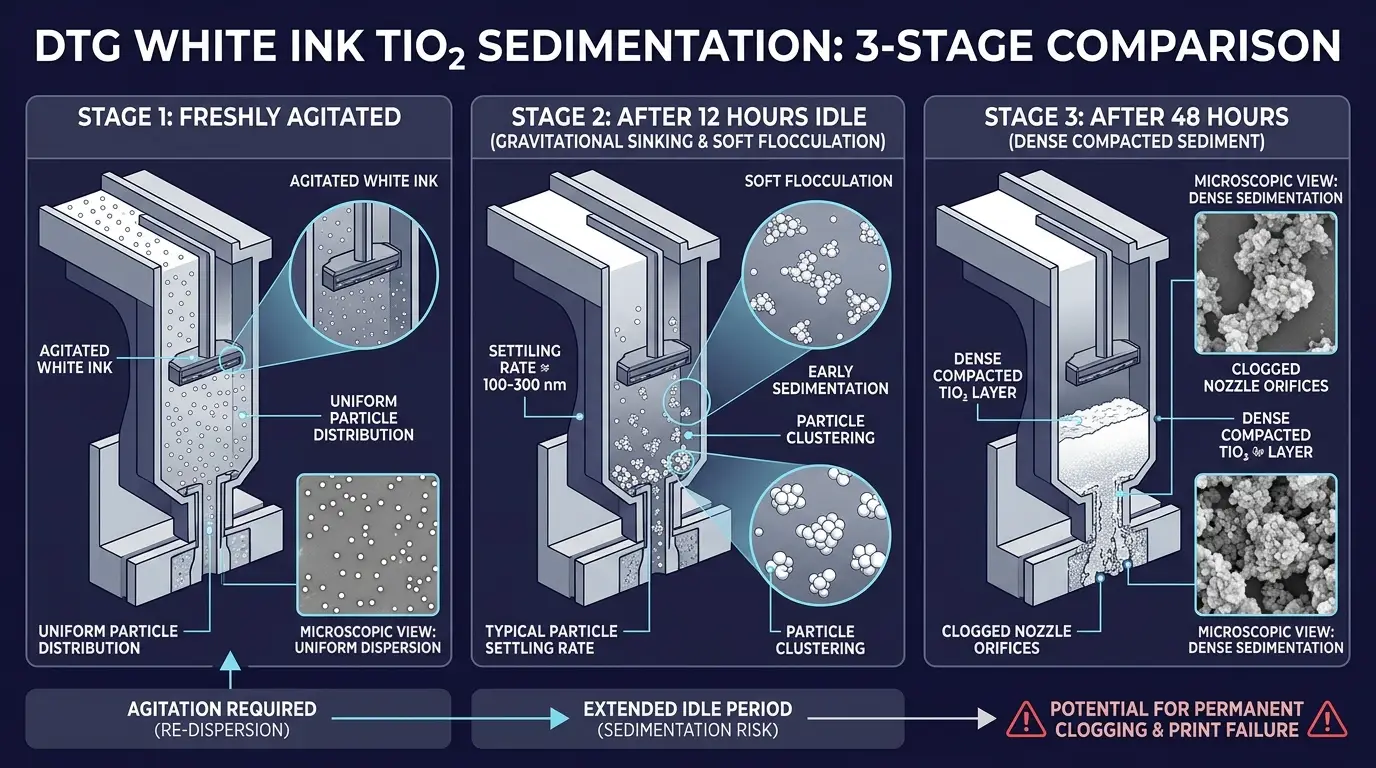
Freshly Agitated & Dispersed
Nanometer-scale TiO2 particles (average 200–250 nm) are uniformly surrounded by electrostatic polymer dispersants. Viscosity is optimal (3 to 6 mPa·s), allowing clean piezoelectric droplet ejection without satellite misting or nozzle misdirection.
Soft Flocculation & Sinking
Gravity overcomes the repulsive charge of the dispersant. Particles drift downward, creating a concentration gradient. The top fluid becomes watery and translucent, while the lower ink becomes thick and sludgy, causing immediate printhead nozzle dropouts.
Hard Cake Compaction
Individual particles interlock into a dense, cement-like sediment layer at the bottom of the damper mesh filter, ink lines, and printhead manifolds. Software cleanings cannot dislodge this paste; chemical flushing or ultrasonic bath recovery becomes required.
3. Meniscus Evaporation & Polymer Binder Crosslinking
Sedimentation explains why ink lines and dampers clog, but why do nozzles clog even when the machine is turned on? The answer lies in the microscopic open interface between the ink and ambient air at the nozzle orifice—known as the meniscus.
DTG inks are formulated to bond to raw cotton yarns and withstand dozens of domestic washing machine cycles. To accomplish this, the ink contains high concentrations of water-borne acrylic and polyurethane self-crosslinking binders. When sprayed onto fabric and heated in a heat press or conveyor dryer at 165°C (330°F), the water evaporates and the polymer chains chemically crosslink into an insoluble, water-resistant latex film.
However, this same chemical mechanism turns destructive at the printhead nozzle plate:
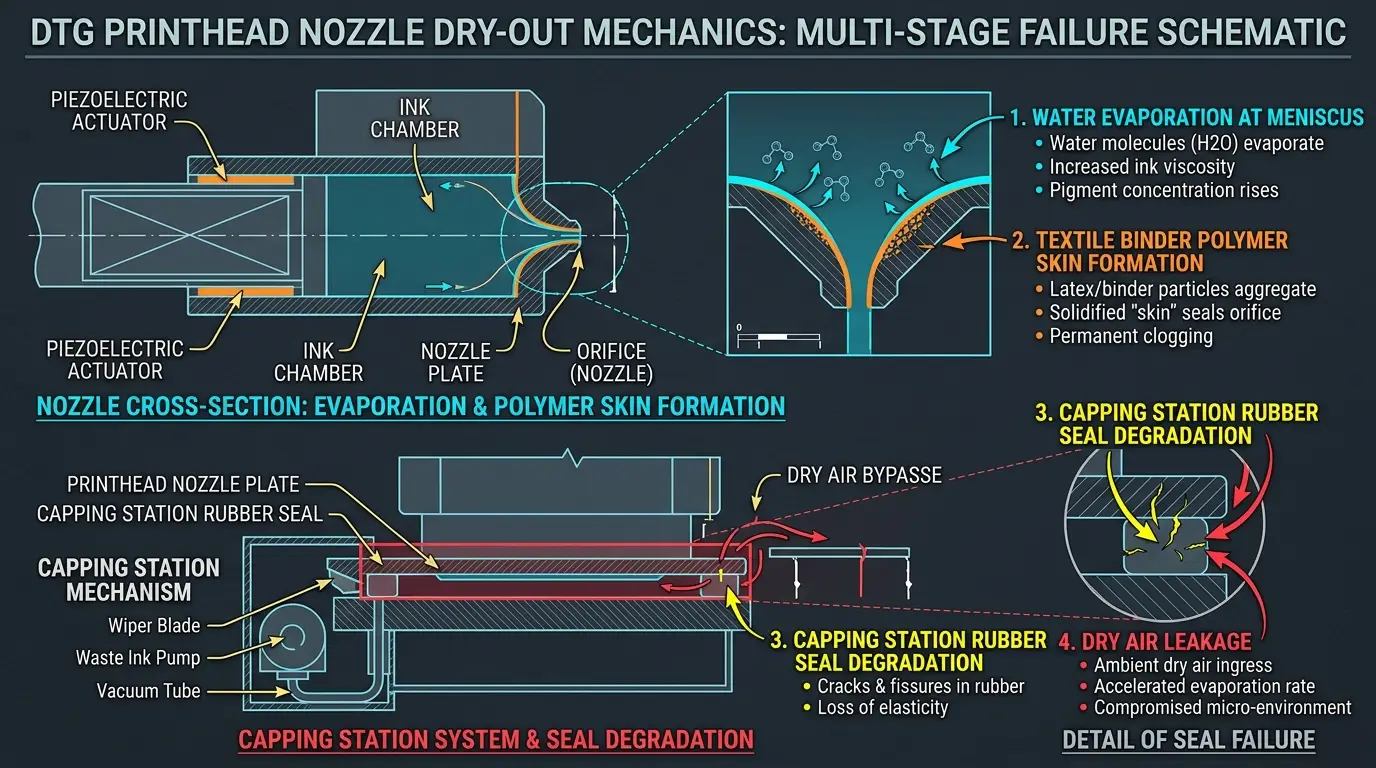
The Fatal Viscosity Spike: Why Cleaning Cycles Fail Once Skin Forms
A functional Epson MicroPiezo nozzle requires ink viscosity between 3.0 and 5.5 mPa·s (centipoise) to fire a microscopic 3 to 20 picoliter droplet. When ambient humidity drops below 50%, surface water evaporates from the 20-micron meniscus in less than 20 minutes. As water leaves, the local binder and pigment concentration increases by 400%, spiking ink viscosity beyond 100 mPa·s. At this point, the micro-piezo actuator ceramic crystal cannot deform with enough force to expel the viscous plug, causing complete nozzle deflection and failure.
4. The Hardware Hotspots: Dampers, Wiper Blades & Capping Stations
While operators often blame the printhead itself when nozzles fail, the root cause is almost always failure in one of three surrounding maintenance and delivery components:
The Damper Mesh Filter
Inside every DTG damper sits a microscopic 15-micron stainless steel screen designed to protect the printhead from contaminants. As titanium dioxide settles over weeks of operation, these mesh pores blind with compacted pigment. Ink flow becomes restricted, causing catastrophic white ink starvation during dense solid-fill prints.
The Rubber Capping Seal
The capping station rubber rim must maintain a hermetic airtight seal against the printhead carriage when parked. If ink crust builds on the rim, air enters the cap overnight. The humid micro-environment collapses, drying all white nozzles into a solid rock before morning.
The Rubber Wiper Blade
The wiper blade removes excess ink droplets after automatic cleanings. When neglected, it collects shirt lint and dried TiO2 paste. Instead of cleaning the mirror-smooth nozzle plate, it drags hard abrasive crystals across the orifices, destroying the delicate hydrophobic surface coating.
5. How Industrial Printers Overcome Clogging: WIMS & Fluid Engineering
Understanding why white ink clogs explains why cheap converted DIY desktop printers fail so quickly—they lack the active fluid mechanics required to handle dense inorganic suspensions. Professional commercial flatbed printers rely on multi-stage active defense architectures:
- White Ink Management System (WIMS): An automated peristaltic pump pulls white ink from the bottom of the main reservoir, circulates it through the sub-tanks and carriage lines, and returns it to the main reservoir 24 hours a day, preventing gravitational settling even during holidays.
- Motorized Reservoir Agitators: Internal rotating magnetic stirrers or mechanical paddles keep the bulk pigment evenly dispersed, preventing heavy sediment layers from accumulating at the base of the tank.
- Dual-Head Dedicated Architectures: Separating the white channel into a dedicated high-volume printhead (e.g., dual Epson XP600 or i3200 heads) allows higher driving voltages, wider droplet sizes (up to 21 picoliters), and independent cleaning cycles that do not waste expensive CMYK color inks.
- Airtight Motorized Capping Modules: CNC-machined capping stations equipped with solvent-resistant fluoroelastomer seals prevent ambient air contact and allow wet-capping with specialized moisturizing fluid during idle periods.
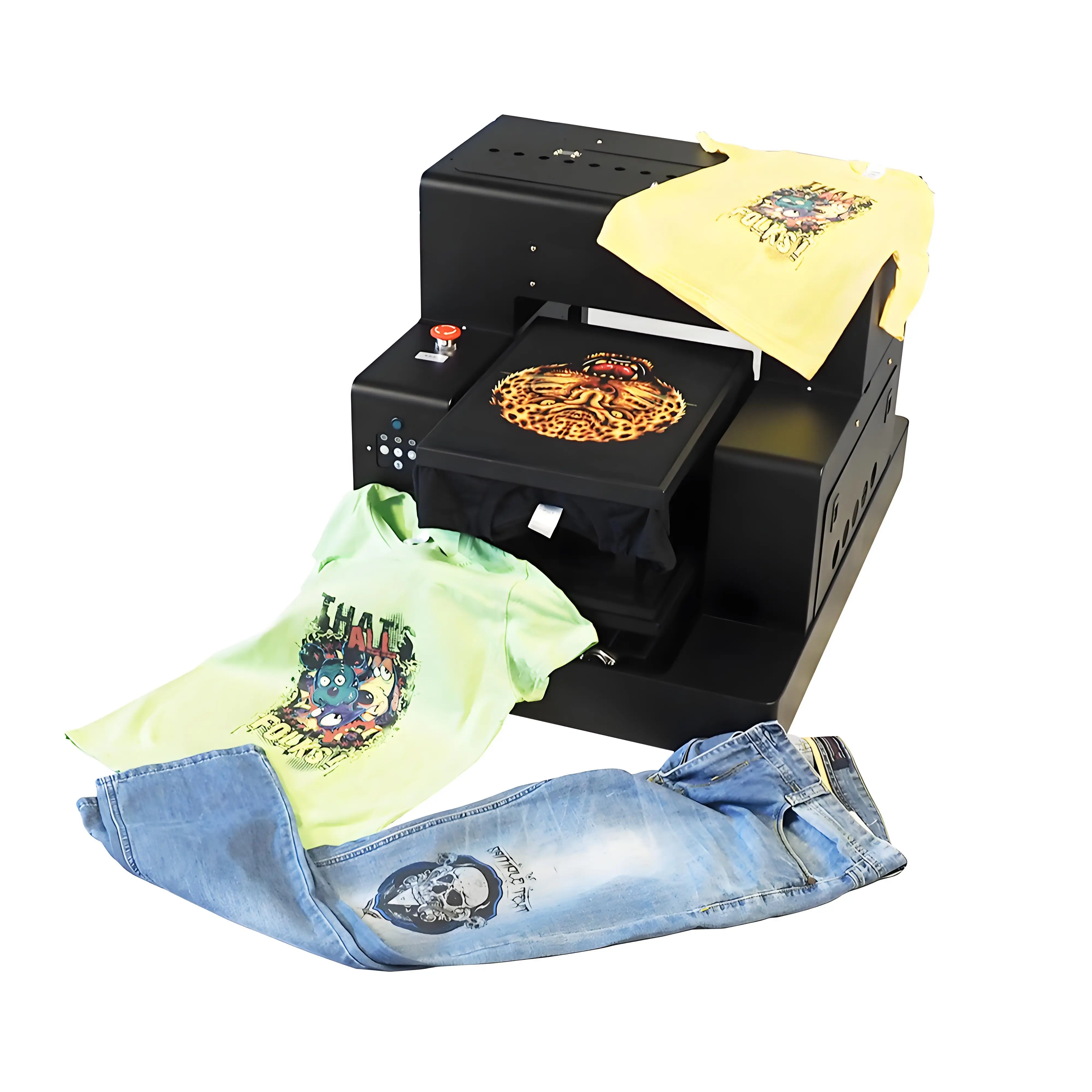
GNFEI A3 Commercial DTG Flatbed Printer
- Active peristaltic white ink circulation system (WIMS) running 24/7 to eliminate settling
- Simultaneous white underbase & CMYK inline printing under 90 seconds per dark shirt
- Industrial HIWIN linear guide rail with high-torque lead-screw motion for sub-millimeter precision
- Automatic optical infrared height sensor to prevent printhead strikes and fiber contact
- Open-bulk textile pigment ink architecture saving 80% on consumable ink supply costs
7. Frequently Asked Questions (FAQ)
Q1. Why is white DTG ink so much heavier than CMYK inks? ▼
White DTG ink uses mineral titanium dioxide (TiO2) to achieve complete optical opacity on dark fabrics. TiO2 has a specific gravity of roughly 4.2 g/cm3, which is more than four times heavier than the organic dyes and carbon black pigments used in CMYK inks (approximately 1.0 to 1.2 g/cm3). This extreme mass causes white pigment particles to rapidly precipitate out of liquid suspension under gravity.
Q2. How quickly does white DTG ink begin to separate when the printer is idle? ▼
Gravitational settling begins within 2 to 4 hours of inactivity. By 12 to 24 hours, measurable concentration gradients form in lines and dampers. After 48 hours without agitation or circulation, titanium dioxide particles compact into a dense, viscous sediment layer that cannot be re-dispersed by normal head cleaning cycles alone.
Q3. What happens chemically when white ink dries at the nozzle plate meniscus? ▼
DTG white ink contains specialized polymer crosslinking binders (acrylic or polyurethane emulsions) formulated to bond ink to cotton fibers during heat curing. When exposed to dry ambient air, the water and humectant carriers evaporate within 15 to 30 minutes, triggering premature polymer film formation. This forms a tough, waterproof plastic skin over the microscopic nozzle orifice.
Q4. Why do standard software head cleans often fail to clear white ink clogs? ▼
Standard software head cleans rely on suction from the capping station peristaltic pump. If pigment sedimentation has packed the damper filter mesh or if binder has hardened over the nozzle orifice, atmospheric vacuum pressure simply draws ink from adjacent channels while pulling air bubbles around the clog, exacerbating nozzle starvation rather than dislodging dense solids.
Q5. What is White Ink Management System (WIMS) and how does it prevent clogging? ▼
A White Ink Management System (WIMS) utilizes an automated peristaltic pump and motorized ink reservoir agitator to continuously recirculate white pigment throughout the entire ink delivery circuit. By maintaining constant fluid shear velocity, WIMS prevents gravitational sedimentation and keeps titanium dioxide nanoparticles evenly suspended 24/7.
Q6. Why do DTG ink dampers need frequent replacement compared to UV or eco-solvent printers? ▼
DTG dampers contain high-precision stainless steel mesh filters (typically 10 to 20 microns) designed to catch flocculated TiO2 particles before entering the delicate printhead. Because white pigment constantly settles inside the damper chamber, the internal filter mesh gradually blinds with hard sediment, causing ink starvation at high print speeds. Dampers should be replaced every 3 to 6 months.
Q7. How does room humidity directly impact DTG white ink printhead health? ▼
DTG printers require 50% to 70% relative humidity. When ambient humidity drops below 40%, the evaporation rate of the aqueous carrier at the nozzle meniscus increases exponentially. Even during normal platen motion between garment passes, nozzles begin drying out, resulting in nozzle deflection, banding, and premature capping station crusting.
Q8. Can a dirty wiper blade cause permanent white ink printhead clogs? ▼
Yes. If the rubber wiper blade is coated with dried white ink crust and textile lint, it no longer squeegees the nozzle plate cleanly. Instead, it drags abrasive dried TiO2 crystals across the microscopic fluoropolymer nozzle plate, scratching the hydrophobic coating and pushing dried binder debris directly into the nozzle orifices.
Q9. Why does capping station failure immediately destroy white ink nozzles? ▼
The capping station creates an airtight, humid micro-chamber over the printhead when parked. If dried ink crust on the capping rim prevents a complete seal, ambient dry air continuously leaks into the cap. The entire white nozzle bank will dry into a solid block of polymer and pigment within 24 to 48 hours.
Q10. What daily maintenance routine is mandatory to keep white ink nozzles firing 100%? ▼
Every operating day requires 3 non-negotiable steps: (1) Agitate all white ink bottles or cartridges for 30 to 60 seconds; (2) Clean the rubber wiper blade, capping station lip, and printhead perimeter with dedicated DTG cleaning solution and lint-free foam swabs; (3) Print a nozzle test pattern and perform an end-of-day capping station flush with wet capping solution.
Protect Your DTG Investment with Active WIMS Circulation
Stop fighting clogged white nozzles every morning. GNFEI commercial A3 and large-format DTG printers feature 24/7 automated peristaltic ink recirculation, motorized agitators, and dual MicroPiezo architecture to keep your production running reliably.