Are Cheap $2,000–$4,000 Chinese DTG Printers Worth Buying? | GNFEI

If you are launching a custom apparel brand, expanding a streetwear print shop, or searching for a high-margin digital printing solution, you have undoubtedly run into the extreme pricing chasm of the Direct-to-Garment (DTG) industry. On one side stand renowned Western industrial machinery giants—Brother GTX, Epson SureColor F2100/F2270, and Ricoh Ri 1000—carrying eye-watering price tags ranging from $15,000 to $25,000+. On the other side, overseas direct-from-factory platforms showcase desktop flatbed DTG printers priced temptingly between $2,000 and $4,000. Online forums and Reddit groups overflow with conflicting opinions: some praise them as the ultimate money-making startup machines, while others warn of endless head clogs, faulty electronics, and wasted money. Are cheap Chinese DTG printers truly worth buying, or are they an expensive trap? In this comprehensive, transparent engineering guide, we dissect the mechanics, financial payback models, maintenance realities, and the exact red flags you must avoid before wiring your hard-earned capital.

1. Why is There a 5x to 10x Price Gap Between Brand-Name & Chinese DTG Printers?
To understand whether a $2,000–$4,000 Chinese DTG printer is viable, you must first understand why big-brand Western printers cost so much. A $25,000 printer from a major multinational brand does not contain $25,000 worth of raw metal, circuit boards, and motors. In fact, a massive portion of that MSRP goes toward corporate marketing budgets, trade show booths, executive overhead, extensive multi-tier international distributor commissions, and regional service dealer warranties.
Furthermore, the Western business model operates on the classic "Razor and Blades" strategy: they sell you a high-priced machine, and then trap you in a closed ecosystem where you must buy proprietary ink pouches or chipped plastic cartridges priced between $250 and $400 per liter. If you attempt to use third-party textile ink, the firmware locks you out and voids your warranty.
Conversely, top-tier Chinese industrial manufacturers operate on a direct-to-customer factory model. They build machinery in concentrated industrial supply chain clusters (such as Shenzhen and Dongguan), utilize open-bulk ink bottle architectures where professional textile pigment ink costs just $45 to $65 per liter, and sell directly to apparel entrepreneurs worldwide with zero distributor markups. The price difference reflects business models and supply chain economics—not necessarily inferior print output.
Direct Factory Pricing
Purchasing directly from the assembly line eliminates 40% to 60% in multi-tier regional distributor markups and sales agent cuts.
Open Bulk Ink System
No locked RFID smartchips or overpriced OEM cartridges. Pay $45–$65 per liter for high-grade textile pigment inks instead of $300/L.
MicroPiezo Standardization
Engineered around universally available Epson MicroPiezo printheads (XP600/TX800/i3200) with ultra-affordable $60–$180 replacements.
2. The Critical Distinction: The $1,500 DIY Trap vs. $3,000 Factory Flatbeds
This is where most first-time buyers get burned and write horror stories online. The term "Chinese DTG printer" is often applied indiscriminately to two completely different categories of machines:
The $1,200–$1,800 Garage DIY Conversion
Small workshops purchase used or surplus consumer paper printers (like the Epson L1800 or R1390), strip off the plastic case, mount the carriage onto a flimsy sheet-metal or acrylic base, and connect a rubber-band friction drive to push a wooden platen forward.
- No White Ink Circulation: Dense titanium dioxide settles in ink dampers within 48 hours, permanently clogging nozzles.
- Friction Belt Platen Drives: Platen slips during multi-pass printing, resulting in misaligned colors and fuzzy graphics.
- No Auto-Height Sensor: Any raised wrinkle in the t-shirt results in a catastrophic head strike that ruins the printhead.
- Pirated Software: Ships with cracked, outdated RIP tools lacking calibrated textile color ICC profiles.
The $2,500–$4,000 Factory Industrial Flatbed
Engineered from the ground up by commercial manufacturing plants (such as GNFEI). Built with heavy CNC-machined aluminum alloy frames, industrial motion controllers, and dedicated high-pressure textile fluid management systems.
- Active WIMS Circulation: Peristaltic pumps circulate and stir white ink every few minutes to completely prevent pigment settling.
- HIWIN Linear Guide Rails: High-precision ball-bearing lead screws ensure sub-millimeter platen alignment pass after pass.
- Dual Infrared Height Sensors: Automatically detects garment thickness and drops platen to prevent head strikes.
- Licensed RIP & ICC Profiles: Ships with genuine AcroRIP/CADlink with hardware USB dongle and custom cotton profiles.

3. The Hidden Superpower: Printhead Replacement Economics
In DTG apparel printing, printheads are consumable wear-and-tear components. Whether you spend $3,000 or $25,000, microscopic textile fibers, ambient dust, humidity fluctuations, or operator oversight will eventually cause nozzle deflections or clogs. This is where Chinese DTG printers reveal an overwhelming financial advantage:
| Printer Category | Printhead Model | Replacement Head Cost | Technician Labor | Total Replacement Downtime |
|---|---|---|---|---|
| Commercial Chinese DTG (GNFEI A3) | Epson XP600 / TX800 / DX5 | $60 – $180 | $0 (Self-installed via video tutorial) | 30 Minutes |
| Western Brand A (Brother GTX) | Proprietary Dual Printhead | $1,800 – $2,400 | – certified service call | 3 – 7 Business Days |
| Western Brand B (Ricoh Ri 1000) | Proprietary GH2220 Array | $1,900 – $2,200 | $500 – $1,000 on-site technician | 5 – 10 Business Days |
| Western Brand C (Epson SC-F2100) | PrecisionCore TFP Printhead | $1,200 – $1,500 | Requires specialized calibration tool | 4 – 8 Business Days |
Imagine an inexperienced staff member accidentally leaves the printer uncapped over a weekend, or a collar button catches the printhead carriage and scratches the nozzle plate. On a $20,000 machine, that mistake can cost you $2,500 to $3,000 and halt production for a week. On a commercial Chinese DTG printer, you unbox an affordable $120 backup printhead, follow a 20-minute step-by-step video guide, align the dampers, and resume customer fulfillment the same afternoon. For a small business, this risk reduction is game-changing.

4. Cost-Per-Shirt & ROI Payback Math: Numbers Don’t Lie
Let’s examine the realistic financial economics of running a commercial $2,500 to $3,500 Chinese A3 DTG flatbed printer in an active custom apparel business:

The Break-Even Timeline: Pay Off Your Machine in Weeks
Let’s calculate the conservative payback period for an A3 DTG flatbed machine costing $2,990:
- Production Rate: 12 printed custom t-shirts per day.
- Average Gross Profit: $18.00 per shirt ($22 retail − $4 total cost).
- Daily Net Cash Flow: 12 shirts × $18 = $216 / day.
- Days to 100% Payback: $2,990 ÷ $216 = 13.8 Production Days!
Compare this to a $20,000 Western commercial machine: at the exact same daily volume, you must print for over 95 production days just to recover the equipment cost—while paying 6x more for proprietary ink cartridges!
5. The Daily Maintenance SOP: The "5 Minutes a Day" Rule
Why do some operators fail with Chinese DTG printers? The #1 cause is operator neglect of titanium dioxide ($) chemistry. White DTG ink contains solid mineral particles that are inherently heavier than water or solvent. In any printer, if white ink remains completely stationary inside the printhead nozzles, the particles settle and coagulate like wet cement.
If you follow this simple 5-minute daily maintenance Standard Operating Procedure (SOP), your machine will run reliably for years:
Morning Nozzle Check
Power on, let the automated WIMS white ink pump circulate for 2 minutes, and print a 10-second nozzle check test pattern.
End-of-Day Wiper Clean
Use a lint-free foam swab dipped in cleaning solution to gently wipe lint and ink residue from the silicone wiper blade and capping rubber rim.
Wet Cap Moisturizing
Add 3 to 4 drops of moisturizing capping solution onto the capping station sponge before shutting down to keep nozzles wet overnight.
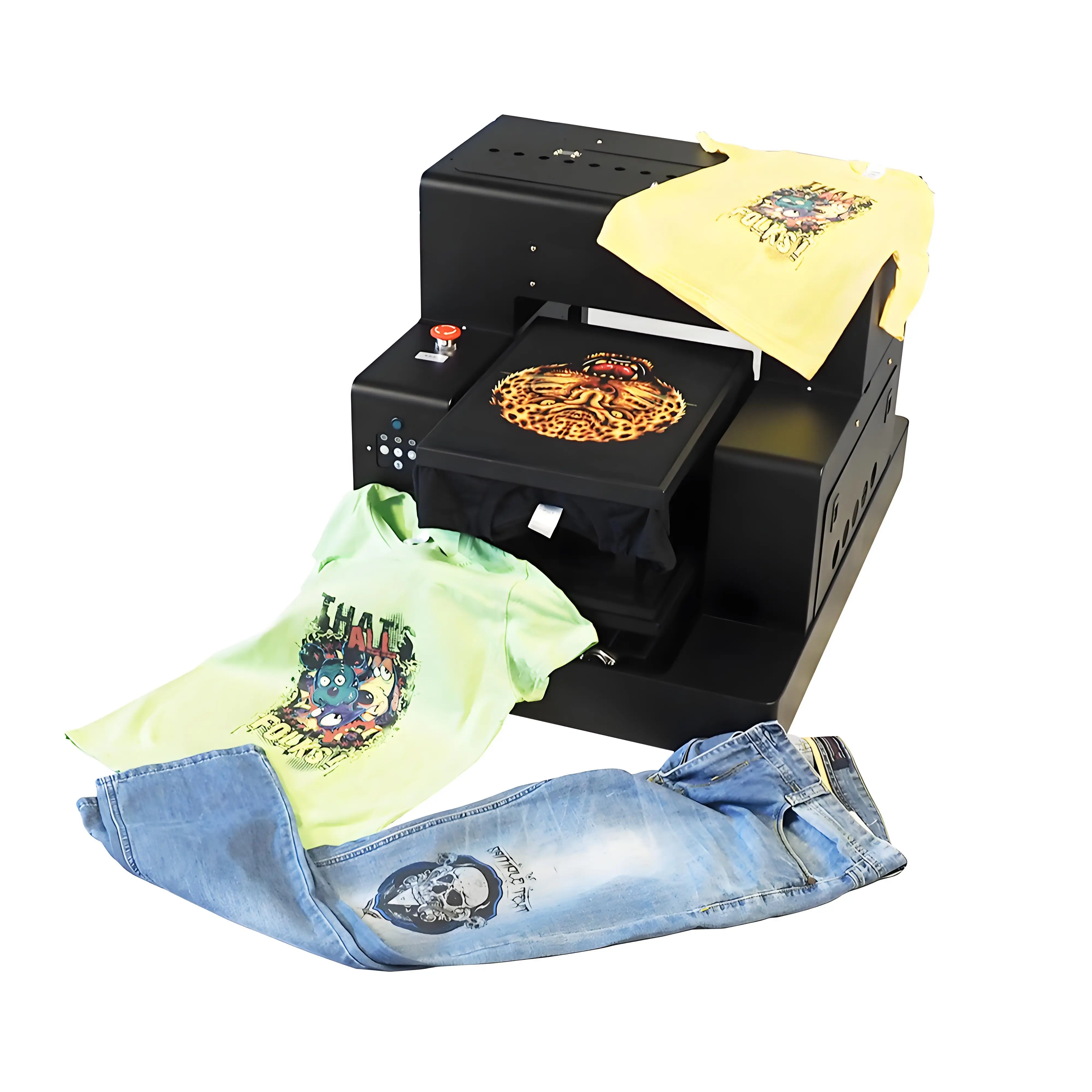
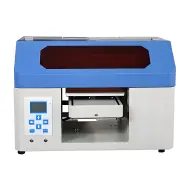
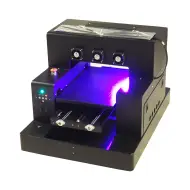
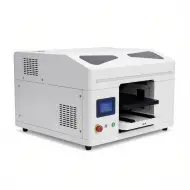
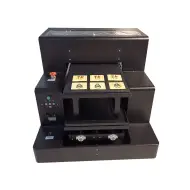
GNFEI A3 Commercial DTG T-Shirt Printing Machine
Engineered specifically for custom apparel brands, streetwear startups, and commercial garment decorators. Features a heavy-duty CNC-machined unibody chassis, industrial linear lead-screw rails, automated infrared platen height detection, active white ink peristaltic circulation, and factory-calibrated licensed RIP software.
- High-resolution MicroPiezo photo-grade printing up to 1440×1440 DPI
- Dedicated White Ink Management System (WIMS) with automatic circulation
- Dual infrared optical sensors to automatically prevent printhead strikes
- Affordable standardized replacement printheads ($60–$180)
- Complete licensed textile RIP software with hardware USB security dongle
Commercial DTG Printing Demonstrations in Action
Witness the real-world speed, white underbase opacity, and vibrant color registration of the GNFEI commercial A3 DTG printing machine on both light and dark cotton textiles:
Full Automatic A3 DTG Production Demo
Watch the automated platen travel, infrared height positioning, and high-speed pigment printing workflow.
Dark Garment White Underbase & Color Pass
Detailed demonstration of titanium dioxide white ink opacity and CMYK color registration on black cotton hoodies.
Frequently Asked Questions About Buying Budget Chinese DTG Printers
Q1. Are cheap $2,000 to $4,000 Chinese DTG printers actually worth buying? ▼
Yes, but only if you purchase a factory-engineered commercial flatbed with active white ink circulation, CNC linear guide rails, and licensed RIP software, rather than a garage-modified paper printer. For custom apparel startups and streetwear brands, a $2,500 to $3,500 factory DTG printer offers rapid return on investment (ROI), achieving break-even in 15 to 30 production days while delivering retail-grade print quality on dark and light cotton garments.
Q2. What is the critical difference between a $1,500 DIY conversion and a $3,000 factory DTG printer? ▼
A $1,500 DIY conversion is essentially a dismantled desktop paper printer (such as an Epson L1800 or R1390) mounted onto a rudimentary friction-driven frame with rubber belts, no white ink circulation, and no height collision sensors. In contrast, a $2,500 to $4,000 factory-engineered DTG printer features a heavy-duty CNC-milled steel chassis, industrial HIWIN linear lead-screw guide rails, peristaltic white ink circulation pumps (WIMS), optical anti-strike sensors, and factory-calibrated textile RIP software.
Q3. Why do big Western brand DTG printers like Brother or Epson cost $15,000 to $25,000+? ▼
Western brand DTG printers command $15,000 to $25,000+ primarily due to corporate overhead, brand premiums, localized distributor markups, and proprietary closed-loop ink cartridge ecosystems where ink costs up to $250 to $400 per liter. Chinese commercial manufacturers sell direct-from-factory at production cost, using open-bulk ink bottle systems costing just $45 to $65 per liter, which drastically reduces both initial machinery investment and ongoing operational costs.
Q4. How much does it cost to replace a printhead on a Chinese DTG printer vs. a Western brand? ▼
Printhead replacement cost is one of the greatest financial advantages of Chinese DTG printers. Utilizing standardized Epson MicroPiezo printheads (such as XP600, TX800, or DX5), genuine replacement heads cost between $60 and $250 and can be swapped by the operator in under 30 minutes. In contrast, proprietary printheads for Western brands (like Brother GTX or Ricoh) cost between $1,800 and $2,500 per head, requiring costly certified technician service calls.
Q5. Do Chinese DTG printers clog more frequently than expensive brand-name machines? ▼
No. All DTG printers in the world use the exact same chemical pigment: heavy titanium dioxide (TiO2) particles suspended in aqueous solvent for white ink. If left idle without daily capping moisture maintenance, a $25,000 Brother printer will clog just as severely as a $3,000 Chinese printer. Clogging is governed by chemical sedimentation and daily operator maintenance SOP, not the price tag on the machine chassis.
Q6. What essential features must you verify before buying a Chinese DTG printer? ▼
You must verify 5 non-negotiable hardware features: (1) Active White Ink Peristaltic Circulation and damper stirring; (2) Industrial linear guide rail and lead screw platen drive (avoid rubber belt drives); (3) Infrared or optical laser automatic platen height collision sensor; (4) Licensed textile RIP software (such as AcroRIP or CADlink); and (5) Direct manufacturer technical support with remote video diagnostic assistance.
Q7. What is the realistic cost to print a dark t-shirt on a $3,000 Chinese DTG printer? ▼
Printing a full-size 10x12 inch graphic on a black cotton shirt consumes approximately 1.5 to 2.2 ml of ink (white underbase + CMYK color). With bulk textile pigment ink at $50 per liter, the ink cost is $0.10 to $0.15. Adding textile pretreatment liquid ($0.25 to $0.40), the total consumable printing cost is only $0.35 to $0.55 per dark t-shirt. Combined with a quality $2.00 blank tee, total production cost is under $2.60.
Q8. How fast is the return on investment (ROI) for a $2,500 to $3,500 DTG printer? ▼
Extremely fast. Producing a custom t-shirt costs roughly $2.50 to $3.00, and sells on retail platforms like Shopify, Etsy, or local events for $20.00 to $25.00, generating $17.00 to $22.00 gross profit per shirt. Printing just 10 custom t-shirts per day generates $170 to $220 daily profit. At this modest volume, the entire $3,000 printer investment is fully paid off within 14 to 18 production days.
Q9. Can a budget Chinese DTG printer match the print washability of commercial machines? ▼
Yes. Wash fastness and vibrant color retention depend on proper pretreatment application chemistry, quality textile pigment ink formulation, and correct heat press curing (typically 160°C / 320°F for 90 seconds under medium pressure). Prints produced on a properly calibrated Chinese DTG flatbed withstand 50+ commercial washing cycles with zero cracking, peeling, or premature fading.
Q10. Does GNFEI provide technical support and warranty on their DTG printers? ▼
Yes. GNFEI provides comprehensive 1-on-1 engineer video support, remote TeamViewer calibration, detailed video tutorials in English, a 1-year hardware warranty on core components, and lifetime supply of genuine factory replacement parts and textile consumables shipped worldwide.
Ready to Launch Your Custom Apparel Brand with Direct Factory Pricing?
Discover how GNFEI commercial A3 DTG flatbed printers combine industrial motion hardware, active white ink circulation, and open-bulk ink economics to maximize your custom apparel profit margins.