Does DTG Ink Sit on Top of the Shirt or Penetrate into the Fibers?
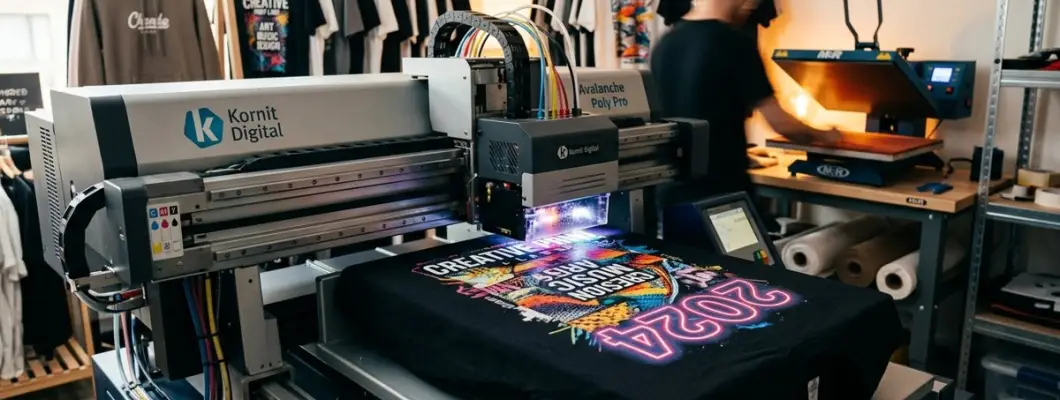
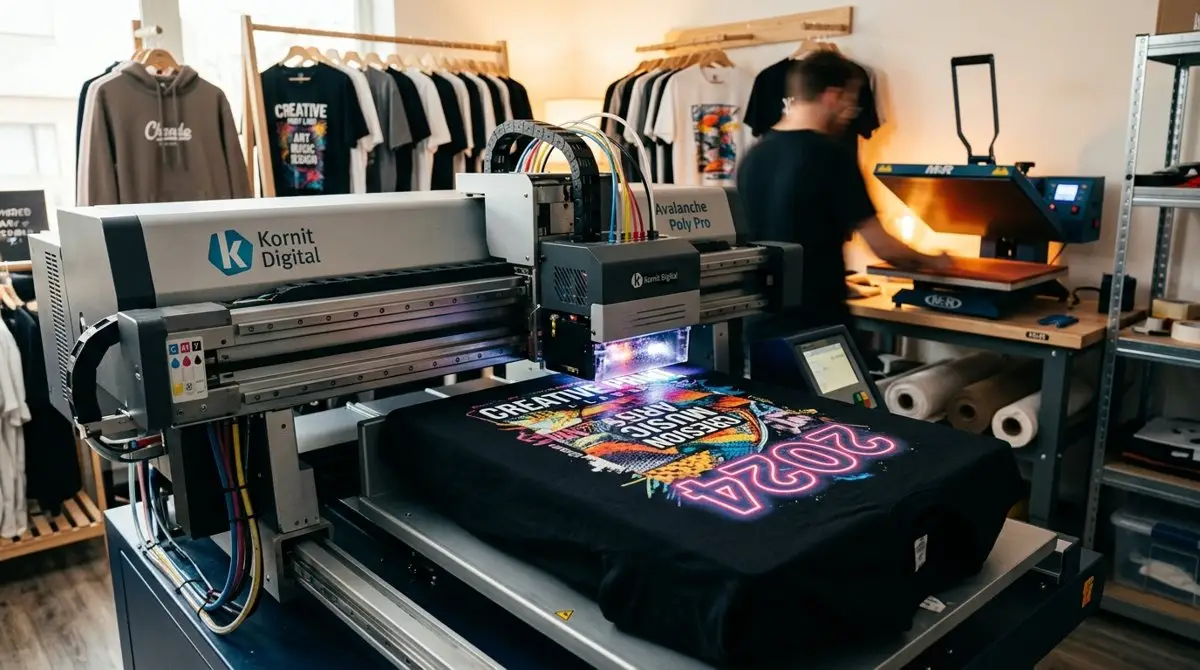
The short answer: On white shirts, DTG ink penetrates into the cotton fibers; on dark shirts, pretreatment flash-binds the white underbase right on the yarn surface.
Understanding how textile pigment molecules interact with natural cellulose fibers is the secret to mastering hand feel, color saturation, and wash durability in commercial apparel printing.
1. Light Garments (CMYK Only): Deep Fiber Penetration
When printing on light-colored or pure white 100% cotton garments without white ink, water-based DTG inks are absorbed directly into the natural tubular structure (lumen) of the cotton fibers.
• The water and humectant carriers wick deeply into the yarn structure.
• Nano-sized pigment particles lodge within the microscopic crevices of the cellulose chains.
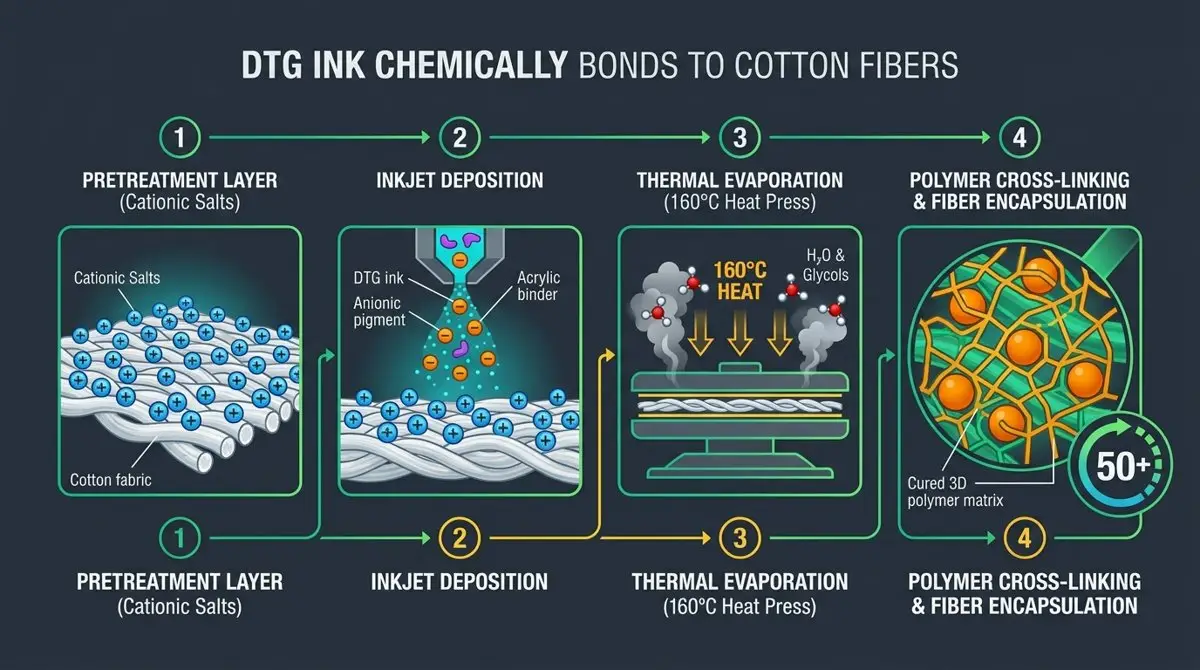
• Heat press curing evaporates moisture and locks the self-crosslinking acrylic polymer binder around individual fiber filaments.
• Result: Zero rubbery surface film, complete breathability, and an ultra-soft hand feel identical to high-end water-based screen printing.
2. Dark Garments: Controlled Surface Crosslinking via Pretreatment
Why don't dark shirts allow the ink to penetrate completely? If white ink sank into the cotton fibers on a black shirt, the print would turn dull, gray, and muddy. Pretreatment acts as a chemical barrier:
1. Pretreatment Flash Coagulation
Pretreatment solution contains multivalent metal salts (calcium salts). When acidic white ink droplets strike the alkaline pretreated cotton, an instant ionic flash-coagulation occurs, halting downward ink bleed.
2. Surface Polymer Anchoring
Instead of sinking through the fabric to the back of the shirt, the titanium dioxide (TiO2) white pigment particles are locked directly onto the upper crown of the cotton yarns.
3. CMYK Color Layer Holdout
With a solid, bright white foundation sitting on the fiber crowns, CMYK colors sit crisply on top without color shifting or bleed.
4. Flexible Polymer Mesh
Unlike thick PVC plastisol ink which forms an airtight rubber shield, DTG binders form a microscopic breathable web that flexes with the fabric knit.
3. Cross-Section Anatomy: Light Garment vs. Dark Garment DTG
4. DTG vs. DTF vs. Plastisol: Fiber Interaction Comparison
| Printing Technology | Ink Location on Fabric | Breathability | Hand Feel | Wash Durability |
|---|---|---|---|---|
| DTG (White / Light Shirts) | Fully penetrated inside cotton fibers | 100% Breathable (Zero barrier) | Ultra-Soft (No texture) | Excellent (50+ washes) |
| DTG (Dark / Black Shirts) | Surface-anchored on fiber crowns | Highly Breathable (Porous micro-film) | Very Soft & Flexible | Excellent (50+ washes) |
| DTF (Direct to Film) | Hot-melt TPU adhesive layer on surface | Low / Moderate (Solid adhesive film) | Smooth, synthetic feel | Very High (60+ washes) |
| Screen Print (Plastisol) | Thick PVC plastic layer sitting on top | Zero Breathability (Airtight shield) | Heavy / Rubbery shield | High (Prone to cracking) |
| Sublimation (Polyester) | Gas dyed inside polymer molecules | 100% Breathable (Molecular bond) | Zero Feel | Permanent (No fading) |
5. How to Optimize Fiber Penetration & Hand Feel in Production
1. Use High-Grade Ring-Spun Combed Cotton
Carded open-end cotton has loose stray fibers that cause fibrillation. 30s or 40s combed ring-spun cotton provides a smooth, tightly woven surface for optimal ink bonding.
2. Calibrate Pretreatment Grammage Precisely
Over-pretreated shirts feel stiff and starchy. Under-pretreated shirts let white ink sink, causing gray prints. Target 18–22g of pretreatment for standard A3 areas.
3. Use Dual-Pass Hover Curing Before Final Press
Hovering the heat press for 15 seconds allows moisture to escape gradually before applying light pressure, preventing ink from flattening into a stiff shield.
4. Enable RIP Black Garment Knockout
Eliminating unnecessary black ink on black shirts reduces ink layer thickness to zero in shadow areas, maximizing natural fabric softness.
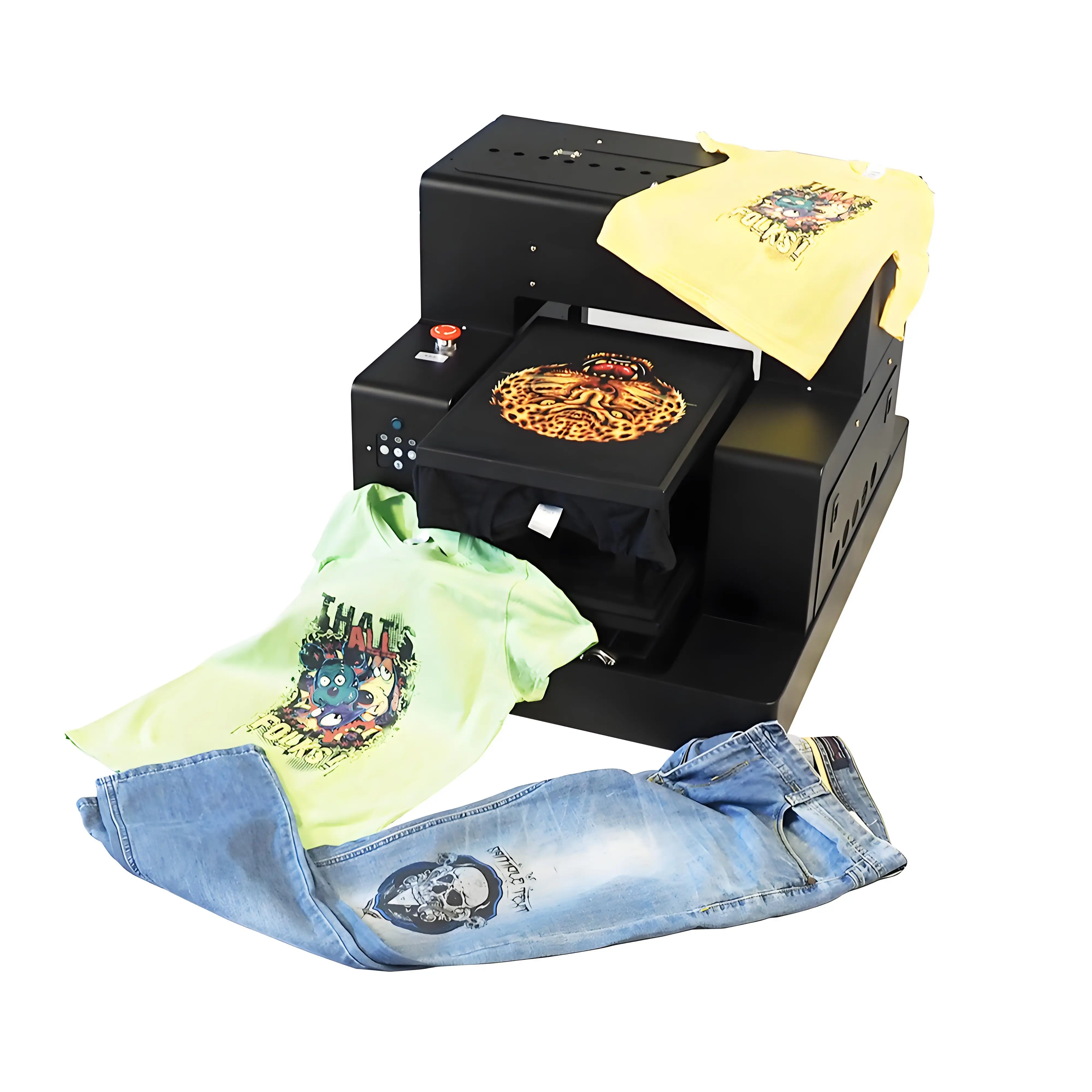
GNFEI F85G3 — Precision Drop Placement & Superior Soft-Hand Finish
Dual Epson i3200 Heads | Variable Drop Technology (3.8–12pl) | Ultra-Fine Micro-Crosslinking
- Epson PrecisionCore i3200 Heads — Precise 3.8 picoliter droplet control for microscopic fiber anchoring
- Water-Based Nano-Pigment Compatibility — Optimized for high-grade eco textile inks with soft-hand binders
- Intelligent Black Knockout Engine — Automatically omits black ink on dark fabrics to preserve breathability
- True 1200×2400 DPI Resolution — Ultra-smooth continuous tone gradients with zero thick ink pooling
- Oversized 40×60 cm Platen — Print expansive graphics across seams with consistent fiber penetration
Frequently Asked Questions About DTG Ink & Fabric Penetration
Q1. Does DTG ink wash out if it penetrates the fibers?
No. The acrylic polymer binders in DTG ink crosslink under heat press curing, locking the pigment permanently into the cotton cellulose chains.
Q2. Why do white DTG shirts feel softer than dark DTG shirts?
White shirts do not require pretreatment or titanium dioxide white ink. The CMYK pigments absorb directly into the fibers without creating any surface film.
Q3. Can DTG ink penetrate polyester fibers?
No. DTG pigment inks bond specifically to natural cellulose fibers like cotton, linen, and viscose. Polyester requires specialized poly-pretreatment or DTF printing.
Q4. What is fibrillation in DTG printing?
Fibrillation occurs when loose surface fibers poke through the ink layer after washing, creating a faded, fuzzy look. Using combed ring-spun cotton prevents this.
Q5. Is DTG ink more breathable than DTF film transfer?
Yes. DTG ink forms a porous microscopic network on the fibers, whereas DTF uses a solid hot-melt polyurethane adhesive layer that blocks airflow.
Q6. How does heat pressing affect ink penetration?
Heat press curing applies heat (160°C / 320°F) and moderate pressure, melting the binder into the fiber crevices while evaporating water.
Q7. Why does excessive pretreatment make the shirt feel stiff?
Too much pretreatment deposits excess binder salts on the fabric, crystallizing into a stiff layer. Proper grammage calibration maintains original shirt softness.
Q8. Can you feel the ink on high-resolution photo prints?
On white shirts, high-res photos have virtually zero hand feel. On dark shirts, the white base gives a subtle, flexible, smooth texture.
Q9. Does ring-spun cotton absorb DTG ink better than open-end cotton?
Yes. Ring-spun cotton has aligned, compact fibers that absorb ink uniformly without fiber fuzzing, resulting in sharper detail and richer color.
Q10. How many washes does DTG ink last when properly cured?
Commercial DTG prints on combed cotton last 50+ wash cycles without significant color fading or peeling when washed inside out in cold water.