Explore what DTG (Direct-to-Garment) printing is and how digital textile inkjet technology works from cotton pretreatment to final heat press curing. Learn the science of water-based pigment inks, cellulose fiber bonding, and cationic pre-treatment chemistry on 100% ringspun cotton and blended fabrics. Discover the exact 5-step operational workflow, compare DTG vs Screen Printing vs DTF transfer technology across setup costs, print resolution (1200-1440 DPI), hand feel, breathability, and production speed. Analyze detailed unit economics, ink consumption costs per t-shirt, and vital white ink recirculation maintenance SOPs for commercial apparel decorators and small business print shops using GNFEI A3 digital garment printers.
Digital Textile Engineering DTG Process SOP Apparel Decorator Guide

What is DTG Printing and How Does Direct to Garment Work?
Reading Time: 12 Mins
Written by: GNFEI Textile & Inkjet R&D Division
Verified for Commercial T-Shirt Production

The custom apparel industry has undergone a massive digital transformation over the last decade. For decades, traditional screen printing dominated t-shirt customization, imposing heavy minimum order quantities (MOQs), costly mesh stencil burnings, and multi-hour setup times. Today, DTG (Direct-to-Garment) printing has revolutionized custom apparel production by jetting specialized aqueous pigment inks straight into natural fabric fibers with photographic precision. Whether you are launching an on-demand streetwear brand, fulfilling corporate apparel orders, or operating a commercial print shop, understanding the chemistry, mechanical workflow, substrate compatibility, and unit economics of direct-to-garment printing is essential for scaling profitability.

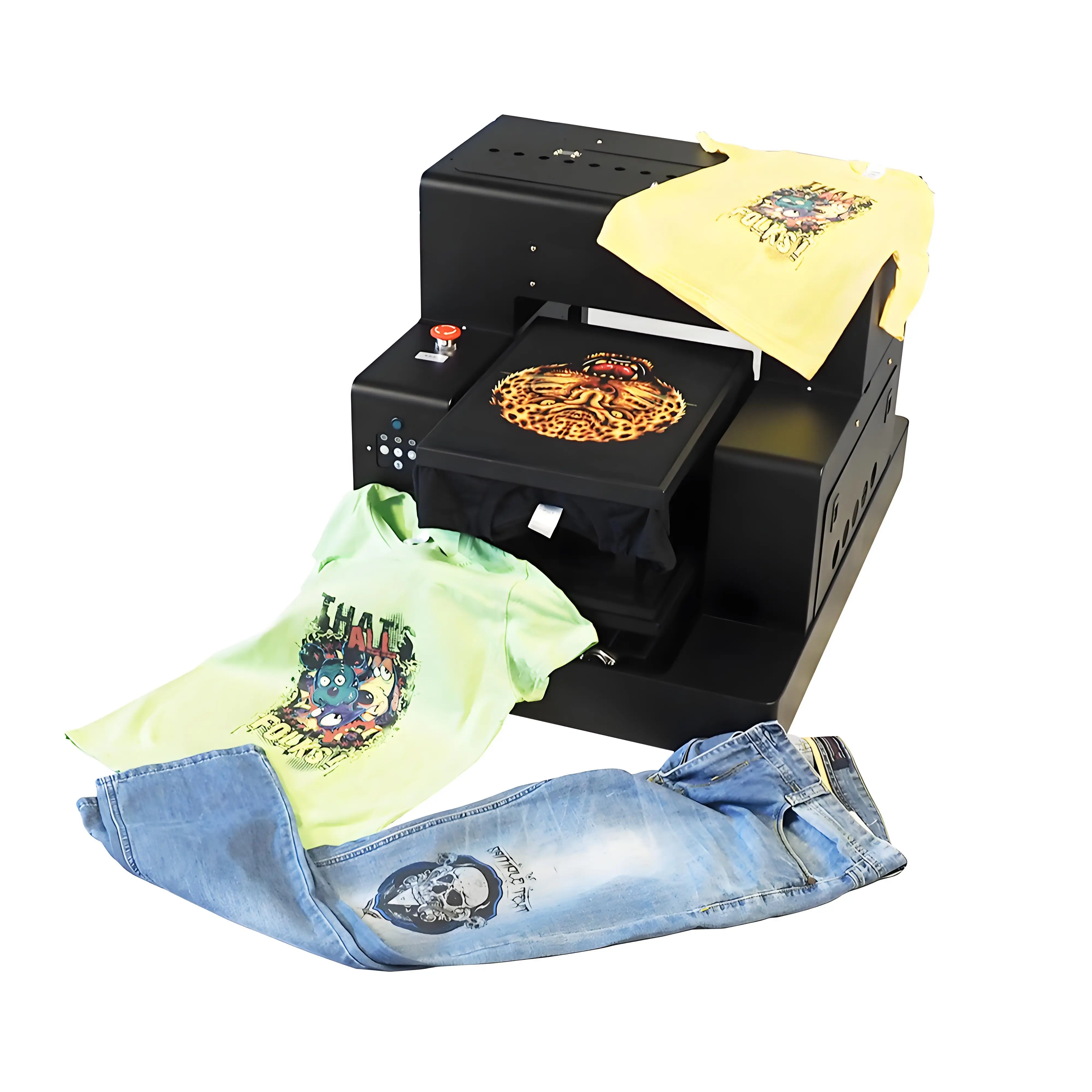
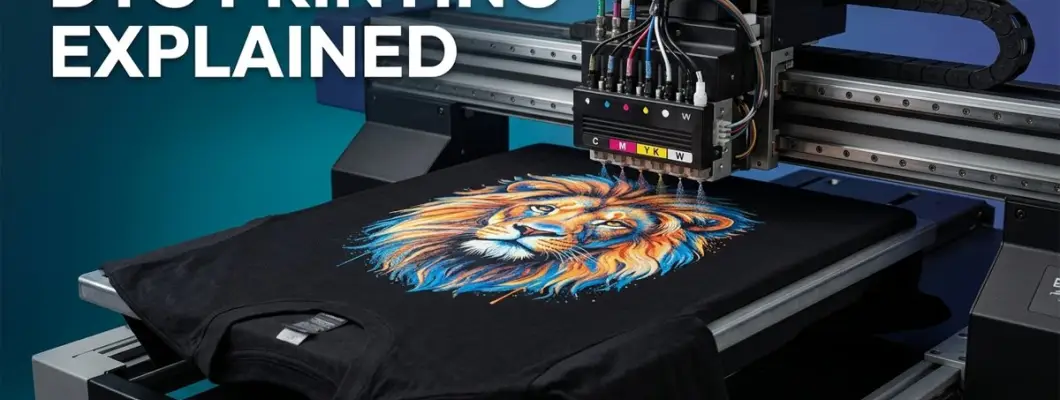
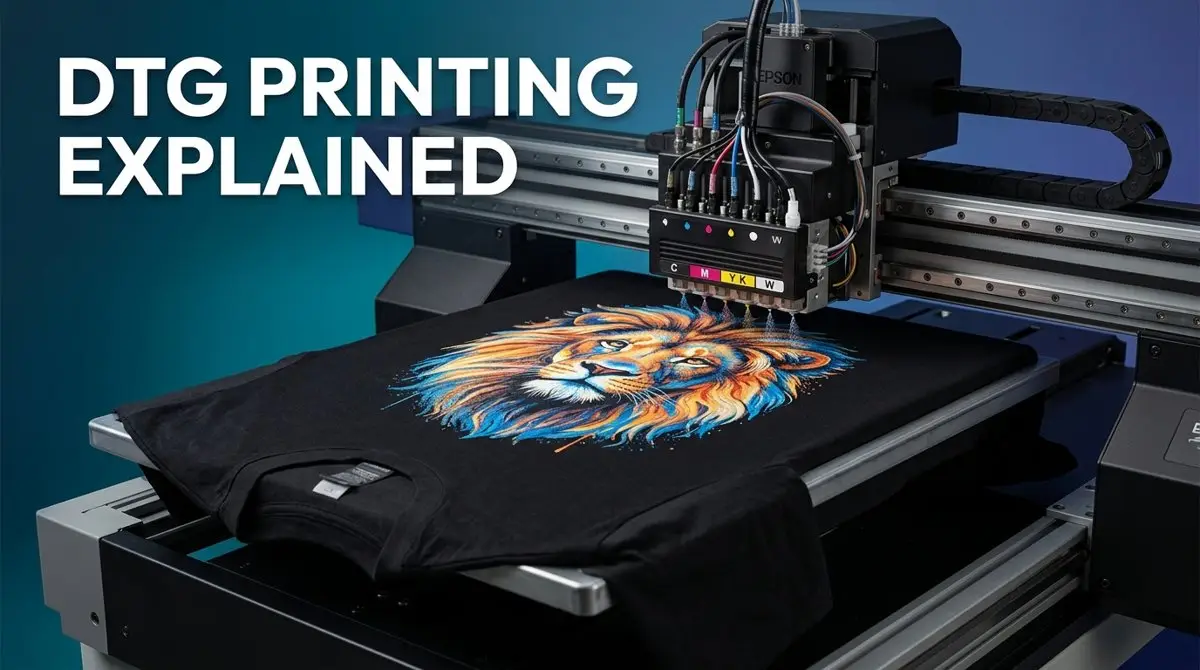
Commercial DTG Printer Actively Printing Full Color Graphic on Black Cotton T-Shirt
Figure 1: High-precision commercial DTG printer executing dual-layer White and CMYK digital textile jetting directly on a 100% ringspun cotton t-shirt.

1. What Is DTG Printing? The Core Definition & Ink Chemistry

At its core, DTG (Direct-to-Garment) printing is an advanced digital inkjet technology designed specifically for textiles. Rather than transferring graphics onto transfer paper or burning physical silk screens, a DTG printer secures an assembled garment onto an adjustable platen, sweeps industrial piezoelectric printheads across the fabric surface, and deposits microscopic picoliter droplets of water-based pigment inks directly into the garment weave.

Unlike sublimation printing (which uses heat-activated disperse dyes that chemically bond only with synthetic polyester polymers), or solvent/UV printing (which forms an external cured polymer film on hard non-porous surfaces), DTG printing relies on a sophisticated tripartite chemistry:

Aqueous Pigments

Sub-micron milled organic pigments suspended in deionized water and humectants that flow smoothly through micro-nozzles without settling.

Polymer Binders

Thermosetting polyurethane or acrylic resin emulsions that melt under heat pressing to lock pigment particles into the cellulose fibril structure.

Cationic Pre-treatment

Positively charged multivalent metal salt primer that chemically flocculates negatively charged white ink to hold it on the fabric surface.

2. Step-by-Step Breakdown: How Does the DTG Printing Process Work?

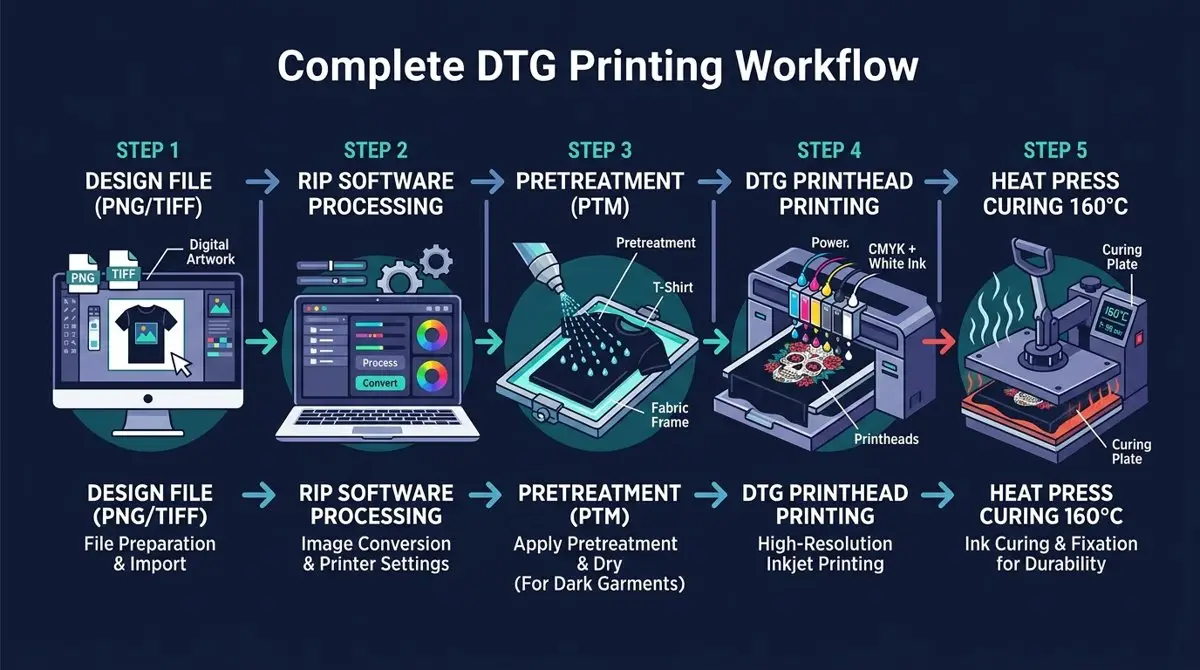
To achieve commercial-grade print resolution, vibrant color gamuts, and 50+ wash cycle durability, DTG printing follows a strict 5-stage standard operating procedure (SOP). Skipping or improperly executing any of these steps results in dull colors, fiber fibrillation, or premature wash flaking.

5-Step DTG Printing Workflow: Pre-treatment, Heat Pressing, Inkjet Printing, Thermal Curing, and Finished Shirt
Figure 2: The complete 5-step industrial DTG production workflow from liquid pre-treatment application to final wash-fast thermal fixation.
1

Step 1: Pre-Treatment Application (Crucial for Dark Garments)

For colored or black garments requiring a white ink underbase, liquid pre-treatment must be evenly applied across the target print area using an automated pre-treatment sprayer or pneumatic spray gun. The application volume must be strictly calibrated (typically 20g to 30g for an A3 area on ringspun cotton). Under-application causes faint, washed-out whites, while over-application creates a stiff, crystallizing "halo" box on the fabric.

2

Step 2: Heat Press Drying & Fibril Flattening

The damp pre-treated shirt is placed under a commercial flatbed heat press set to 160°C (320°F) for 25 to 35 seconds with medium-to-heavy pressure using protective silicone-coated parchment paper. This serves two critical purposes: it completely evaporates water content from the pre-treatment solution, and physically presses down microscopic cotton surface fibers (fibrils), preventing fuzzy grain and rogue threads from interfering with the inkjet head clearance.

3

Step 3: Loading Platen & High-Precision Inkjet Printing

The garment is mounted smoothly onto the printer platen and secured using a tuck hoop or platen vacuum suction to eliminate wrinkles. The printer's infrared auto-height sensor adjusts platen-to-nozzle clearance (typically 1.5mm to 2.0mm). RIP software processes the graphic, outputting a dense white ink foundation layer on dark garments, instantly followed by CMYK process ink droplets. Micro-piezo printheads fire drop sizes from 3.5 to 7 picoliters at up to 1440 DPI resolution.

4

Step 4: Thermal Curing & Polymer Resin Cross-Linking

Freshly printed textile ink is completely wet and water-soluble upon exiting the printer platen. To achieve permanent water and detergent resistance, the garment is cured on a commercial heat press at 165°C (330°F) for 90 seconds with light pressure (or passed through a forced hot-air tunnel conveyor dryer at 155°C for 2.5 minutes). Thermal energy drives off all moisture, forcing polyurethane binder chains to cross-link and permanently encapsulate the color pigment particles into the cotton fibers.

5

Step 5: Inspection, Folding & Premium Soft-Hand Quality Delivery

Once cooled, the garment exhibits a signature soft-hand touch. Because the ink is absorbed and bound at the fibril level rather than forming a solid plastic sheet, the fabric remains highly breathable, flexible, and comfortable to wear. After a rapid stretch-and-visual quality control check, the shirt is ready for immediate folding, packaging, and retail delivery.

3. The Critical Role of Pre-Treatment: Why White Ink Demands Flocculation

One of the most frequently asked questions by newcomers to digital apparel decoration is: "Why do I need to spray pre-treatment on dark shirts before printing?" The answer lies in colloidal chemistry and the physical behavior of opaque white textile ink.

Standard CMYK textile inks are semi-translucent dye/pigment blends. When printed on a white 100% cotton t-shirt, the white fabric acts as the reflective background, making colors pop without any underbase or pre-treatment required. However, if you spray liquid CMYK ink directly onto a black cotton t-shirt, the dark fabric absorbs the transmitted light, rendering the colors virtually invisible.

To print vibrant graphics on dark garments, the printer must first deposit a layer of opaque white ink (formulated with microscopic titanium dioxide — TiO2 particles). But cotton is an intensely porous, capillary-rich natural fiber. Without pre-treatment, wet white ink immediately soaks deep into the core of the yarn, disappearing into the dark cotton matrix:

The Cationic Flocculation Reaction Explained

Pre-treatment fluid contains multivalent cationic salts (typically calcium or magnesium salts). The titanium dioxide particles in white DTG ink are negatively charged (anionic) to keep them stable in the liquid suspension. The millisecond the anionic white ink droplet hits the dried cationic pre-treatment on the cotton shirt, an instantaneous charge-neutralization reaction occurs. The colloidal emulsion breaks, causing the white titanium dioxide particles to flocculate (instantly coagulate and solidify) on top of the fabric. This creates an impenetrable white barrier that allows subsequent CMYK color drops to sit crisply on top without bleeding or sinking.

4. Fabric Compatibility: What Textiles Can You Print On?

Aqueous pigment textile inks are chemically engineered to interact with natural organic fibers. However, modern commercial apparel features a wide array of textile compositions. Here is how direct-to-garment printing behaves across common garment fabrics:

100% Combed Ringspun Cotton

Optimal Choice (10/10)

The absolute benchmark substrate for DTG printing. Natural cellulose fibers absorb binders deeply, producing maximum color vibrancy, smooth skin-tones, and superior wash fastness exceeding 50 washes.

Recommended blanks: Next Level 3600, Bella+Canvas 3001, AS Colour 5001.

Cotton / Polyester Blends

Good Performance (7-8/10)

Works reliably for fleece hoodies and heathered tees. 80/20 blends yield solid opacity; 50/50 blends show a subtle vintage/heathered look as pigment only anchors to the cotton strands.

Tip: Use specialized poly-blend pre-treatment fluid and reduce curing temperature to 150°C.

Tri-Blend Garments

Vintage Aesthetic (6/10)

Because rayon and polyester fibers do not bond with aqueous binders as effectively as cotton, prints on tri-blends exhibit an intentional, highly soft, muted vintage/distressed look.

Caution: Heat press with lighter pressure to avoid scorch marks on heat-sensitive rayon fibers.

100% Synthetic Polyester

Not Recommended (3/10)

Polyester fibers are non-porous and hydrophobic. During heat press curing at 160°C, the synthetic dye inside the polyester sublimates and migrates into the wet DTG ink (dye migration), tinting white prints pink or gray.

Better Alternative: For 100% polyester sports jerseys, use DTF transfer printing or dye sublimation.

5. DTG vs Screen Printing vs DTF: Comprehensive Comparison

In modern garment customization, apparel decorators frequently weigh the trade-offs between DTG (Direct-to-Garment), Screen Printing, and DTF (Direct-to-Film). Each technology serves specific production volumes, fabric types, and business models.

Comprehensive Benchmark Matrix: DTG vs Screen Printing vs DTF Comparison Infographic
Figure 3: Technical and economic benchmark matrix comparing DTG, Screen Printing, and DTF transfer workflows.
Technical Metric DTG (Direct-to-Garment) Screen Printing DTF (Direct-to-Film)
Minimum Order (MOQ) 1 piece (Zero setup) 50-100+ pieces (High setup) 1 piece (Zero setup)
Setup Cost & Time Instant digital RIP file import $25-$50 per screen, 1-2 hours Instant digital RIP file import
Color & Gradient Detail Photographic (up to 1440 DPI) Limited spot colors, halftone dots Photographic (up to 1440 DPI)
Hand Feel & Breathability Ultra-soft, breathable, natural Heavy plastisol shield feel Slight polymer badge feel
Fabric Compatibility Best on 100% Cotton / Poly blends All fabrics with special ink setups Universal (Cotton, Poly, Nylon, Leather)
Production Speed 60-90 sec per shirt (1 platen) 500+ shirts/hr (automated press) Roll-to-roll automated film printing
Sweet Spot Application On-demand retail, 1-50 shirts Bulk event apparel, 100-10,000+ Logos, hats, synthetics, mixed fabrics

6. Production Economics & Profitability Breakdown

Understanding consumable cost per print is vital when establishing retail pricing and calculating equipment return on investment (ROI). Because DTG eliminates costly physical screens, custom print studios capture extremely healthy profit margins even on single-shirt orders:

Typical Unit Cost Breakdown (A3 Full-Chest Graphic on Dark T-Shirt)

Blank Combed Ringspun Cotton T-Shirt (Wholesale): $2.75
DTG Pre-Treatment Fluid (25ml spray volume): $0.25
White Ink Underbase (High-opacity double pass): $0.85
CMYK Color Pigment Ink (Full photographic coverage): $0.35
Electricity & Protective Parchment Paper Wear: $0.15
Total Landed Production Cost: $4.35
Average Retail Streetwear Price
$28.00 – $35.00
Net Profit Per Custom T-Shirt
+$23.65 – +$30.65

7. Essential Maintenance: Protecting Your DTG Printheads from Clogs

The Achilles' heel of any direct-to-garment printer is white ink sedimentation. Because titanium dioxide particles are inherently heavy, they will settle out of suspension if allowed to sit motionless in ink bottles, dampers, or micro-piezo nozzle chambers. Following rigorous preventative maintenance ensures uninterrupted production and extends printhead lifespan past 18 to 24 months:

Active White Ink Recirculation

Modern commercial machines feature automated timed circulation pumps that cycle white ink through dampers and back to the tank every 30 minutes, preventing pigment stagnation even when idle.

Daily Capping Station & Wiper Swabbing

At the close of each production shift, gently swab the rubber capping rim and polyurethane wiper blade with specialized textile cleaning solution to remove sticky binder skin.

Strict Ambient Humidity Control (50-60%)

Aqueous textile inks evaporate rapidly in dry air. Keep your print workshop at 20-26°C (68-78°F) and 50% to 60% relative humidity using an ultrasonic humidifier.

Wet Capping for Overnight Protection

Before powering off, introduce 5-8 drops of moisturizing cleaning solution into the capping station pad to keep the nozzle plate bathed in vapor, preventing micro-clog skin formation.

8. Recommended Commercial Hardware: GNFEI A3 DTG Printing Solutions

Whether you are launching an online print-on-demand studio, setting up an in-store custom t-shirt kiosk, or expanding an established screen printing workshop into short-run orders, GNFEI engineering delivers reliable, factory-direct DTG hardware engineered for maximum uptime.

Featured Production Solution

GNFEI A3 DTG T-Shirt Printing Machine

Model: F85G3 · Commercial Grade · Factory Direct

The premier compact digital apparel workstation for commercial t-shirt decorators. Built with active white ink recirculation, intelligent infrared platen height sensing, and high-density micro-piezo jetting at up to 1440 DPI resolution.

  • Integrated white ink circulation pump preventing nozzle clogging
  • Large 330 x 420mm (A3+) printable platen area for hoodies and tees
  • Infrared height collision sensor preventing garment head strikes
  • High-precision RIP software for white underbase raster generation
Get Factory Quote
Quality Sample Demonstration

High-Density Black Cotton T-Shirt Sample

Substrate: 100% Ringspun Cotton · 1440x1440 DPI

Notice the razor-sharp typography, flawless color transitions, and complete absence of background bleed through the dense white underbase. The fabric retains full breathability and premium stretch resilience without surface cracking.

  • Zero screen burning fees — perfect for 1 to 50 shirt runs
  • Soft-hand feel certified for commercial retail apparel
  • 50+ cycle wash fastness with standardized heat cure profile
View A3 DTG Specs

Frequently Asked Questions (FAQ)

Q1. What is DTG printing in simple terms?

DTG (Direct-to-Garment) printing is a digital printing method that sprays specialized aqueous pigment inks directly onto textiles, such as t-shirts, hoodies, and tote bags, using high-precision piezoelectric inkjet printheads. It functions much like an advanced office inkjet printer, but is engineered with industrial garment platens and specialized textile chemistry that binds directly to natural cellulose fibers.

Q2. How does the direct to garment printing process work step-by-step?

The complete DTG process follows 5 core stages: 1) Pre-treatment application onto the garment; 2) Heat pressing to dry the pre-treatment and flatten fabric fibrils; 3) Loading onto the printer platen and digital inkjet printing of opaque white ink followed immediately by CMYK color ink; 4) Final thermal heat press curing (or conveyor dryer) at 160-165°C for 90 seconds to cross-link the binder resins; 5) Finished garment ready for immediate wear or distribution.

Q3. Why is pre-treatment required for DTG printing?

Pre-treatment contains a cationic multivalent salt solution that acts as a chemical flocculant. When the anionic titanium dioxide white ink droplets contact the pre-treated fabric, they instantly precipitate and coagulate on the surface instead of absorbing deep into the porous textile fibers. This creates a solid, high-opacity white foundation layer, allowing vibrant CMYK colors to sit vividly on top.

Q4. What fabrics work best for DTG printing?

100% combed ringspun cotton is the gold standard for DTG printing because natural cellulose fibers form strong hydrogen bonds with water-based pigment inks. 80/20 and 50/50 poly-cotton blends also yield great results when using polyester-compatible pre-treatments. However, 100% polyester is generally challenging for standard DTG due to hydrophobic fibers and disperse dye migration (bleeding) under heat curing.

Q5. How does DTG compare to screen printing?

Screen printing requires burning physical emulsion mesh screens, mixing inks, and lengthy mechanical setup, making it cost-prohibitive for small orders but extremely fast and cheap for mass runs (100+ identical units). DTG has zero physical screen setup, allowing effortless 1-off customized prints with photographic detail (up to 1440 DPI) and infinite colors, though its per-print speed is slower than an automated screen press.

Q6. What is the difference between DTG and DTF printing?

DTG prints directly onto the garment fabric, embedding pigment into the fibers for exceptional breathability and a soft, natural hand feel. DTF (Direct-to-Film) prints in reverse onto a PET transfer film, applies hot-melt adhesive powder, melts it, and heat-presses the transfer onto any fabric (including 100% nylon, polyester, and dark synthetics). DTF produces a slightly more rubberized badge feel, whereas DTG offers premium textile touch on cotton.

Q7. How much does it cost to print one t-shirt with DTG?

On light cotton t-shirts (CMYK only without white ink), ink cost is approximately $0.20 to $0.45 per print. On dark t-shirts requiring a heavy white underbase plus full CMYK coverage, ink cost ranges from $0.80 to $1.50, plus approximately $0.20 to $0.35 in pre-treatment fluid. Adding a quality blank t-shirt ($2.00 to $4.00), total production cost is roughly $3.00 to $5.85, while custom printed shirts commonly retail for $25.00 to $35.00.

Q8. How long do DTG printed shirts last in the wash?

When pre-treated correctly and cured at 160-165°C for 90 seconds, quality DTG prints achieve 45 to 50+ commercial wash cycles before noticeable fading occurs. To maximize longevity, garments should be washed inside-out in cold water with mild detergent and line-dried or tumble-dried on low heat.

Q9. Why do DTG white ink lines frequently clog and how is it prevented?

White DTG ink relies on titanium dioxide (TiO2) nanoparticles, which are heavy and naturally settle to the bottom of tanks, dampers, and printhead channels over time. Commercial DTG printers like GNFEI systems feature active white ink circulation pumps, timed magnetic stirrers, and motorized head capping stations with peristaltic waste flushing to prevent nozzle sedimentation and blockages.

Q10. What equipment is needed to start a commercial DTG printing business?

A complete starter DTG workstation requires four primary components: 1) A commercial DTG flatbed printer (such as the GNFEI A3 F85G3 model); 2) A dedicated pneumatic or manual pre-treatment sprayer (or automated pre-treatment booth); 3) A professional flatbed heat press (at least 16x20 inches) with teflon and silicone sheets; 4) Professional RIP software (like CADlink Digital Factory or AcroRIP) for color profile management and white ink underbase generation.