How Long Does It Take to Print a Single Shirt on a DTG Printer? | GNFEI

If you are considering investing in a Direct-to-Garment (DTG) printing machine or calculating production capacity for an apparel brand, one question sits at the center of your operational financial model: "Exactly how long does it take to print a single shirt?" If you browse equipment manufacturer brochures or sales spec sheets, you will frequently see bold claims like "Prints in 28 seconds!" or "Produces 60 shirts per hour!"
However, experienced print shop owners know that manufacturer marketing specs almost always measure raw carriage pass speed on white t-shirts under ultra-low draft resolution. In a real-world commercial apparel workshop fulfilling retail customer orders, the answer is nuanced: machine printing time ranges between 45 seconds and 3 minutes, while the total end-to-end production cycle (pretreating, pre-pressing, printing, and heat press curing) takes 3.5 to 5 minutes per finished garment. In this engineering guide, we break down the physics, workflow stages, hardware configurations, and mathematical formulas that govern real DTG production throughput.

1. Machine Print Time vs. Total Garment Cycle Time
To build a profitable custom apparel printing business, you must never confuse carriage print speed with garment production cycle time. A digital inkjet printer is merely one component of a 4-step manufacturing pipeline:
2. Light vs. Dark Garments: Why Black Shirts Take 2x to 3x Longer
The single biggest factor dictating DTG print duration is garment fabric color. Many beginners are shocked to discover that printing a black shirt takes more than double the time of printing a white shirt. The reason lies in chemical physics and optical opacity:
Light / White T-Shirts
45 – 60 Seconds- Single-Pass CMYK: Inks jet directly into light cotton fabric fibers with zero white ink needed.
- No Pretreatment Required: Saves 60 seconds of spraying, drying, and pre-pressing.
- Immediate Cure: Straight to final heat press curing; softest breathable hand feel.
- High Hourly Capacity: 35 to 50 finished shirts per hour per operator.
Dark / Black T-Shirts
90 – 180 Seconds- White Underbase Mandatory: Dense titanium dioxide (TiO2) base mask must be jetted first.
- Pretreatment Mandatory: Pretreatment fluid must be sprayed and heat-flattened beforehand.
- Dual Mechanical Passes: Single-head units sweep platen twice (White Pass + Color Pass).
- Production Speed: 15 to 25 finished dark shirts per hour per operator.

3. Resolution, Graphic Size & Printhead Architecture
Beyond garment fabric color, three technical variables directly calculate how many seconds the print carriage will spend shuttling across the platen:
Print Resolution (DPI) & Pass Count
Higher resolution requires smaller nozzle stepping and more bidirectional carriage passes. Printing at 1440×1440 DPI delivers museum-grade photo fidelity but takes roughly 150 to 210 seconds on a dark shirt. In contrast, running commercial 1440×720 DPI cuts print time down to 80 to 110 seconds with virtually indistinguishable visual sharpness on porous cotton weaves.
Graphic Surface Area Dimensions
The printhead carriage travels only as far as the artwork extends along the Y-axis. A Left-Chest Pocket Logo (4×4 inches) prints in just 20 to 30 seconds. A Standard Chest Graphic (10×12 inches) takes 75 to 100 seconds. An Oversized Full-Front A3 Graphic (12×16 inches) utilizes the maximum platen travel, taking 120 to 160 seconds.
Printhead Stagger & "One-Pass Inline" Architecture
Single-printhead machines must print the white underbase, return the platen back to start position, and print the color channels sequentially. Modern dual-printhead industrial flatbeds (such as the GNFEI A3 dual MicroPiezo setup) stagger Head 1 (White) slightly ahead of Head 2 (CMYK), jetting white base and vivid color simultaneously in a single continuous forward sweep, cutting dark garment print times by 40% to 50%!
4. Step-by-Step Production Cycle Timeline: From Blank Tee to Finished Product
Here is the complete operational timeline required to print a retail-ready custom graphic on a black cotton garment from scratch:

5. Real-World Speed Matrix Across Machine Categories
How does machine engineering translate into hourly shop capacity? The table below compares print duration, labor cycle, and realistic commercial output across the three dominant categories of garment printers:
| Equipment Tier | Printhead Setup | Light Shirt Print Time | Dark Shirt Print Time | Real Output (Dark Shirts/Hr) |
|---|---|---|---|---|
| DIY Modified Paper Printer ($1,500) | Single Epson L1800 (Friction belt) | 90 – 120 Seconds | 210 – 300 Seconds | 5 – 8 Shirts / Hr |
| GNFEI Commercial A3 DTG ($2,990) | Dual MicroPiezo (WIMS + Linear Screw) | 45 – 60 Seconds | 75 – 100 Seconds (Inline) | 18 – 24 Shirts / Hr |
| Industrial Western Unit ($20,000+) | Brother GTX / Epson F2270 | 35 – 50 Seconds | 60 – 85 Seconds | 22 – 28 Shirts / Hr |
| High-Volume Multi-Platen ($50,000+) | Dual Carousel Platen Conveyor | 20 – 30 Seconds | 35 – 50 Seconds | 45 – 65 Shirts / Hr |
6. How to Double Your DTG Output Without Buying More Printers
If a single shirt takes 3.5 to 5 minutes from start to finish, how do professional apparel decorators hit 20 to 30 shirts per hour with just one machine? The secret is pipelining and batch processing:
Batch Pre-Treating
Never pre-treat one shirt at a time while waiting to print. Pre-treat 50 to 100 shirts in a single morning session and store them in dry air-sealed bins. When printing begins, zero seconds are wasted on spraying or pre-drying.
Dual Heat Press Pipeline
While Shirt #1 is curing for 90 seconds under Heat Press A, Shirt #2 is actively printing on the DTG platen. As soon as Shirt #2 finishes, Shirt #1 is removed and Shirt #2 enters Heat Press B. The printer platen never waits!
Optimize RIP Choke & DPI
Use textile RIP software to choke white underbase by 2 pixels and set production resolution to 1440×720 DPI. This reduces ink volume, prevents over-saturation, speeds up drying, and shaves 30 seconds off every print cycle.
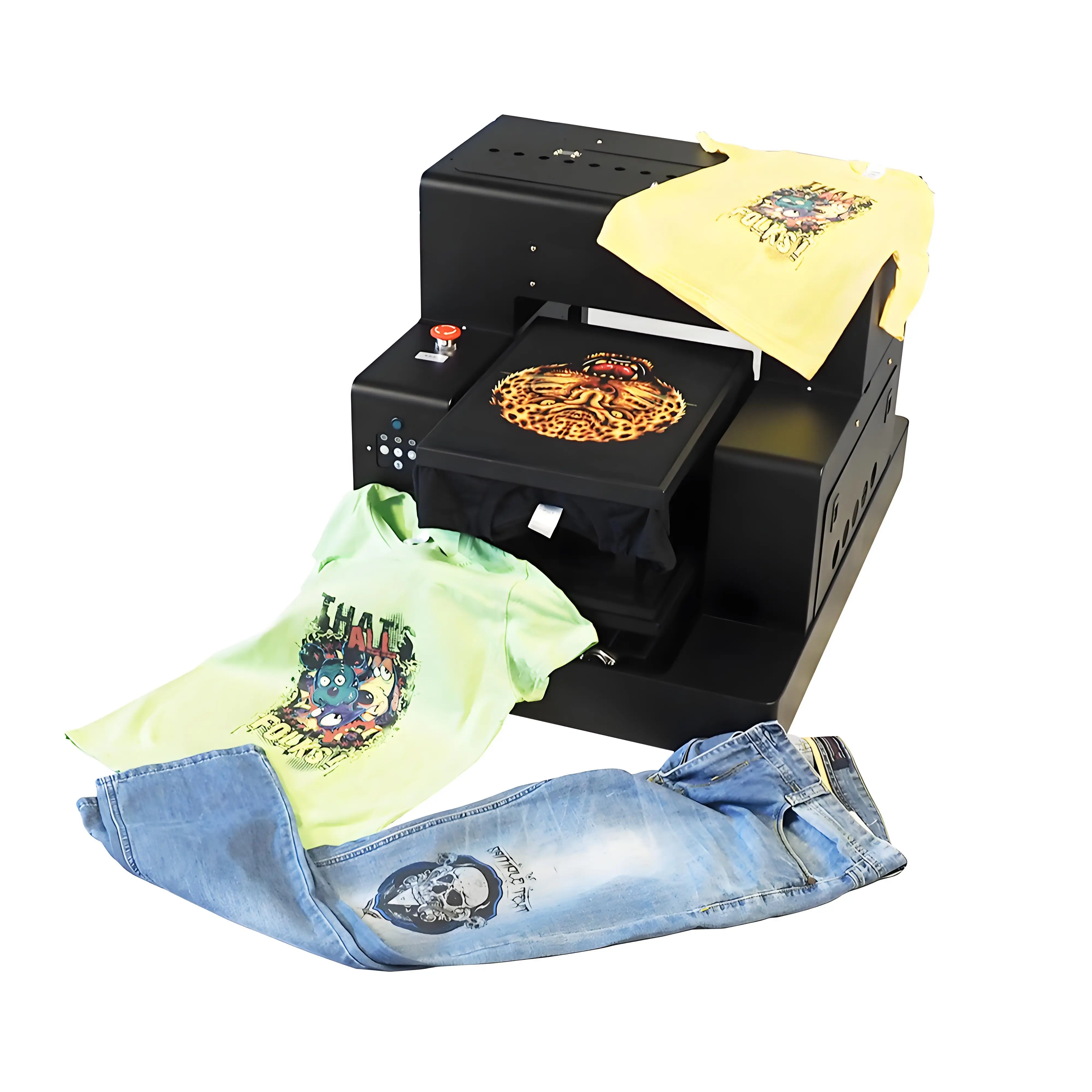
GNFEI A3 Commercial DTG Flatbed Printer
- Simultaneous white underbase & CMYK inline printing (under 90 seconds per dark shirt)
- Active peristaltic white ink circulation system (WIMS) preventing nozzle clogs
- Industrial HIWIN linear guide rail with high-torque lead-screw motion
- Automatic optical infrared height sensor to prevent printhead strikes
- Open-bulk textile pigment ink system: save 80% on consumable ink costs
7. Frequently Asked Questions (FAQ)
Q1. Exactly how long does it take to print a single shirt on a DTG printer? ▼
The raw machine print time for a single shirt ranges between 45 seconds and 3 minutes, depending on the garment color and graphic dimensions. A light or white t-shirt requires only a single CMYK pass (45 to 60 seconds). A dark or black t-shirt requires a dense white ink underbase followed by a full-color CMYK layer, taking 90 to 180 seconds on a single-head flatbed, or 60 to 90 seconds on an inline dual-head commercial printer. However, when factoring in the entire production cycle (pretreatment spraying, pre-pressing, printing, and final heat press ink curing), the total door-to-door production time is roughly 3.5 to 5 minutes per finished shirt.
Q2. Why do dark t-shirts take significantly longer to print than white t-shirts? ▼
Dark t-shirts take 2x to 3x longer because textile inks are translucent pigments. To render bright, photo-accurate colors on black or dark garments, the printer must first deposit a solid, opaque white titanium dioxide (TiO2) underbase layer to mask the fabric fibers. Once the white base is laid down, the printer deposits the CMYK color layer over it. On single-head DTG printers, this requires two separate sequential mechanical carriage sweeps. Furthermore, dark cotton shirts require chemical liquid pretreatment and pre-drying before printing, adding 60 to 90 seconds of manual preparation time.
Q3. Can you speed up DTG printing by lowering the print resolution? ▼
Yes, resolution directly dictates printhead carriage pass count and printing duration. Dropping resolution from 1440x1440 DPI to 1440x720 DPI typically reduces print time by 35% to 45% while preserving 95% of perceptual visual sharpness on cotton fabric. Draft modes (such as 720x720 DPI) print in under 45 seconds, making them ideal for high-volume promotional giveaways or text-only graphics. However, high-end photographic graphics, fine gradients, and intricate vector art generally achieve optimal wash durability and color saturation at 1440x720 or 1440x1440 DPI.
Q4. Does pretreatment drying time count as part of the DTG print time? ▼
In technical machinery specifications, manufacturers list only raw flatbed carriage print time. However, in practical print shop operations, pretreatment spraying (15 to 25 seconds) and heat press moisture evaporation (35 to 45 seconds at 160°C) must be completed before the garment can be loaded onto the printer platen. Smart apparel decorators pre-treat and cure shirts in bulk batches during morning setup, completely decoupling pretreatment time from active printing operations.
Q5. How many finished t-shirts can a single operator produce in an 8-hour workday? ▼
In a realistic production environment using a commercial single-platen A3 DTG flatbed and two standard heat presses, a single trained operator comfortably produces 15 to 22 dark t-shirts per hour, or 30 to 45 light t-shirts per hour. Over an 8-hour shift, accounting for setup, platen loading, platen unthreading, and routine head cleaning cycles, typical real-world output is 110 to 160 finished dark custom garments, or up to 260 white garments.
Q6. What is the difference in print time between single-head and dual-head DTG printers? ▼
A single-head DTG printer (utilizing an Epson XP600 or TX800) splits its nozzle channels between White and CMYK. Because the head cannot lay down wet color ink over uncapped white ink simultaneously on the same micro-pass, it performs two separate passes: first printing the white underbase, returning the platen, and then printing color. This results in print times of 120 to 180 seconds per dark shirt. A dual-head DTG printer features staggered printheads: Head 1 lays white ink, and Head 2 immediately jets CMYK in a single synchronized pass ('One-Pass Inline Printing'), cutting print time in half to 55 to 80 seconds.
Q7. How long does the heat press ink curing step take after printing? ▼
Final ink curing on a standard heat press requires 90 seconds at 160°C (320°F) under medium pressure (approx. 30 to 40 PSI) using silicone or parchment protective sheets. Water-based DTG textile inks rely on heat-activated cross-linking binders that need sufficient dwell time and thermal energy to bond permanently into the core cotton fibers. Shortening cure time beneath 60 seconds severely degrades wash fastness and causes colors to fade after several wash cycles.
Q8. Can you use a conveyor tunnel dryer instead of a heat press to speed up curing? ▼
Yes. While a heat press cures shirts individually in 90 seconds, commercial production shops running multiple DTG printers or high-volume orders often utilize forced-hot-air conveyor tunnel dryers. Shirts travel along a heated belt for 2.5 to 3 minutes at 160°C. Although the per-shirt transit duration is longer than a heat press, conveyor dryers allow continuous hands-free loading, eliminating the operator bottleneck and permitting simultaneous curing of 60 to 120 garments per hour.
Q9. Why do manufacturer spec sheets claim 30-second print speeds when real production takes longer? ▼
Manufacturer marketing spec sheets benchmark print speeds under theoretical lab conditions: using a 10x10 inch graphic printed onto a pure white polyester-blend garment at lowest draft resolution (360 or 720 DPI) with zero white underbase, high bi-directional carriage velocity, and excluding all garment loading, threading, positioning, and heat pressing. Real-world retail orders require opaque white underbases, 1440 DPI photo resolution, manual platen loading, and thermal curing.
Q10. How can custom apparel shops maximize daily DTG output without hiring extra staff? ▼
Shops maximize output through 3 proven workflow optimizations: (1) Bulk Pre-Treating: Spray and pre-press all garments in large morning batches so printers never sit idle waiting for fabric preparation; (2) Dual Heat Press Pipeline: Position one heat press on the left for garment drying and one on the right for final ink curing, allowing continuous loading while the printer runs; (3) Inline RIP Pre-Ripping: Process and spool print files across multiple platen queues before production starts to eliminate PC processing latency.
Ready to Accelerate Your Custom Apparel Production?
Discover how GNFEI commercial A3 DTG flatbed printers combine high-speed dual MicroPiezo printheads, active peristaltic white ink circulation, and open-bulk ink economics to maximize your daily garment output and profits.