Direct UV golf ball printer vs UV DTF stickers: why pro shops need a golf ball printing machine. Many print shop newcomers wonder if they can decorate golf balls using peel-and-stick UV DTF crystal transfers instead of investing in a dedicated direct UV golf ball printer. While UV DTF stickers excel on smooth rigid tumblers and glass, they fail immediately on playable golf balls for four engineering and regulatory reasons: the 75-to-90-micron adhesive film bridges across concave golf ball dimples trapping air and moisture, rips off within 1 to 2 driver or wedge strikes over 100 MPH, disrupts dimple aerodynamics, and renders the ball non-conforming under USGA and R&A tournament rules. Discover why country club pro shops and tournament merchandisers rely on the GNFEI F23V4 20-ball direct UV golf ball printing machine for 8-to-12-micron USGA-legal logos at $0.58 per dozen.
Pro Shop Technology Direct UV vs UV DTF USGA Compliance

Direct UV Golf Ball Printer vs UV DTF Stickers: Why Pro Shops Need a Golf Ball Printing Machine

Reading Time: 9 Mins
Written by: GNFEI Golf Engineering Team
Updated: November 2026
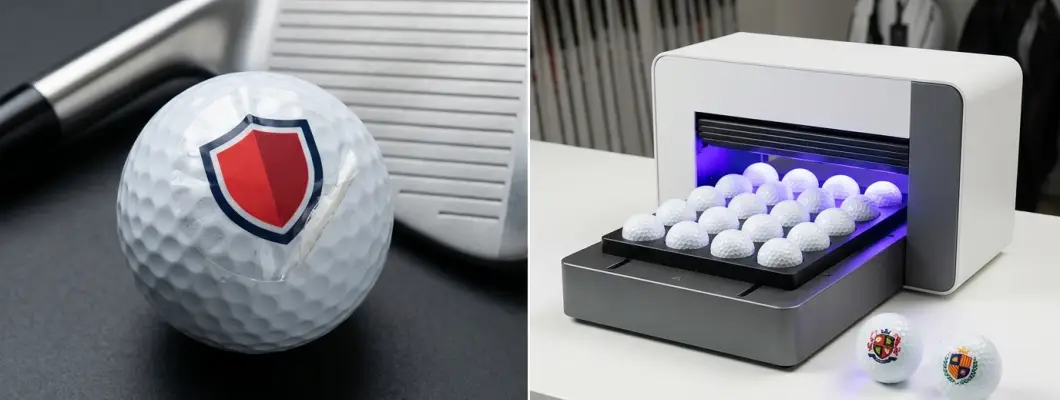
Direct UV Golf Ball Printer vs Peeling UV DTF Stickers in a Country Club Pro Shop

The definitive pro shop answer: UV DTF transfer stickers CANNOT be used on playable golf balls. While peel-and-stick UV DTF "crystal labels" work well on smooth glass, ceramic mugs, and hard plastic boxes, pressing a 75-to-90-micron adhesive transfer onto a dimpled 42.67 mm sphere traps air across dimple valleys, rips off on the very first 100+ MPH club strike, ruins dimple flight aerodynamics, and makes the golf ball illegal under USGA & R&A tournament rules. To sell tournament-legal, chip-proof custom golf balls at commercial speed, pro shops need a dedicated direct-to-substrate UV golf ball printing machine such as the GNFEI F23V4.

With UV DTF gang sheets gaining popularity among craft sellers, golf course merchandise managers and promotional decorators frequently ask our engineering lab: "Why can't we just order or print UV DTF stickers and rub them onto blank Titleist or Callaway golf balls?" Below, we examine the surface mechanics, impact physics, USGA equipment regulations, and per-dozen labor math comparing UV DTF decals against direct UV flatbed golf ball printing.

1. Four Engineering & Rulebook Reasons UV DTF Stickers Fail on Golf Balls

A golf ball is not a smooth coffee mug—it is a high-velocity aerodynamic projectile engineered with 300 to 432 precision concave dimples (averaging 0.22 mm deep) across a tight compound spherical radius. Here is what happens the moment you apply a UV DTF transfer sticker:
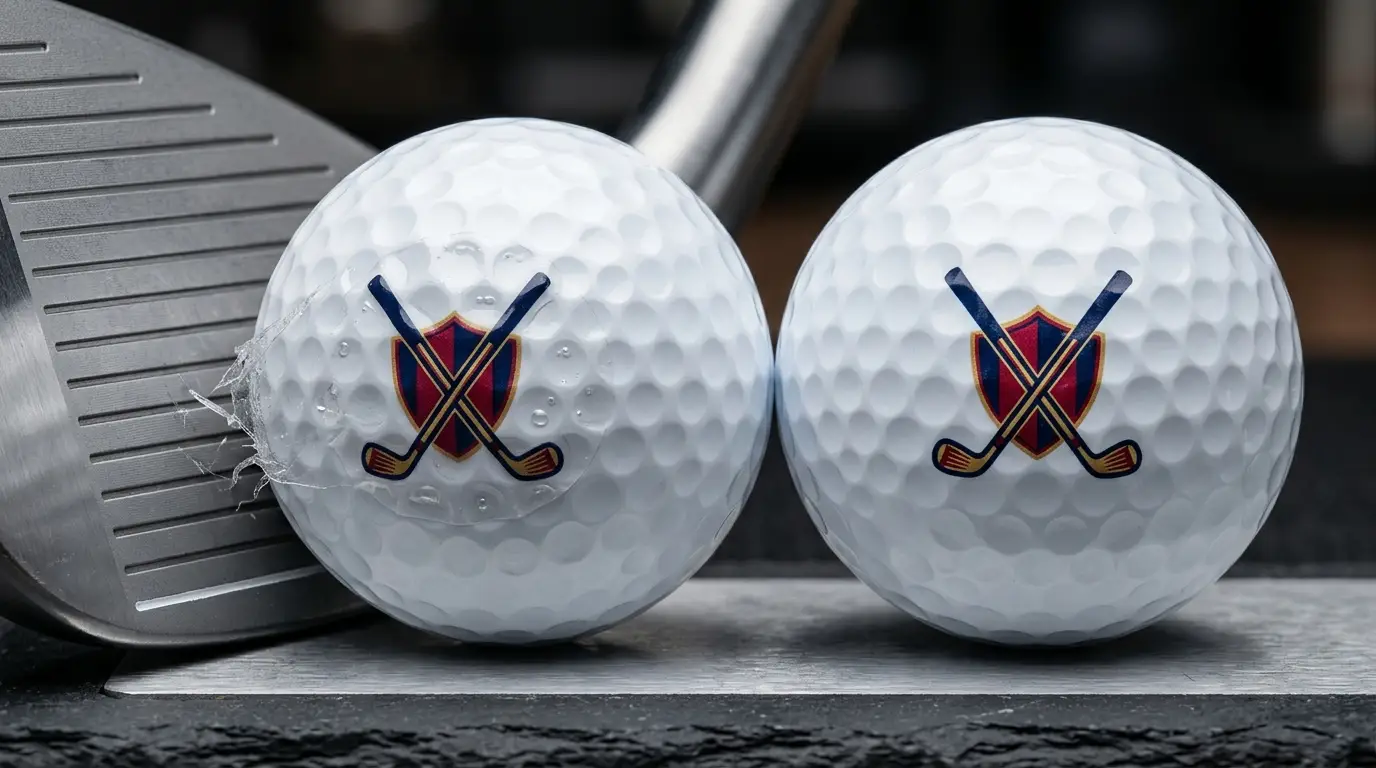
Macro Comparison of Peeling UV DTF Sticker Air Bubbles vs Seamless Direct UV Printed Golf Ball Dimples

1. Dimple-Bridging Air & Water Traps

UV DTF transfers consist of pressure-sensitive acrylic glue, white ink, color ink, and thick cured clear varnish (~80 microns thick). Instead of flowing smoothly into concave dimple bowls, the semi-rigid decal bridges across dimple rims—losing over 40% adhesive contact area and letting wet fairway dew and bunker grit creep underneath.

2. Instant Shear Off on Club Grooves

Sticker glue relies on tacky pressure adhesion rather than chemical cross-linking. When struck at 105 MPH by a driver (25% core flattening) or sheared at 9,500 RPM by sharp 56-degree sand wedge grooves, the raised 80-micron sticker edge catches the metal groove like a scraper blade and tears off in 1 to 2 swings.

3. USGA & R&A Tournament Disqualification

Under USGA and R&A Rules of Golf (Rule 4.2a), players may identify balls with ink markings, but attaching any external sticker or raised decal modifies surface dimple geometry and renders the ball non-conforming—resulting in immediate disqualification in club tournaments and handicap rounds.

4. Erratic Flight & Carry Distance Loss

Golf ball dimples create a thin turbulent boundary layer that cuts aerodynamic drag in half. Covering 12 to 18 dimples on one side of the ball with a flat plastic-like UV DTF sticker creates asymmetric drag—inducing unpredictable side-spin wobbles and robbing 8 to 15 yards of driver carry.

2. Head-to-Head Matrix: Direct UV Golf Ball Printer vs. UV DTF Stickers

How does contactless micro-piezo direct UV printing solve every single limitation of transfer decals while slashing pro shop labor time by 85%? Compare the engineering and operational numbers side by side:
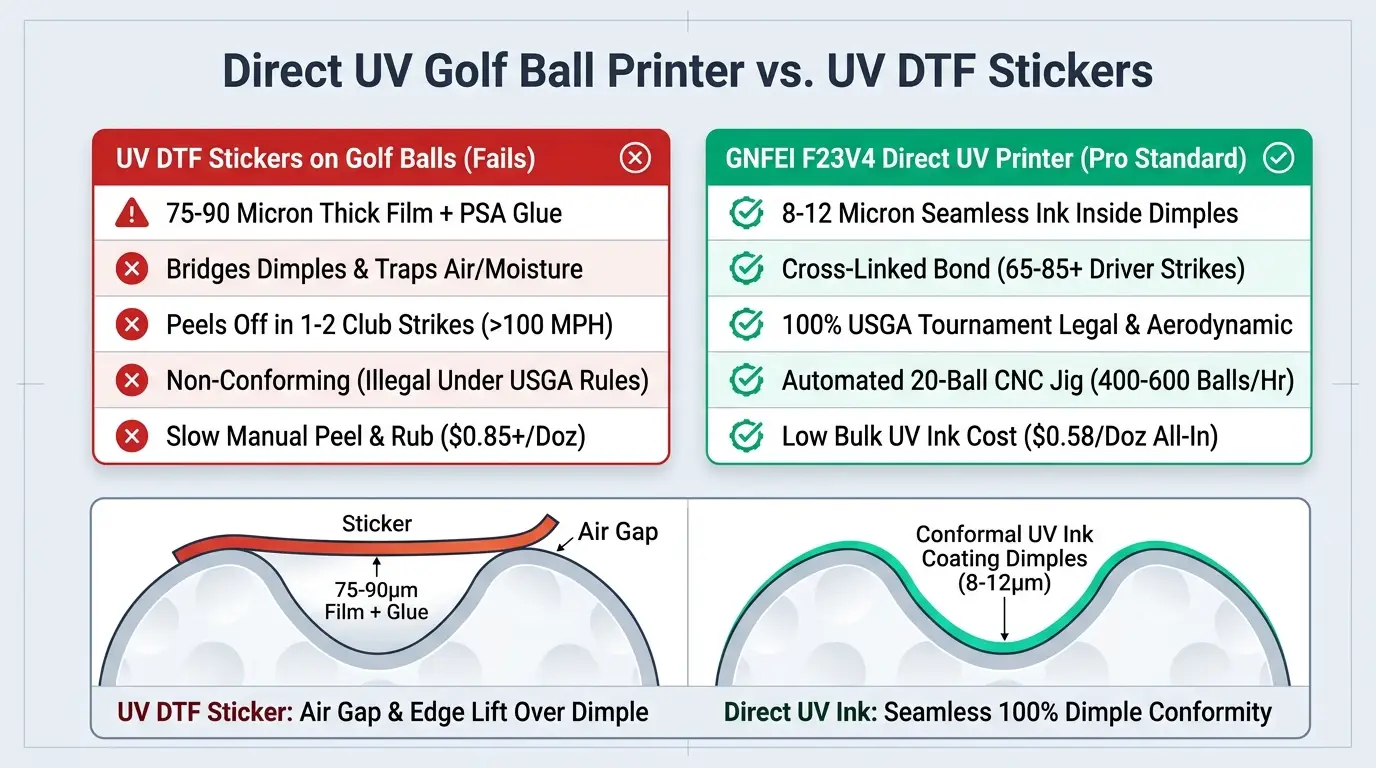
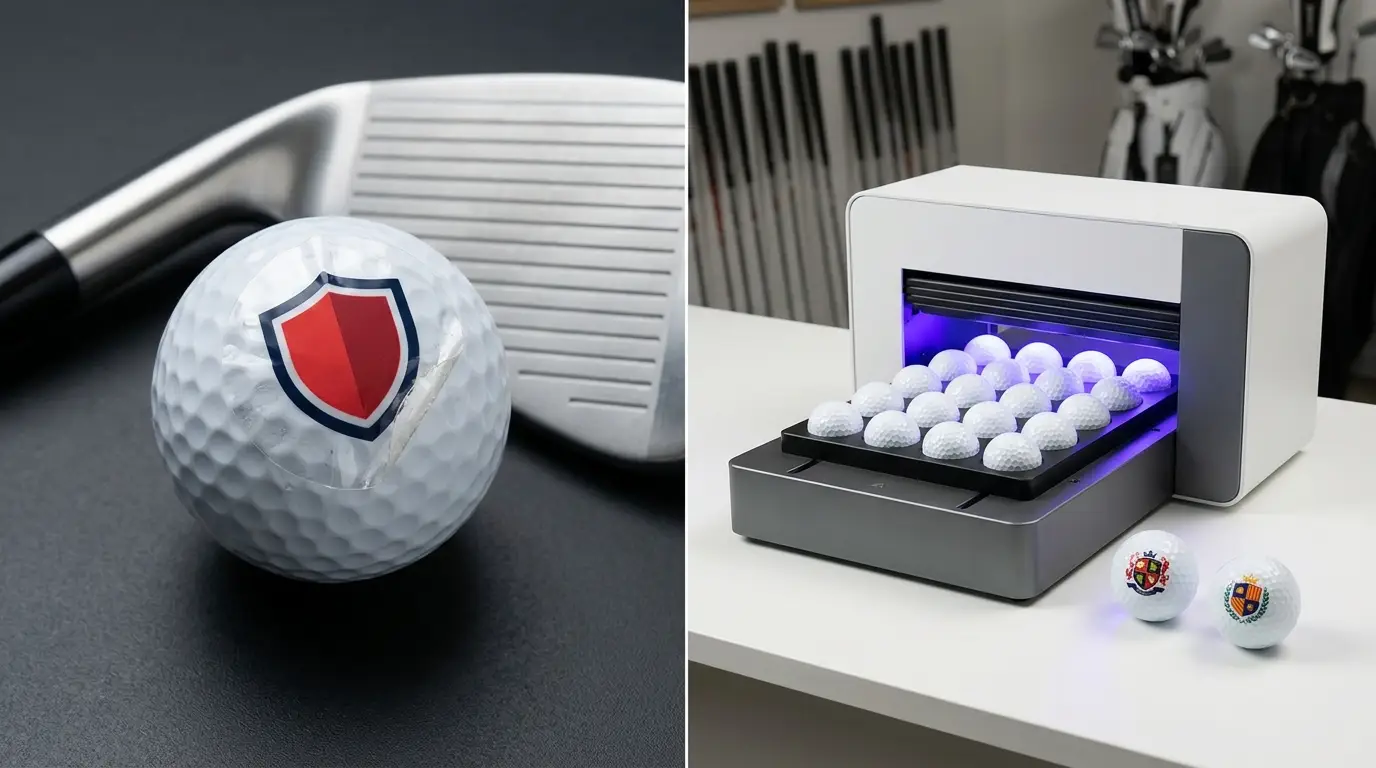
Direct UV Golf Ball Printer vs UV DTF Stickers Comparison Diagram and Dimple Cross Section
Evaluation Metric UV DTF Transfer Stickers GNFEI F23V4 Direct UV Golf Printer
Applied Layer Thickness 75 – 90 microns (Thick glue + varnish stack) 8 – 12 microns (Ultra-thin direct ink film)
Dimple Contour Conformity Poor — bridges dimple valleys & wrinkles 100% — 3.5 pl droplets coat inside dimple bowls
100+ MPH Driver Durability Fails in 1 – 2 strikes (Edge peel & tear) 65 – 85+ strikes (ASTM 5B cross-linked bond)
USGA / R&A Tournament Legality Illegal (External sticker violates Rule 4.2a) 100% Conforming & Tournament Legal
Fine Text & Standalone Letters Tiny letters lack glue area & fall off instantly 1440 DPI micro-text & thin lines with zero border
Time to Fulfill 20 Dozen (240 Balls) 3.0 – 3.5 hours of manual cutting & thumb rubbing 22 – 25 minutes automated (12 cycles x 20-ball jig)
Consumable Cost Per Dozen $0.75 – $1.40/doz (A/B PET film + glue + waste) $0.58/doz all-in ($0.04 raw UV ink, zero film)

3. Why Country Club Pro Shops Standardize on the GNFEI F23V4

For golf club pro shops, resort boutiques, and tournament merchandise providers, floor space is tight and staff members are golf professionals—not full-time press technicians. That is exactly why the GNFEI F23V4 Desktop UV Golf Ball Printer has become the go-to dedicated golf ball printing machine in 2026:

01

Same-Day Charity Scramble & Corporate Member Turnaround

Traditional OEM logo ball orders take 3 to 5 weeks and carry 12-dozen minimums. With the F23V4 sitting in your pro shop back office, a corporate member hosting a Thursday morning client foursome can email their company logo at 8:00 AM and pick up 4 custom sleeves at the first tee by 8:30 AM.

02

Drop-In 20-Ball CNC Fixture + 1.0 mm Infrared Auto-Height Sensor

Zero manual eyeballing or crooked sticker placement. Drop 20 golf balls into the CNC-machined 42.67 mm jig cavities, press one button so the F23V4 infrared laser locks exact 1.0 mm nozzle clearance above the ball apex, and print 20 perfectly centered crests in 90–120 seconds.

03

Customize Tees, Ball Markers, Bag Tags & Divot Tools on One Bed

Lift out the 20-ball jig and the F23V4's 210 x 297 mm flatbed instantly prints high-margin pro shop impulse items—custom club-crested wooden tees, magnetic metal hat-clip ball markers, acrylic bag tags, and tournament award plaques—using the exact same CMYK + 2x White UV LED ink channels.
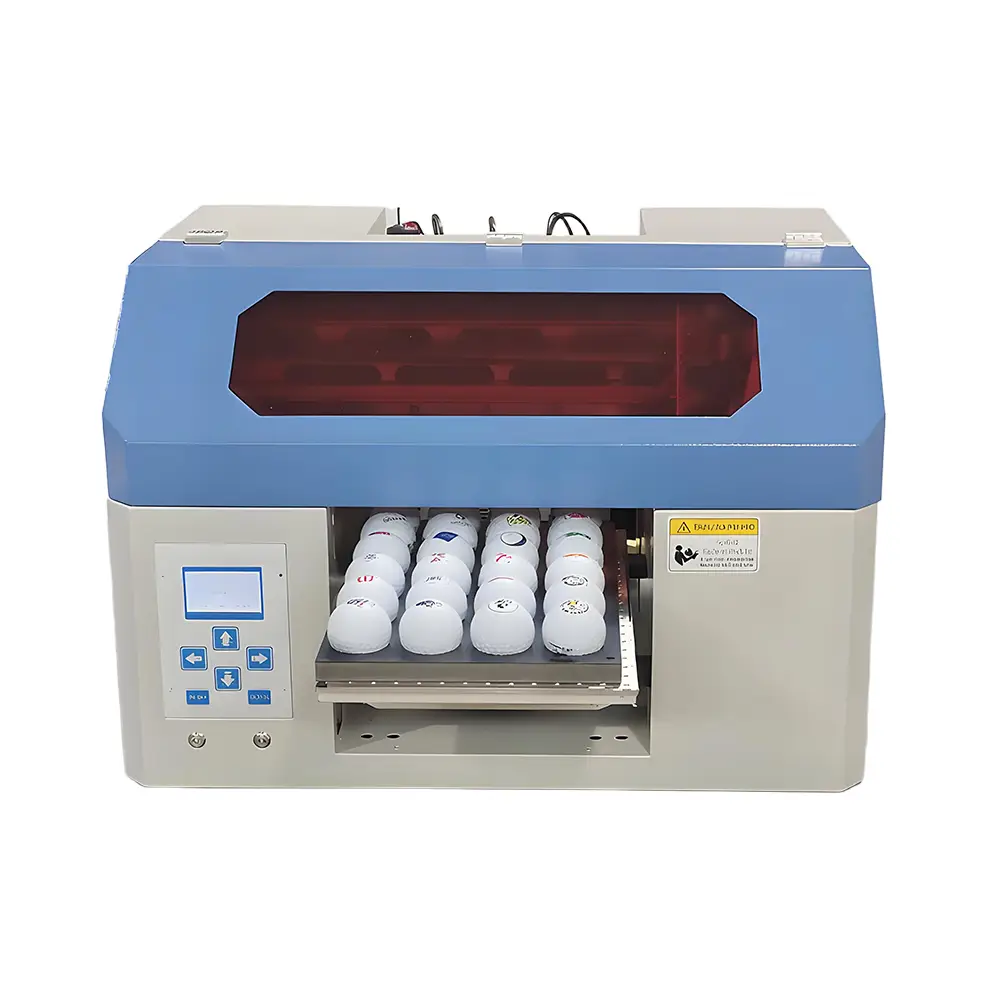
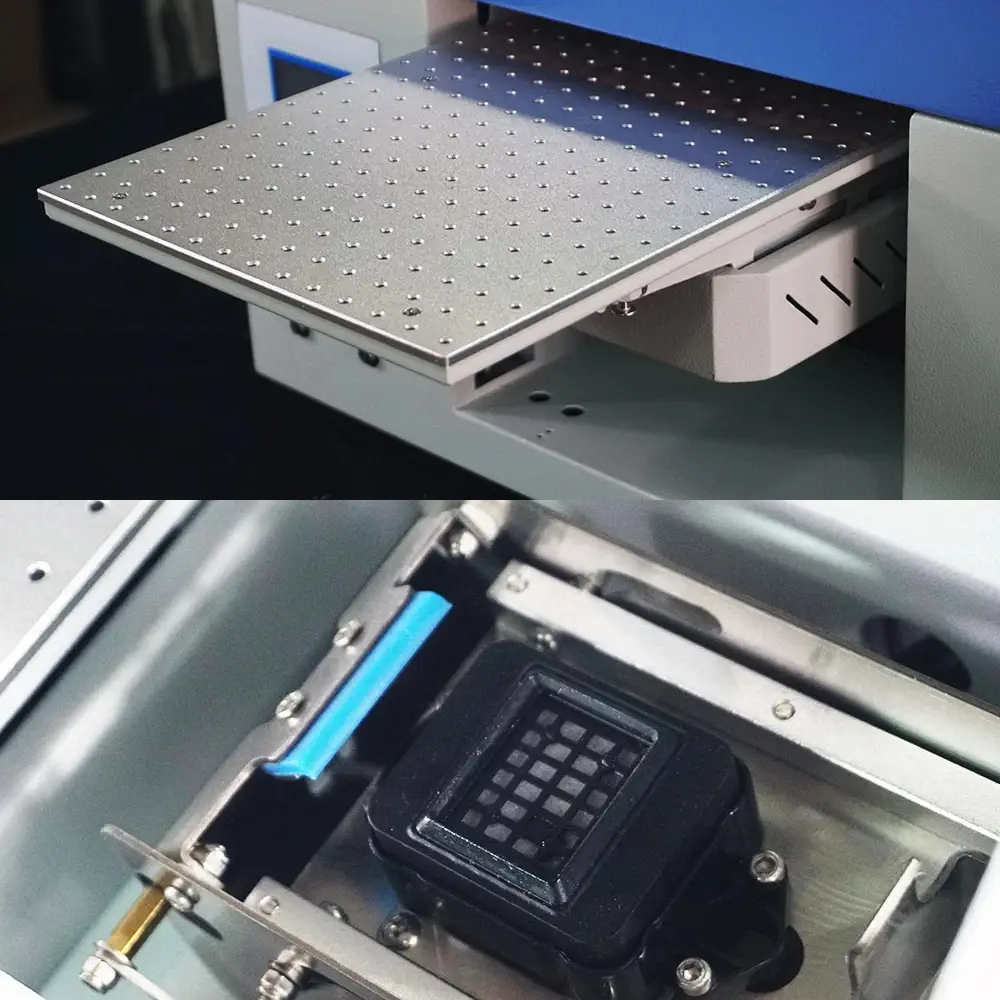
Featured Pro Shop Choice — GNFEI F23V4
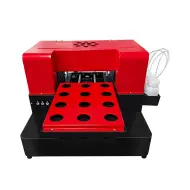
GNFEI F23V4 Compact Desktop UV Golf Ball Printing Machine for Pro Shops
GNFEI F23V4 20 Cavity Precision CNC Golf Ball Printing Jig on Flatbed

GNFEI F23V4 Compact UV Golf Ball Printer

Purpose-built to fit right on a standard pro shop back-office desk (43 kg compact chassis, standard 110V/220V outlet). Delivers seamless, USGA-legal direct-to-dimple CMYK + White prints at 400–600 balls per hour without messy transfer films, sticker edges, or minimum order delays.

  • 20-Cavity CNC Golf Ball Jig Included: Print 20 balls per 90–120 second pass with dead-center accuracy
  • 1440 x 1440 DPI Epson Micro-Piezo Head: Crisp club crests, photos & individual member names
  • CMYK + Dual White Ink Channels: Vibrant opacity on white, neon yellow, matte orange & black balls
  • Infrared 1 mm Auto-Height Laser: Zero manual height guesswork & $0.04 raw UV ink cost per dozen

4. The Right Tool for Each Job: Where UV DTF Actually Helps Around the Clubhouse

While UV DTF stickers never belong on dimpled golf balls, understanding where each method shines helps pro shops build a complete, waste-free customization workflow:

  • Use Your GNFEI F23V4 Direct UV Printer For: All playable and commemorative golf balls, wooden & plastic tees, metal divot tools, magnetic hat clips, acrylic bag tags, wooden 3-ball presentation box lids, and tournament award plaques.
  • Use Sheet-Fed UV DTF Stickers Only For Oversized Smooth Surfaces: Because the F23V4 is a true UV LED flatbed, you can even place A4 UV DTF Film A sheets flat on its bed to print raised club-crest decals for non-dimpled oversized gear that cannot fit inside a printer—such as golf cart windshields, pull-cart frames, laser rangefinder hard shells, and smooth cooler chests!

Frequently Asked Questions (FAQ)

Q1. Can you put UV DTF stickers on golf balls and play a round with them? ▼
No. UV DTF stickers bridge across concave golf ball dimples, trapping air pockets underneath, and rip or peel off within 1 to 2 full driver or iron strikes. Even for unhit display balls, sticker edges visibly wrinkle across the compound spherical curve.
Q2. Are UV DTF stickers on golf balls legal under USGA and R&A rules? ▼
No—they are illegal for tournament and handicap play. Under USGA and R&A Rule 4.2a, applying a physical sticker or external decal alters a ball's dimple profile and aerodynamic properties, making it non-conforming. Direct UV inkjet printing (8–12 microns of ink) is 100% USGA legal, just like a Sharpie pen or OEM factory stamp.
Q3. Why does direct UV ink stay inside golf ball dimples without peeling? ▼
A direct UV golf ball printer like the GNFEI F23V4 jets microscopic 3.5-picoliter liquid ink droplets directly into both dimple valleys and rims, curing them instantly with 395 nm UV LED light. Paired with an IPA wipe, adhesion promoter, and flexible urethane-acrylate ink, the 10-micron layer stretches 150%+ with the ball cover across 65 to 85+ driver strikes.
Q4. How much faster is the GNFEI F23V4 compared to applying stickers by hand? ▼
Roughly 7 to 8 times faster. Hand-cutting, centering, thumb-burnishing, and peeling 240 stickers onto 20 dozen golf balls takes over 3 hours of tedious manual labor. Loading the GNFEI F23V4's 20-ball CNC jig prints all 240 golf balls in 12 automated 2-minute passes—finishing the entire tournament order in under 25 minutes.
Q5. How does per-dozen cost compare between direct UV printing and UV DTF stickers? ▼
Direct UV printing on the F23V4 uses zero transfer film or laminating glue, costing just $0.04 in raw UV ink per dozen ($0.58/dozen all-in including cleaning purges, primer, and head wear reserve). UV DTF requires disposable Film A, Laminating Film B, heavy white + varnish layers, and spacing waste, costing $0.75 to $1.40+ per dozen before counting manual application labor.
Q6. Does heating a UV DTF sticker with a heat gun help it stick to golf ball dimples? ▼
No—and heating a golf ball above 70°C (158°F) with a heat gun can permanently warp the thermoplastic Surlyn cover and degrade the polybutadiene core compression! Even warmed, cured UV DTF varnish remains too thick to survive iron groove shear or pass USGA conformance rules.
Q7. How much desk space does the GNFEI F23V4 require in a pro shop office? ▼
The GNFEI F23V4 features a compact A4 desktop footprint weighing 43 kg that fits comfortably on a standard 80 x 60 cm office counter or sturdy utility cart, plugging into any ordinary 110V/220V wall outlet.
Q8. Can pro shop staff with zero graphic design experience operate the F23V4? ▼
Yes. GNFEI supplies pre-aligned 20-cavity digital jig templates where staff simply drag and drop a transparent PNG club or sponsor logo, load 20 balls, tap auto-height detect, and press print. Most assistant golf pros master the workflow in a single 45-minute video onboarding session.
Q9. Can the GNFEI F23V4 print fine standalone text and alignment lines without a clear border? ▼
Yes! That is one of direct UV printing's biggest visual advantages over UV DTF. UV DTF stickers require a visible clear varnish halo around tiny text so letters don't peel off during transfer. The F23V4 jets crisp 6-point player initials, custom putting alignment arrows, and intricate club crests directly onto the ball with zero background film.
Q10. What if our pro shop also wants to print cylindrical golf tumblers alongside golf balls? ▼
If your shop focuses strictly on golf balls, tees, ball markers, and flat plaques, the dedicated GNFEI F23V4 ($1,800–$2,200) is your cleanest, lowest-cost solution. If you also want 360-degree motorized rotary printing for stainless golf tumblers and water bottles, step up to our sibling GNFEI F60V4 Multifunction UV Printer.

Equip Your Pro Shop With the GNFEI F23V4 Golf Ball Printer

Stop losing tournament orders to 4-week factory lead times or peeling stickers. Request live F23V4 print demo videos, custom golf ball samples, and factory-direct turnkey pricing today.