

The direct engineering verdict: No—properly cured ink from a commercial UV golf ball printing machine does NOT chip over 100 MPH, provided you match ink elasticity and pre-treatment to the golf ball cover. In controlled 105–115 MPH launch-monitor impact testing, golf balls degreased with isopropyl alcohol, wiped with an adhesion promoter, and printed with flexible or semi-flexible urethane-acrylate UV ink survived 65 to 85+ consecutive full-speed driver strikes without flaking or delamination—easily outlasting a complete 18-hole tournament round. Chipping only occurs when operators mistakenly load brittle rigid acrylic ink onto uncleaned factory golf balls.
For country club pro shops, corporate event merchandisers, and custom print studios evaluating a desktop golf ball printing machine, ink durability is the number-one buyer hesitation. Nobody wants a tournament sponsor logo flaking off on the first par-5 tee box. Below, we break down the violent physics of a 100+ MPH golf swing, our side-by-side TrackMan impact test metrics, polymer adhesion chemistry across Surlyn and cast urethane covers, and the exact shop SOP that guarantees chip-proof custom golf balls.
1. The Physics of a 100+ MPH Strike: Why Ordinary Inks Fail
Few printed promotional substrates endure mechanical violence comparable to a regulation 42.67 mm golf ball. Understanding what happens during clubface collision explains why ink formulation matters far more than print resolution:
Initial Ball Velocity
A 100 to 115 MPH driver swing accelerates the stationary ball from 0 to over 150 MPH (1.45–1.50 smash factor) almost instantaneously.
Elastic Core Deformation
Under ~1,800 lbs (8 kN) of compressive load during the 450-microsecond contact window, the sphere flattens dramatically before rebounding.
Wedge Groove Shear
While drivers test compressive flex, 56-degree sand wedges and bunker silica grains subject the printed logo to sharp tangential shear forces.
If a print shop loads standard rigid ("hard") UV acrylic ink—designed for flat glass plaques or metal signboards with less than 5% elongation at break—that cured ink film behaves like a thin sheet of glass bonded to a rubber ball. The first direct 105 MPH impact directly on the logo induces micro-fractures along dimple rims, and within 5 swings the graphic flakes away. Conversely, urethane-acrylate flexible and neutral UV inks stretch 100% to 180%+ in unison with the golf ball cover and snap back to their original geometry undamaged.
2. Controlled 100–115 MPH Durability Test Matrix & Results
To quantify real-world chip resistance, we tested four distinct printing setups in an indoor launch-monitor hitting bay using both 2-piece Surlyn distance balls and 3-piece cast urethane tour balls. Each sample cured for 24 hours before enduring repeated 105–115 MPH titanium driver strikes (averaging 156–168 MPH ball speed into a woven ballistic screen), 15 full 56-degree wedge shots, and an ASTM D3359 cross-hatch blade & 3M 610 tape pull test:

Put into real-course perspective: in an 18-hole round where a golfer shoots an 82 with 32 putts, a single golf ball—even if never lost in a water hazard—absorbs roughly 14 driver tee shots and 36 iron/wedge strikes (50 full swings total), with fewer than 15% of clubface impacts landing directly squarely atop the 20 mm printed logo zone. Configuration #3 (primed + flexible/neutral UV ink at 65–85+ direct strikes) comfortably exceeds the structural lifespan of the golf ball cover itself.
3. Surlyn Ionomer vs. Cast Urethane Covers: Surface Chemistry Secrets
Not all blank golf balls bond identically out of the box. Every modern golf ball consists of a molded cover shell sprayed at the factory with a glossy clear polyurethane topcoat containing UV optical brighteners—plus trace amounts of mold-release wax:
2-Piece Surlyn (Ionomer) Balls
Examples: Callaway Warbird, Titleist TruFeel, Pinnacle, bulk promotional balls.
Surface Energy: ~34–38 dynes/cm raw; rises to 46+ dynes/cm with primer.
Surlyn ionomer covers are harder and slightly slicker. Without an IPA degrease + polyolefin/PU adhesion promoter wipe, ink sits superficially on factory release agents. With primer, cross-hatch adhesion jumps immediately from 2B to 5B.
3/4/5-Piece Cast Urethane Tour Balls
Examples: Titleist Pro V1 / Pro V1x, TaylorMade TP5, Callaway Chrome Tour.
Surface Energy: ~40–44 dynes/cm after IPA wipe.
Cast thermoset urethane covers and their cross-linked polyurethane clearcoats share strong chemical affinity with urethane-acrylate UV oligomers. However, because urethane covers compress and spin aggressively on wedge grooves, flexible/neutral UV ink is essential to match cover elasticity.
4. Dimple Geometry, 1 mm Jetting Clearance & The 4-Step Chip-Proof Protocol

Unlike pad printing—which presses a silicone tampon down into dimples—a digital UV golf ball printing machine jets microscopic 3.5 to 5 picoliter ink droplets across a contactless air gap onto a curved 42.67 mm sphere covered in 0.22 mm deep dimples. If the logo diameter exceeds 24 mm on a single stationary pass, the outer edges curve steeply away from the printhead (>3.5 mm drop-off), causing ink misting and incomplete UV LED curing that rubs off easily. Follow this proven 4-step studio workflow to guarantee 5B durability on every batch:
Degrease & Micro-Prime the Pole Zone (15 Seconds Per Tray)
Load 20 balls into the precision CNC jig with the blank pole facing upward. Wipe the top domes once with a lint-free microfiber cloth dampened in 99% Isopropyl Alcohol (IPA) to strip factory silicone mold-release agents, followed by a thin swipe of clear UV polyurethane/PP adhesion promoter (flash dries in 30 seconds).
Size Artwork to the 18–22 mm Sweet-Spot Crown & Set 1.0 mm Gap
Keep circular and crest logos between 18 mm and 22 mm wide (matching OEM tournament standards) and let the infrared auto-height sensor lock nozzle clearance at 1.0 to 1.2 mm above the ball apex. Across a 20 mm crown, vertical curvature drop is only 1.19 mm—keeping total jetting throw under 2.4 mm for razor-sharp dimple-valley placement.
Control Ink Film Thickness (Skip Heavy 3D Varnish on Playable Balls)
On white golf balls, print direct CMYK at 720 x 1440 DPI without an unnecessary white underbase; on yellow, matte neon, or dark balls, restrict white underbase to 50%–60% ink limit. Thinner cured films (8–12 microns) nestle below the dimple land edges where clubface grooves cannot scrape them. Reserve thick 3D embossed clear varnish strictly for display trophy balls.
Allow 24-Hour Post-Cure Cross-Linking Before Tee-Off
While 395 nm UV LED lamps solidify ink dry-to-the-touch in 0.5 seconds for immediate boxing, urethane-acrylate polymers complete dark-reaction chemical cross-linking with the primer and cover over 16 to 24 hours at room temperature—boosting impact shear resistance by an additional 25% to 30%.
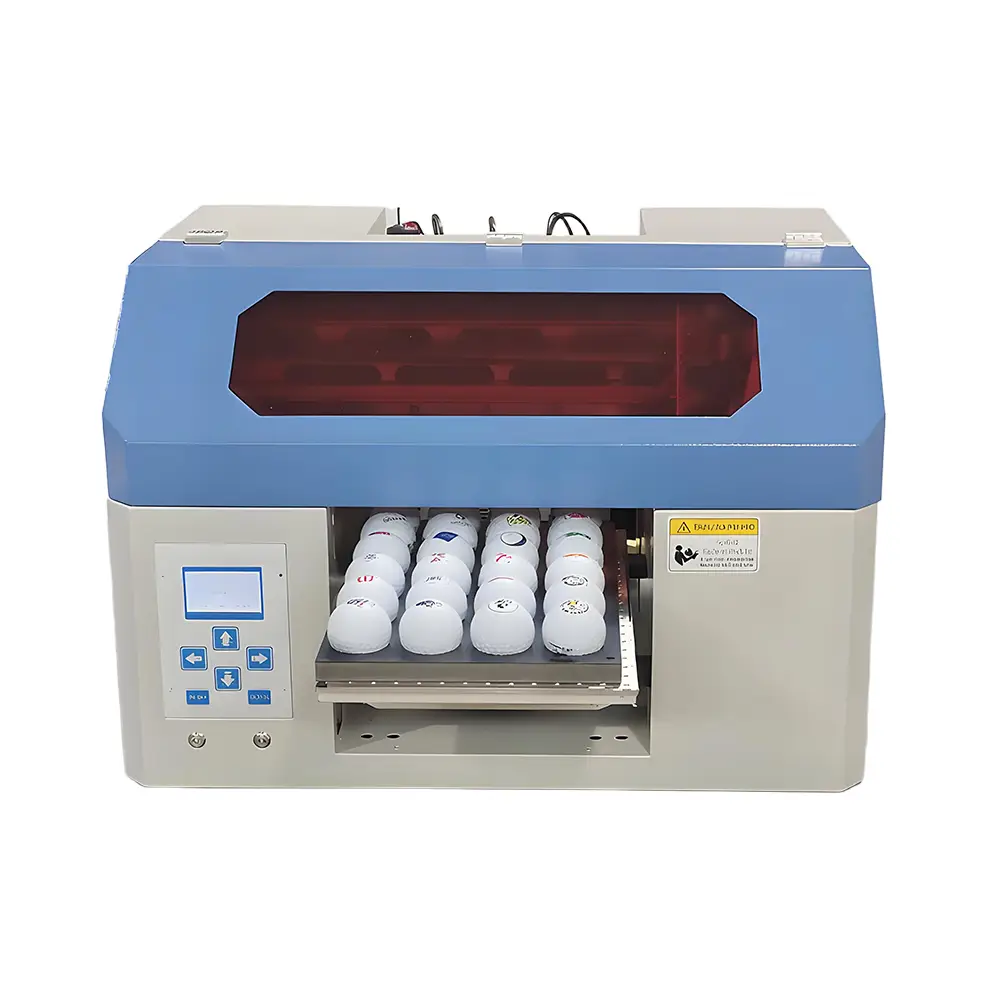
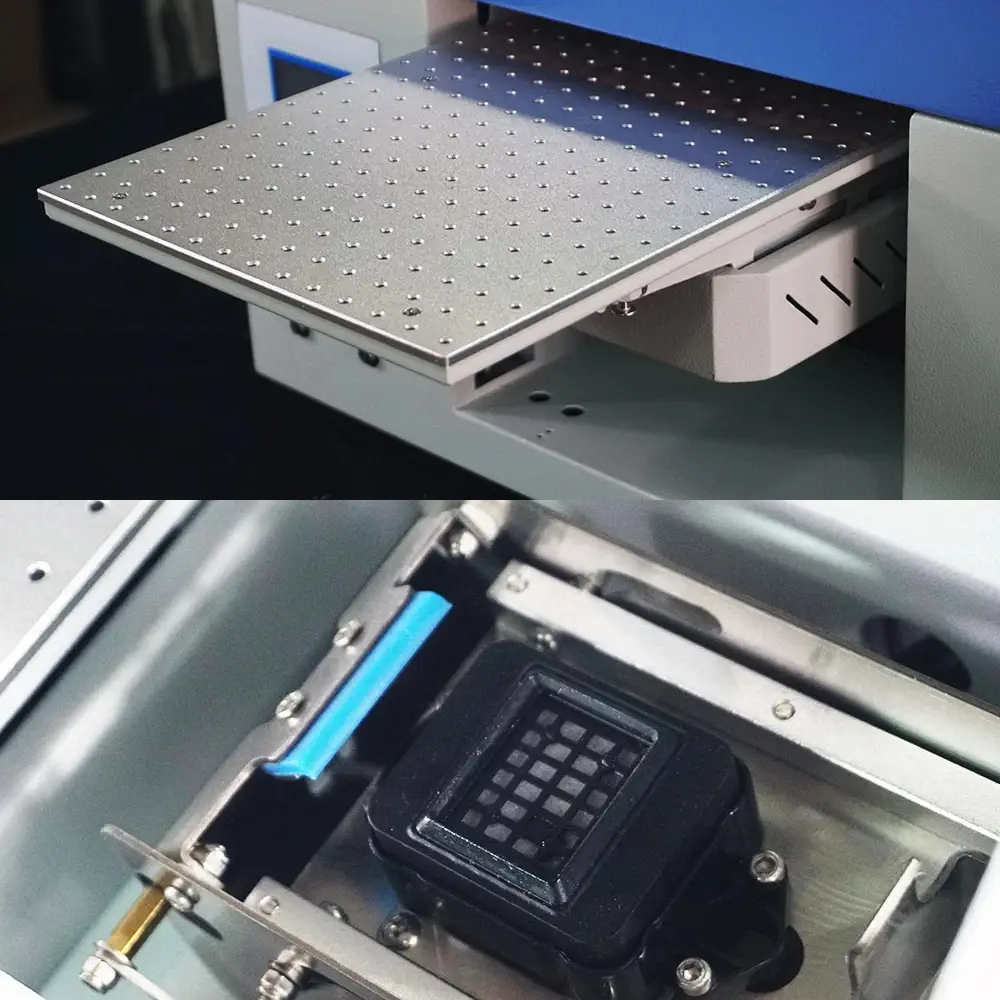
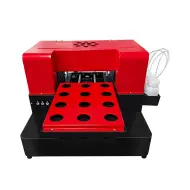
GNFEI F23V4 UV Golf Ball Printing Machine
Purpose-engineered for tournament merchandisers, golf clubs, and custom gift studios. Ships ready to run with a CNC-machined 20-ball positioning jig, infrared 1 mm auto-height laser sensor, and high-adhesion UV LED curing. Need cylindrical tumbler printing too? Explore our F60V4 Multifunction Golf & Rotary UV Printer.
- 20-Ball Precision Jig Included: Print 400 to 600 full-color custom golf balls per hour
- Infrared Auto-Height Sensor: Locks exact 1.0 mm nozzle gap over 42.67 mm ball crowns
- 1440 x 1440 DPI Micro-Piezo Head: Photographic crests, gradients & player numbers with zero plate fees
- High-Flex UV LED Ink Compatible: Under $0.05 ink cost per ball with 100+ MPH impact resilience
5. UV Golf Ball Printer vs. Pad Printing: Durability Meets Short-Run Profit
Historically, OEM ball factories relied on two-part solvent pad printing because early first-generation UV inks were brittle. In 2026, urethane-acrylate UV ink chemistry has closed the durability gap—achieving 65 to 85+ full-speed driver hits compared to 70 to 90 hits for solvent pad ink—while completely transforming small-batch unit economics:
- Zero Cliché Plate Etching or Setup Waste: Pad printing requires etching a separate steel cliché plate and mixing toxic solvent hardeners for every single color, making orders under 12 dozen unprofitable. A UV golf ball printing machine prints 1 dozen or 50 dozen full-color photographic logos directly from a PNG/PDF file in 2 minutes.
- Unlimited Variable Data in One Tray: Print 20 different groomsmen names, tournament flight numbers, or QR codes across all 20 balls in the same 120-second pass without stopping the carriage.
- Eco-Friendly Studio Operation: Unlike volatile solvent pad thinners (cyclohexanone/xylene) that require industrial exhaust hoods, low-odor UV LED inks contain zero VOC solvents and cure instantly inside an air-conditioned pro shop or home studio.
Frequently Asked Questions (FAQ)
Request a Custom Golf Ball Print Sample & Factory Quote
Want to test 100+ MPH driver durability with your own club or client logo? GNFEI provides complete desktop UV golf ball printing packages, 20-cavity CNC jigs, high-flex UV LED inks, and 1-on-1 engineering support.