How Often Should Dampers, Wiper Blades, and Capping Stations Be Replaced? | GNFEI
How Often Should Dampers, Wiper Blades, and Capping Stations Be Replaced?
In Direct-to-Garment (DTG) textile printing, machine operators frequently focus all their anxiety on the printhead. At $800 to $1,800 per unit for an Epson or Ricoh MicroPiezo head, it represents the single most expensive mechanical component on the carriage.
Yet senior field technicians understand a fundamental industry truth: printheads rarely fail on their own; they are murdered by worn-out peripheral consumables. Specifically, degraded ink dampers, nicked wiper blades, and hardened capping stations are responsible for over 85% of catastrophic printhead clogs, color starvation, and plate delamination. Below is the definitive engineering replacement schedule.
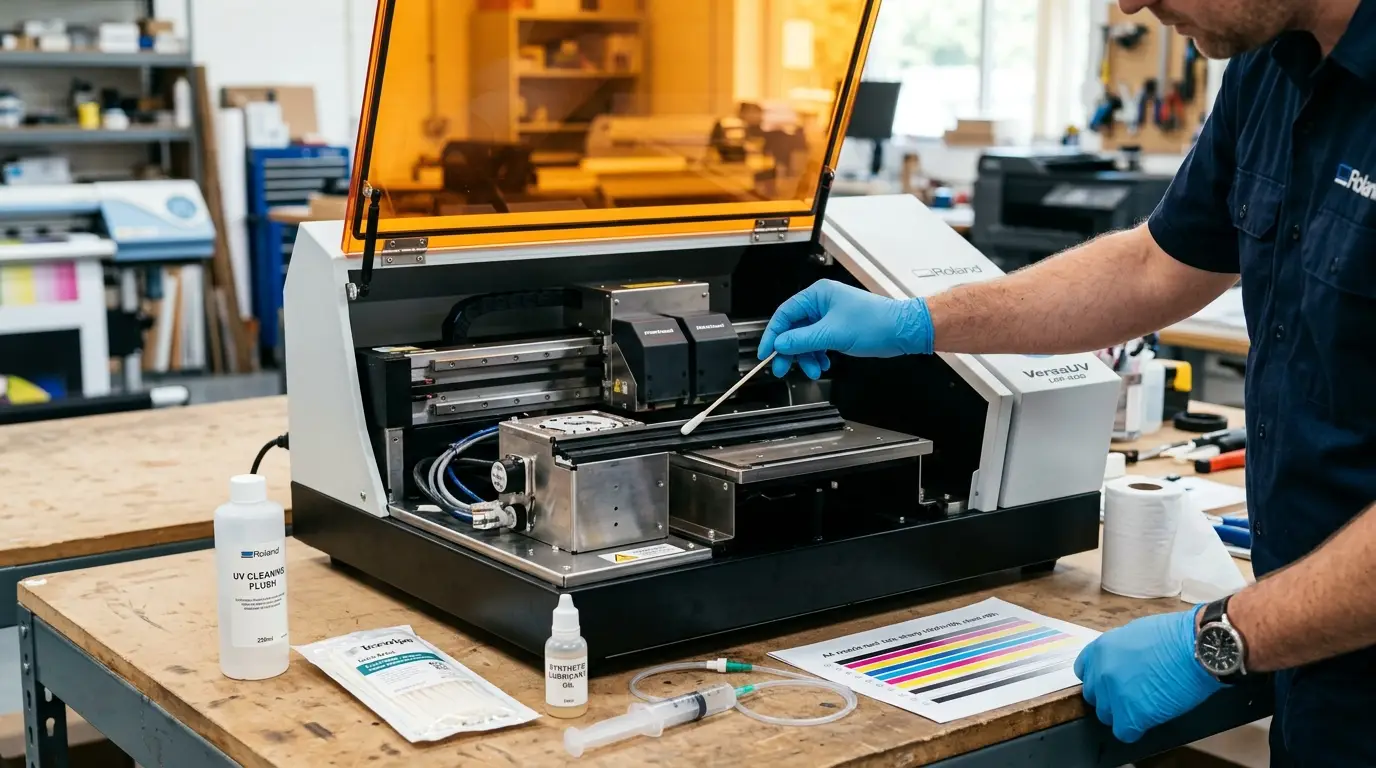
The DTG Wear Reality: Why Garment Printing Destroys Consumables Faster
Operators migrating from paper, eco-solvent, or UV printing are often shocked by how frequently DTG consumables must be replaced. A UV printer damper might survive 12 to 18 months, but a DTG white ink damper can expire in just 3 to 6 months. Why the stark difference?
Two unavoidable environmental factors accelerate DTG wear part degradation:
The physical and chemical forces degrading DTG consumables:
1. Titanium Dioxide (TiO2) Sedimentation Silt
White textile ink contains dense inorganic TiO2 nanoparticles (specific gravity ~4.2). Even with active recirculation, gravity causes micro-pigments to pack into damper mesh filters (10-15 microns) and settle inside capping station pump tubes, forming dense chalky blockages.
2. Airborne Cotton Lint & Microfiber Intrusion
Loading and curing cotton t-shirts sheds billions of microscopic cellulose fibers. These airborne fibers stick to ink-moistened wiper blades and capping station seals. The rubber wiper turns into an abrasive lint-covered squeegee that scratches nozzle surfaces.
3. Acrylic Latex Polymer Cross-Linking
DTG ink relies on acrylic latex polymers to bind pigment to cotton fibers during heat pressing. When exposed to microscopic air leaks at an aging capping seal, these resins polymerize into tough, rubbery films that jam pump tubing and seal gaskets.
Dampers: White Ink (3-6 Months) vs CMYK (6-12 Months)
Dampers serve two vital functions: filtering fine particulate debris before it reaches the printhead's micro-nozzles, and regulating ink flow pressure spikes caused by the rapid acceleration and deceleration of the print carriage.
A damper is not a passive plastic cup. It contains an internal stainless steel or nylon mesh filter (rated at 10 to 15 microns) and a flexible polyimide film diaphragm backed by a tiny internal spring:
The Mechanics of Damper Starvation
As heavy titanium dioxide particles pass through the damper, they gradually silt up the fine mesh screen. Simultaneously, constant pressure flexing causes the thin plastic membrane to lose elasticity and wrinkle. When a high-density white underbase job requires rapid ink flow, the constricted filter and rigid membrane cannot deliver the required volume. The printhead fires empty nozzles (ink starvation), pulling vacuum bubbles into the chambers and overheating delicate piezo actuators.
Because white ink contains 4x to 6x the solid particulate mass of CMYK inks, white dampers must be replaced every 3 to 6 months (or every 500 garments on heavy production schedules). CMYK color dampers experience significantly lower silt loads and typically last 6 to 12 months.
Consumable Wear Timeline & Failure Progression
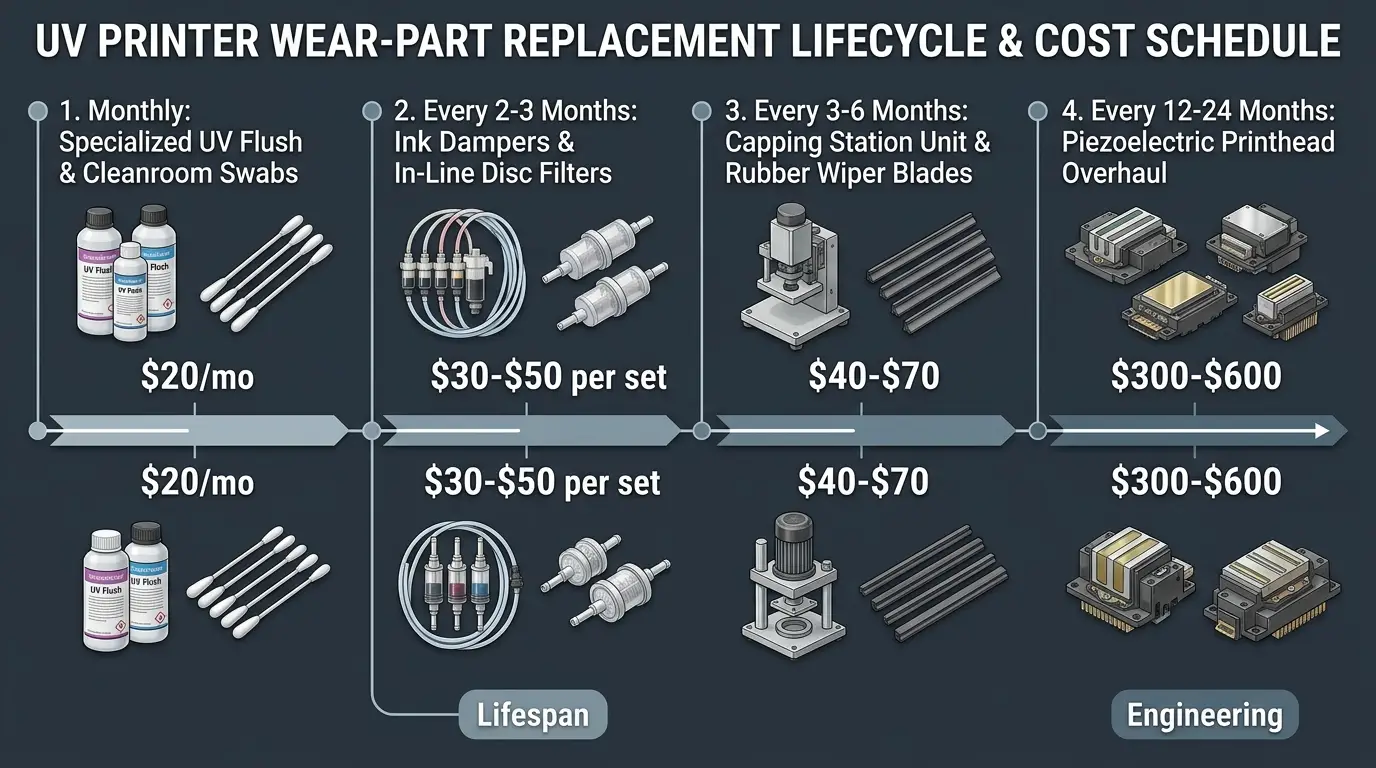
The following technical diagram illustrates the chronological degradation phases of DTG dampers, wiper blades, and capping stations, highlighting critical intervention windows before printhead damage occurs:
Wipers (1-3 Months) & Capping Stations (3-6 Months): The Vacuum Defense
While dampers protect the top of the printhead, the wiper blade and capping station guard the vulnerable nozzle plate underneath.
Understanding the specific failure modes of these surface-contact components:
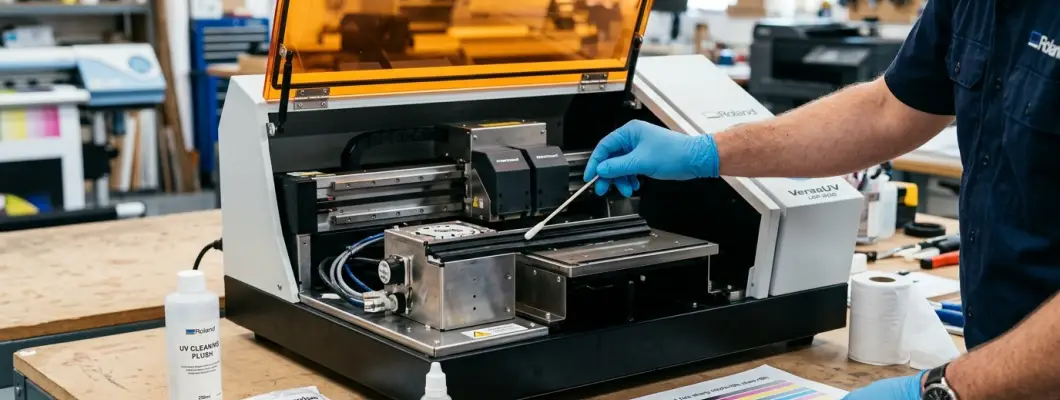
Wiper Blades: Micro-Scratches on Fluoropolymer
Lifespan: 1 to 3 MonthsThe printhead nozzle plate is coated with a microscopic (0.1 micron) hydrophobic fluoropolymer layer to ensure straight droplet ejection. When rubber wiper blades become nicked, warped, or encrusted with dried titanium lint, they drag sharp particles across the plate, stripping the non-wetting coating and causing permanent nozzle deflection.
Capping Rubber Gaskets: Vacuum Bleed
Lifespan: 3 to 6 MonthsAutomatic head cleaning relies on a peristaltic pump creating a sealed vacuum (-30 to -50 kPa) against the head. Contact with cleaning solutions and carriage docking pressure flattens the beveled silicone rim. Once the seal leaks air, the pump draws ambient air instead of ink, rendering head cleaning completely ineffective.
Capping Station Porous Sponge: Polymer Clogging
Crystallization HazardThe open-cell foam inside the capping cup captures purged ink. Over months, acrylic latex cross-links inside the foam pores, turning the soft absorbent pad into a hard, crusty brick that physically gouges printhead nozzles upon mechanical docking.
Peristaltic Pump Tubing: Plasticizer Creep
Pump FatigueThe flexible silicone or Tygon tubing under the capping station is squeezed continuously by rotating rollers. Over 3 to 6 months, the tubing permanently deforms (tube flattening), drastically reducing suction flow rate even if the motor runs normally.
Exhaustive DTG Wear Part Replacement Matrix
Engineering comparison of replacement intervals, symptoms, and failure risks across all DTG wear items:
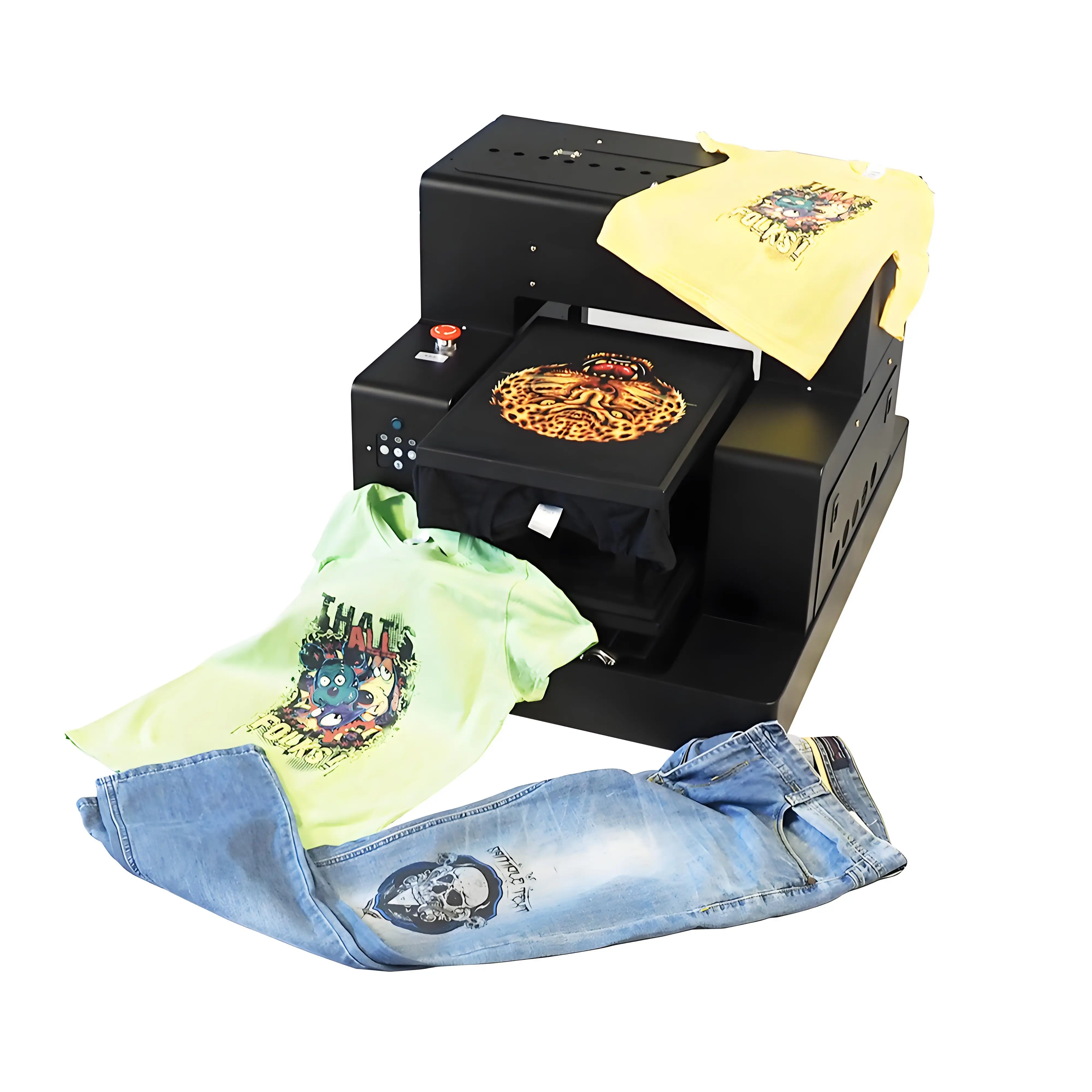
GNFEI A3 Flatbed DTG T-Shirt Printer (Epson XP600 / L1800 Engine)
Engineered with quick-release white ink dampers, active WIMS agitation, heavy-duty industrial capping station with replaceable silicone seals, and dedicated lint-resistant wiper assemblies. Delivers vivid, wash-fast white and color prints on dark cotton apparel.
SOP Protocol: Replacing DTG Wear Parts Safely
When replacing wear consumables on your DTG printer, follow these standard operating procedures:
Pre-Prime New Dampers Before Printhead Mounting
Never install a dry damper onto a delicate printhead manifold nipple! Use a clean 10ml luer-lock syringe to gently draw ink from the tank through the line into the damper until the internal chamber is 60-70% full, then press onto the nipple.
Lubricate Wiper Blades & Capping Rims with DTG Flush
When installing a brand-new silicone wiper or capping station, moisten the rubber contact edges with official glycol cleaning solution. Dry rubber dragging across a dry nozzle plate can strip the fluoropolymer surface on the very first carriage pass.
Calibrate Mechanical Docking Height & Perform Vacuum Test
After replacing the capping station assembly, verify that the rubber rim compresses evenly by 1.0 to 1.5 mm against the nozzle plate when the carriage parks. Pour 3 ml of cleaning fluid into the cap and run a purge cycle to confirm instantaneous suction evacuation.
Frequently Asked Questions (FAQ) on DTG Consumables
Q1. How do I know if my DTG white ink damper needs replacement?
The three unmistakable symptoms are: (1) White prints start bright but fade or show horizontal banding toward the bottom of the shirt; (2) The clear film diaphragm on the side of the damper appears sucked flat or concave; (3) You see visible chalky white sediment accumulation at the bottom of the damper mesh screen.
Q2. Can I clean and reuse clogged DTG dampers instead of buying new ones?
No. Dampers are precision consumables costing under $5-$10 each. Attempting to back-flush a damper with a syringe almost always ruptures the internal 10-micron filter mesh or dislodges trapped particles straight into the printhead. Always install brand-new dampers.
Q3. Why do DTG wiper blades need replacement every 1-3 months while UV wipers last longer?
DTG printing generates substantial airborne cotton lint and uses abrasive titanium dioxide pigments. This combination causes micro-grooves and sharp fiber build-up on the rubber edge within 60-90 days, which scratches the delicate hydrophobic coating of the printhead.
Q4. What happens if my capping station loses its airtight vacuum seal?
If the capping seal leaks air, the peristaltic waste pump cannot generate the negative pressure (-30 to -50 kPa) needed to suck fresh ink through the nozzles during cleaning cycles. Consequently, clogs cannot be cleared and nozzles will dry out overnight.
Q5. Should I replace all dampers at once, or only the white ink dampers?
White dampers wear out twice as fast as color dampers. It is common practice to replace white dampers every 3-4 months, and perform a complete set replacement (White + CMYK) every 6-9 months to maintain balanced fluid resistance across all channels.
Q6. How can I test if my capping station pump is still creating sufficient vacuum?
Park the carriage on the capping station, fill the cap cup with 3-5 ml of distilled water or cleaning solution, and initiate a head cleaning cycle. The fluid should be sucked out completely within 2 to 3 seconds. If fluid remains or drains sluggishly, the cap seal or pump tubing is compromised.
Q7. What tools are required to replace DTG dampers on Epson-based printheads?
You will need a small Philips screwdriver, lint-free wipes, a 10ml luer-lock syringe with silicone tubing for priming, nitrile gloves, and a flashlight. Always ensure the printer is completely powered off before disconnecting dampers.
Q8. Does white ink circulation (WIMS) eliminate the need to replace dampers?
No. While WIMS keeps white ink moving through the external lines and sub-tank, ink inside the damper chamber sits relatively quiescent between print jobs. Furthermore, the damper's internal filter continues to trap aggregate particles, requiring routine replacement every 3 to 6 months.
Q9. Can a dirty or worn wiper blade cause color mixing or cross-contamination?
Yes! A warped, swollen, or fiber-encrusted wiper cannot squeegee the nozzle plate cleanly. Instead, it puddles excess white ink over adjacent cyan, magenta, yellow, or black nozzle rows, causing muddy or contaminated prints on subsequent garments.
Q10. How long do peristaltic waste ink tubes last on a DTG printer?
Peristaltic pump tubing typically lasts 6 to 12 months. Because rotating rollers constantly compress the silicone tube, it eventually suffers mechanical fatigue and flattening ('plasticizer creep'), reducing suction power by over 50%.