What is White Ink Circulation (WIMS) and Does It Eliminate Clogs? | GNFEI
What is White Ink Circulation (WIMS) and Does It Eliminate Clogs?
In the world of digital direct-to-garment apparel printing, white ink is both an indispensable superhero and an unrelenting operational nemesis. Without opaque white textile ink, vibrant printing on dark, black, and colored cotton garments is physically impossible. Yet, the very chemical component that creates this brilliant opacity—Titanium Dioxide (TiO₂)—is also the primary culprit behind clogged dampers, starved printheads, and catastrophic $1,200 hardware replacements.
To solve this chronic industry challenge, printer manufacturers developed WIMS (White Ink Management System). Equipment marketing brochures frequently claim that WIMS "completely eliminates printhead clogs forever." But does this marketing promise match workshop engineering reality? In this exhaustive guide, we dissect the inner fluid mechanics of closed-loop WIMS circulation, clarify what it solves versus what it cannot prevent, and outline the true operational protocol required to keep your DTG printheads firing flawlessly.
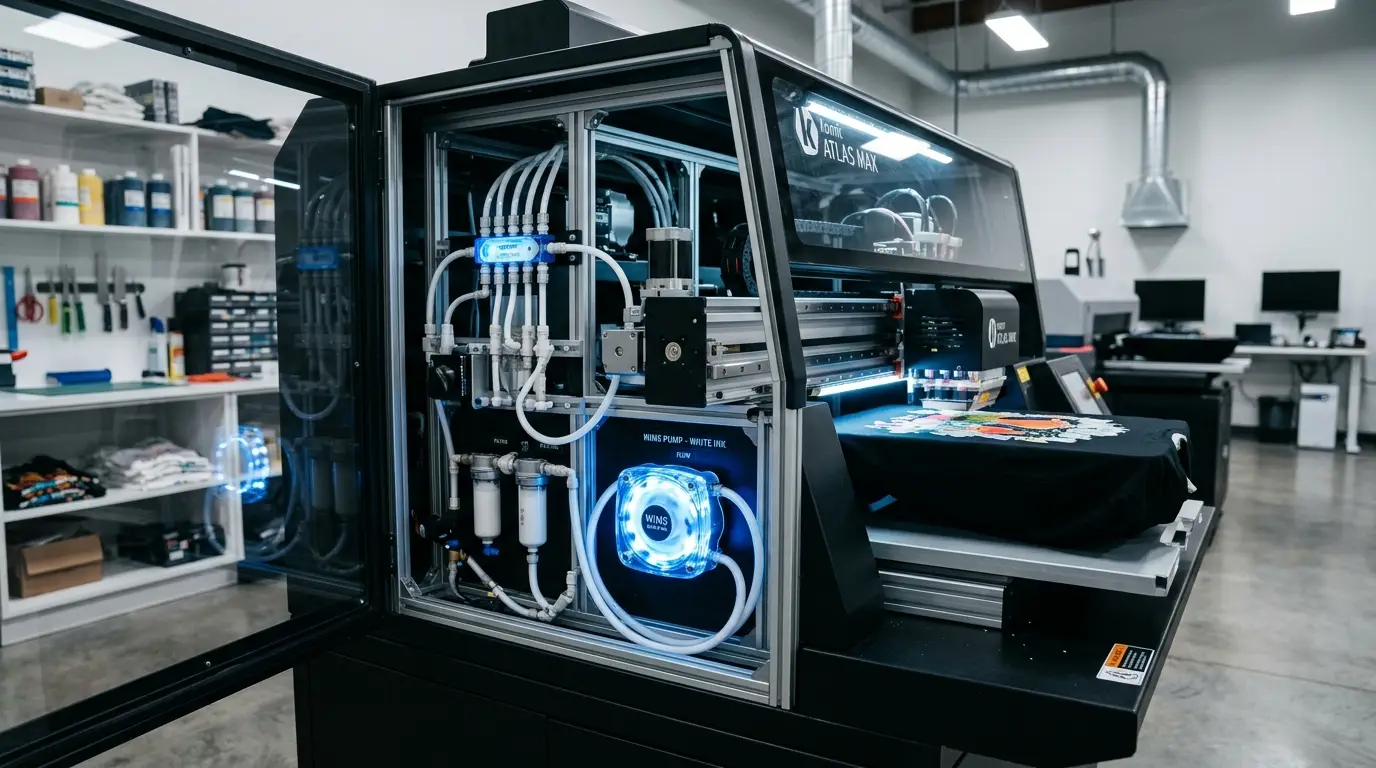
What is WIMS? Mechanical Anatomy and Working Principles
WIMS (White Ink Management System) is an automated electromechanical sub-system engineered to combat gravity-driven pigment sedimentation in direct-to-garment printing machines. Unlike standard CMYK color inks that use dissolved dyes or ultra-fine organic pigment molecules (which remain permanently suspended in liquid carrier solutions), white DTG ink is a heavy mineral slurry.
Titanium dioxide has a specific gravity of approximately 4.2 g/cm³, making it over four times denser than the water and glycol carrier fluids (approx. 1.0 g/cm³) in which it is dispersed. If left static, gravity inevitably pulls these dense TiO₂ particles downward, causing them to fall out of suspension within 4 to 8 hours.
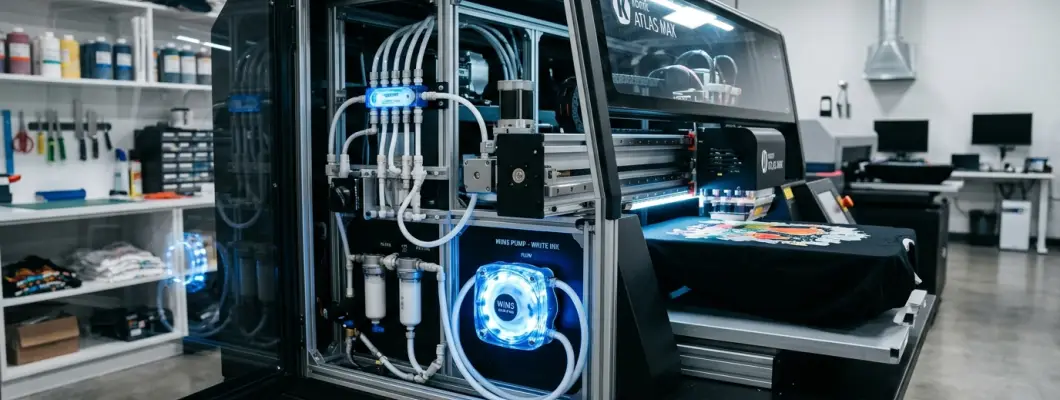
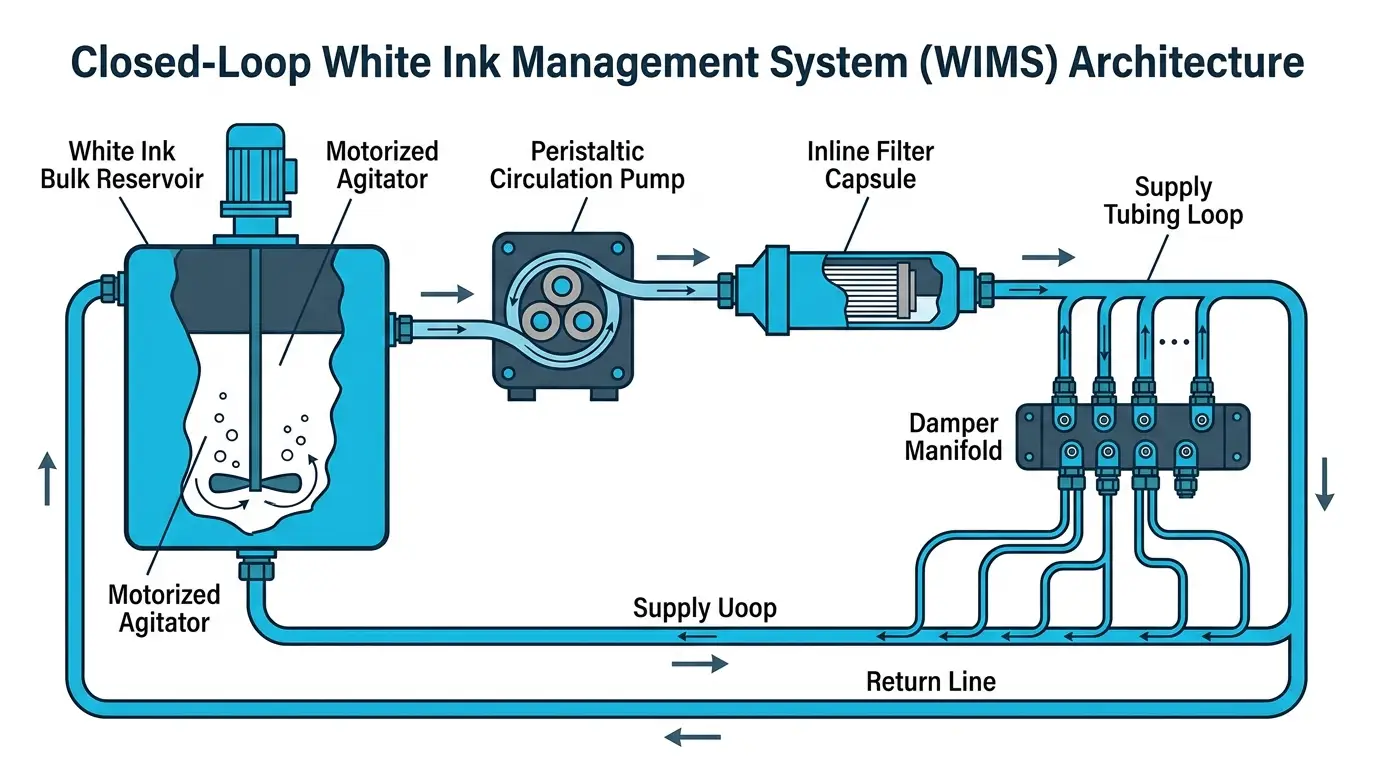
A true professional WIMS architecture prevents this sedimentation through continuous or timer-driven fluid motion across five integrated mechanical stages:
1. Motorized Bulk Reservoir Agitator
A low-RPM motorized stirring paddle or magnetic induction impeller continuously gently mixes the white ink inside the main bulk bottle, preventing hard sedimentation from packing onto the container bottom.
2. Low-Shear Peristaltic Pump
Instead of high-friction impeller pumps that generate heat and shear forces (which destabilize polymer dispersants), WIMS utilizes a multi-roller peristaltic pump to gently squeeze ink through flexible silicone tubing without shearing delicate latex binders.
3. Inline Sub-Micron Filter Capsule
Before ink enters the carriage drag chain, it passes through a 5-micron to 10-micron disc filter to trap any microscopic pigment agglomerates or agglomerated polymer clusters before they can reach the printhead dampers.
4. Dual-Line Closed Loop with Damper Manifold
Ink travels down an outgoing supply line to the printhead carriage damper manifold, sweeps past the damper intake ports, and routes immediately back through a secondary return tube into the bulk reservoir, maintaining continuous kinetic velocity.
Architectural Blueprint: The Closed-Loop WIMS Circulation Cycle
To understand how fluid circulation operates without dripping ink onto the garment platen, examine the engineering schematic below. Notice how the circulation pathway forms a complete hermetic circuit between the bulk tank, pump, filter, and carriage damper block:
The Honest Engineering Truth: Does WIMS Eliminate Clogs?
Here is the direct, unvarnished answer from printhead engineers: No, WIMS does NOT completely eliminate printhead clogs on its own.
What WIMS does do is solve internal ink line and damper sedimentation. In non-WIMS printers, heavy TiO₂ settles inside horizontal tubing runs, forming thick sludge that chokes dampers and causes ink starvation mid-print. WIMS reduces this internal line sedimentation by approximately 85% to 90%.
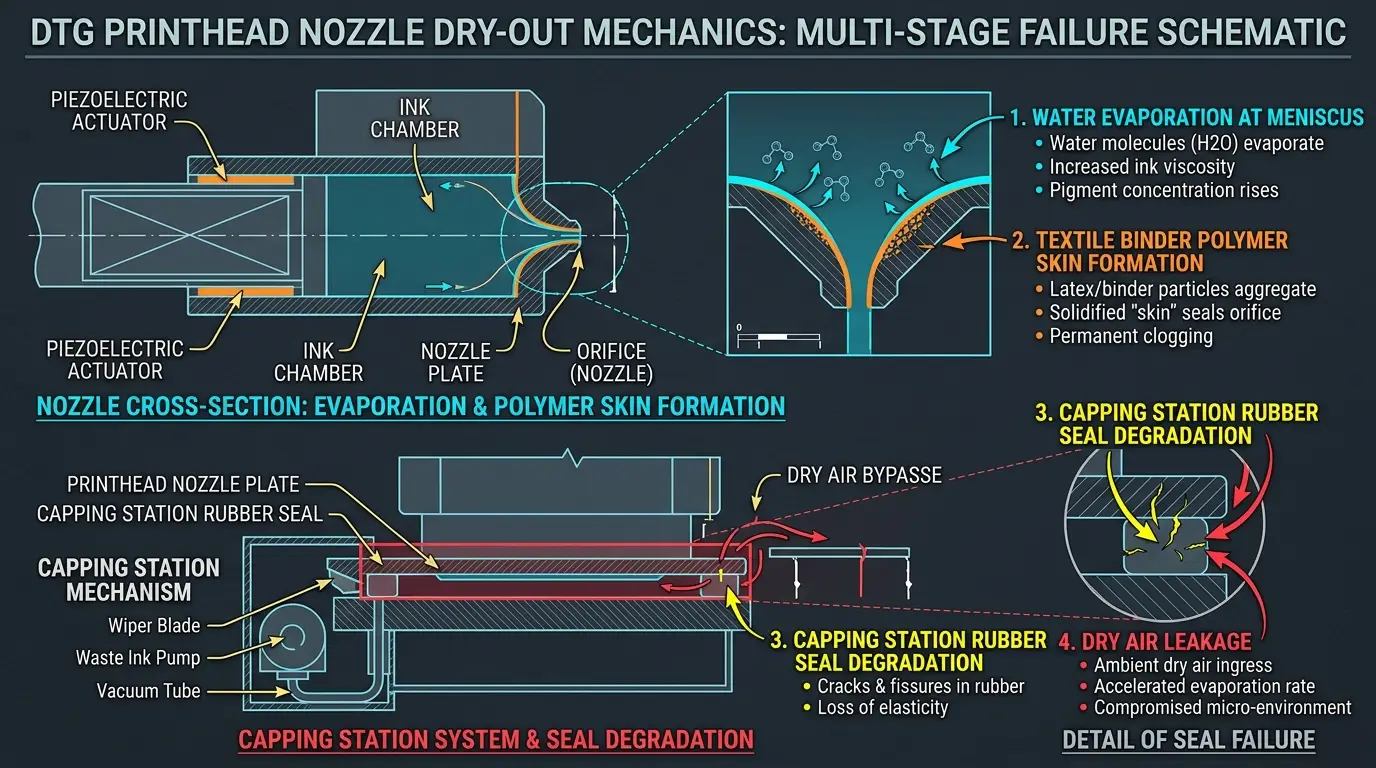
However, WIMS cannot protect the most vulnerable microscopic point of failure in the entire machine: the exterior nozzle plate face.
The Physical Limitation of Standard WIMS
In conventional desktop and commercial DTG printers (such as those using Epson MicroPiezo i3200, XP600, or DX5 heads), WIMS circulation stops at the damper manifold. The ink inside the damper circulates, but the ink sitting inside the actual microscopic 20-micron nozzle channels (fractions of a millimeter from the open air) remains static.
If your print shop air is dry (relative humidity below 40%), or if dried ink crust on the capping station rubber seal allows air to leak into the cap overnight, the water and humectants at the nozzle orifice evaporate rapidly. Within hours, the reactive acrylic latex binder polymerizes into an elastomeric skin, locking the titanium dioxide particles into an impenetrable solid plug right at the nozzle tip.
The Meniscus Dehydration Mechanism: Why Capping Still Matters
The illustration below demonstrates why a printer with a 100% functional WIMS system can still suffer catastrophic nozzle dropouts if capping maintenance is neglected:
The Three Tiers of White Ink Circulation in Modern Textile Printing
Not all "white ink circulation" systems marketed by equipment vendors are created equal. In the current garment printing machinery market, there are three distinct technological tiers:
Tier 1: Basic Bottle Stirring / Agitation Only
Entry LevelFound on low-cost DIY converted printers. A small electric motor rotates a magnet or stir bar inside the white ink tank. Limitation: While the bottle stays mixed, ink sitting in the 1.5-meter delivery tubes and dampers remains completely stagnant and settles rapidly.
Tier 2: Closed-Loop Line & Damper WIMS
Commercial Standard (GNFEI F85G3)Combines bottle stirring with an active peristaltic pump and return line running all the way through the cable carrier to the carriage damper manifold. Ink continuously recirculates from bottle to carriage and back. Result: Zero tubing sedimentation, uniform white opacity, and dramatically longer damper life.
Tier 3: Through-the-Nozzle Recirculating Printheads
High-End IndustrialFound on premium industrial print engines (such as Kyocera KJ4B, Ricoh Gen5/Gen6, or specialized Seiko/Fujifilm Dimatix heads). Ink recirculates continuously across the rear channel of every individual piezo firing chamber. Result: Micro-bubbles and sediment are swept away continuously directly behind the nozzle opening, delivering maximum uptime.
Head-to-Head Comparison: Non-WIMS vs. Closed-Loop WIMS vs. Through-the-Nozzle
Here is how the three operational architectures compare across real-world workshop reliability and maintenance metrics:
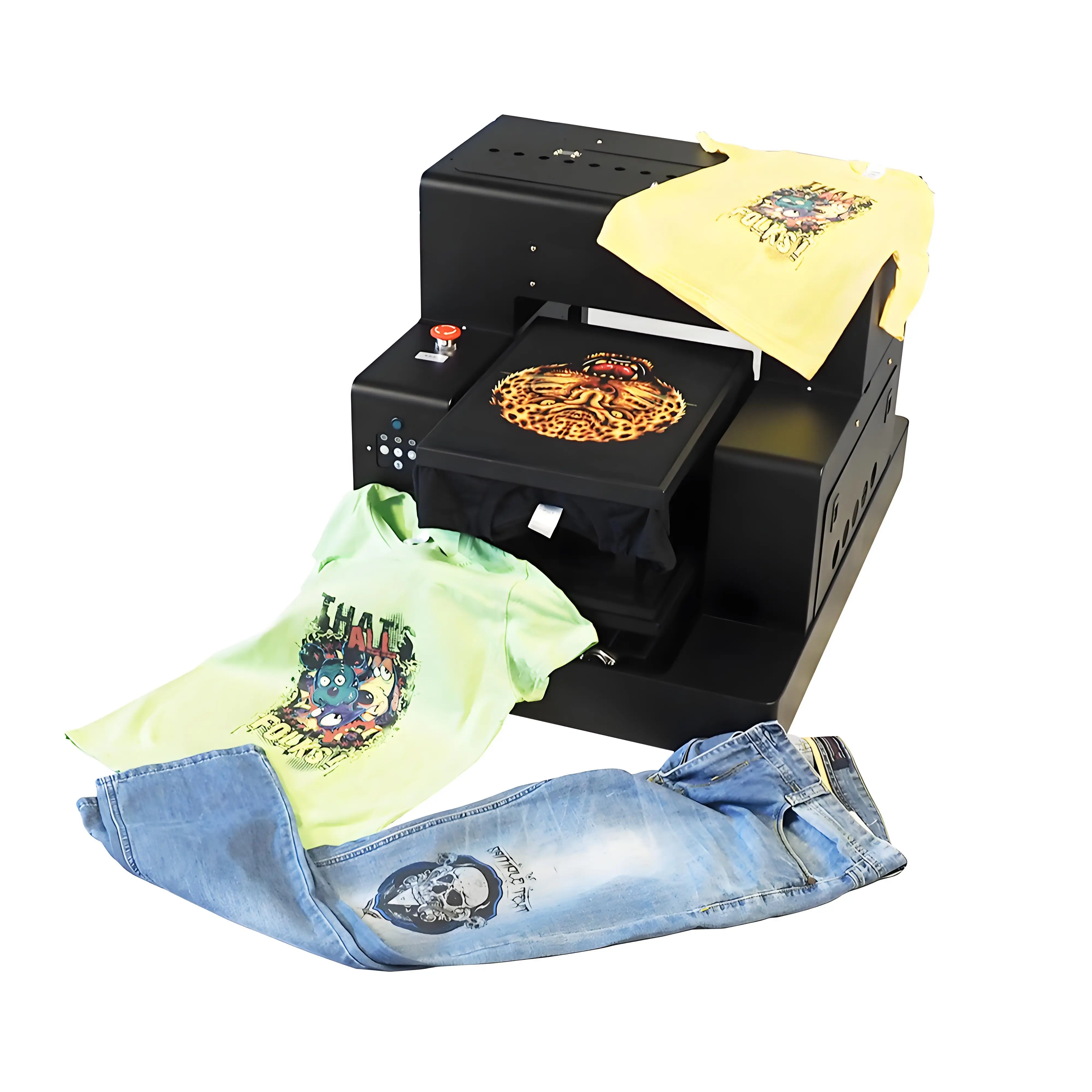
GNFEI F85G3 A3 DTG T-Shirt Printer
Engineered with a true Dual-Line Closed Loop WIMS Circulation System, active magnetic reservoir stirring, sub-micron inline filter capsules, and timer-driven standby recirculation. Dramatically minimizes morning ink purging, prevents titanium dioxide sedimentation, and produces brilliant, high-opacity white underbases on black cotton apparel.
The Complete Anti-Clog Triad: How to Achieve 100% Clog-Free DTG Production
If WIMS alone cannot guarantee zero nozzle clogs, what is the complete formula? Professional apparel decorators rely on the Three Pillars of DTG Reliability:
Pillar 1: Active Fluid Motion (WIMS)
Maintain continuous or timer-driven closed-loop circulation through supply lines and dampers 24/7. Keep the machine in standby mode overnight so WIMS timer cycles run autonomously every few hours.
Pillar 2: Hermetic Moisture Seal (Wet Capping)
Never park the printhead on a bone-dry capping station sponge. Every evening, clean the rubber gasket seal and deposit 0.5 to 1.0 mL of humectant moisturizing solution into the capping station sponge to lock in 100% relative humidity beneath the nozzle plate.
Pillar 3: Workshop Climate Control (Humidity & Temp)
Keep your production environment strictly between 20°C and 26°C (68°F - 78°F) and relative humidity between 45% and 65%. If humidity drops below 40%, water evaporates from the nozzle plate faster than any cleaning cycle can compensate.
Frequently Asked Questions: White Ink Circulation (WIMS) & Clogs
Q1. What is WIMS on a DTG printer?
WIMS stands for White Ink Management System. It is an active electromechanical circulation loop comprising motorized reservoir agitators, low-shear peristaltic pumps, inline filtration discs, and dual supply-and-return tubing. Its primary purpose is to keep heavy titanium dioxide pigment particles continuously suspended in liquid solution to prevent settling.
Q2. Does WIMS completely eliminate printhead nozzle clogs?
No. While WIMS drastically reduces ink sedimentation inside the bulk bottles, supply lines, and dampers by 85% to 90%, it cannot prevent ink from drying on the exterior nozzle plate. Water evaporation at the nozzle meniscus, dry capping station seals, and airborne lint accumulation can still cause nozzle clogs if daily maintenance is neglected.
Q3. How often should white ink circulate through a WIMS system?
Commercial DTG printers typically run white ink circulation cycles for 45 to 90 seconds every 2 to 4 hours while in standby mode, and continuously or at high frequency during active print queues. Automated firmware timers ensure circulation executes even during nocturnal shop shutdowns.
Q4. What is the difference between ink stirring and true WIMS circulation?
Ink stirring only agitates the white ink sitting inside the bulk bottle or cartridge using an electric paddle or magnetic stir bar. True WIMS circulation includes both bottle stirring and an active peristaltic pump loop that continuously moves ink through the entire delivery tubing right up to the carriage dampers and returns it to the tank.
Q5. Does white ink circulation waste ink during operation?
Standard closed-loop WIMS circulation does not waste any ink because it moves ink in a sealed continuous loop back into the supply bottle without purging through the printhead nozzles. Ink is only consumed when the printer performs an automated micro-spit or vacuum cleaning cycle into the waste bottle.
Q6. Do I still need to shake white ink bottles if my DTG printer has WIMS?
Yes. Even with active WIMS circulation, you should gently invert and rock your white ink bulk bottles or cartridges for 30 to 45 seconds at the start of every production day. Physical rocking dislodges any micro-sediments clinging to container corners that circulation currents might miss.
Q7. What happens if a WIMS peristaltic circulation pump fails?
If the circulation pump or timer relay fails, white ink stops moving through the delivery tubing. Heavy titanium dioxide particles settle along horizontal tube walls within 12 to 24 hours, leading to ink starvation, transparent underbases, and severe damper choking when the carriage attempts to print.
Q8. What is through-the-nozzle recirculating printhead technology?
Through-the-nozzle recirculation is an advanced printhead architecture where ink continuously flows directly behind the microscopic nozzle orifices across the piezo firing chambers. This prevents sedimentation right at the meniscus, virtually eliminating nozzle drying even during machine idling.
Q9. How often should WIMS inline filters and tubing be replaced?
WIMS inline disc filters should be replaced every 3 to 6 months to prevent trapped titanium dioxide agglomerates from restricting fluid flow. Peristaltic pump silicone tubing should be inspected every 6 months and replaced annually to avoid tube fatigue or pinhole leaks.
Q10. Why is wet capping still mandatory on a WIMS-equipped DTG printer?
Wet capping protects the 20-micron nozzle openings from atmospheric dehydration. While WIMS protects the internal fluid lines, it does not seal the outside of the printhead. Saturating the capping sponge with moisturizing solution creates a 100% relative humidity barrier that stops surface meniscus skinning.