Is a DTG Printer Just a Modified Desktop Paper Printer?
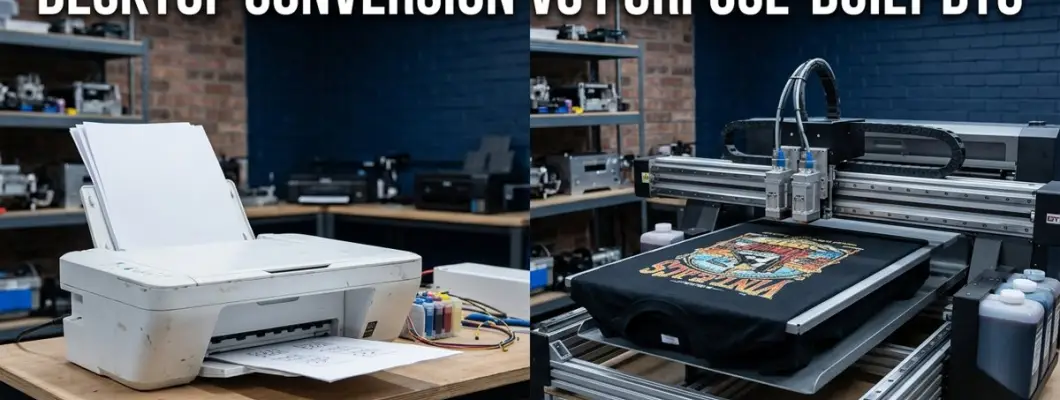
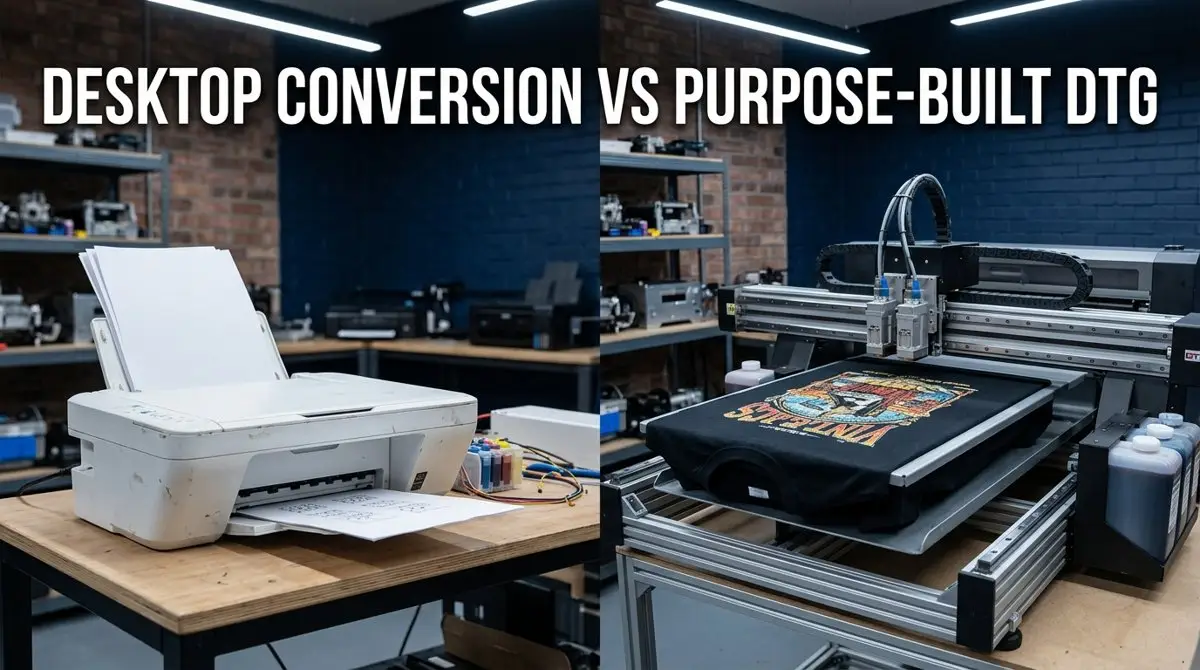
The short answer is: in the early days, yes — but today, absolutely not. In the early 2000s, the very first DIY direct-to-garment printers were indeed built by hobbyists who took apart cheap desktop paper printers (like the Epson Stylus Photo R1800, R2000, or L1800), cut away the bottom plastic chassis, and mounted a manual moving wooden platen underneath to pass T-shirts through.
However, attempting to run a modern garment decoration business on a converted paper printer is a recipe for daily downtime, ruined shirts, and blown printheads. Modern purpose-built DTG printers are industrial flatbed machines designed specifically to handle high-density textile inks, heavy fabric platens, and continuous production runs.
The Origin: How DIY Converted Paper Printers Started
To understand where the myth came from, look at the history of digital apparel printing. When Epson developed piezoelectric MicroPiezo printhead technology, decorators quickly realized that piezo crystals could jet water-based textile inks without boiling or damaging the pigments (unlike thermal inkjet heads from Canon or HP). Makers began removing the paper feed mechanisms from desktop printers and rigging timing belts to move a platen. While this proved the concept, these desktop conversions suffered from fatal structural flaws.
10 Critical Differences: Converted Paper Printer vs. Purpose-Built DTG
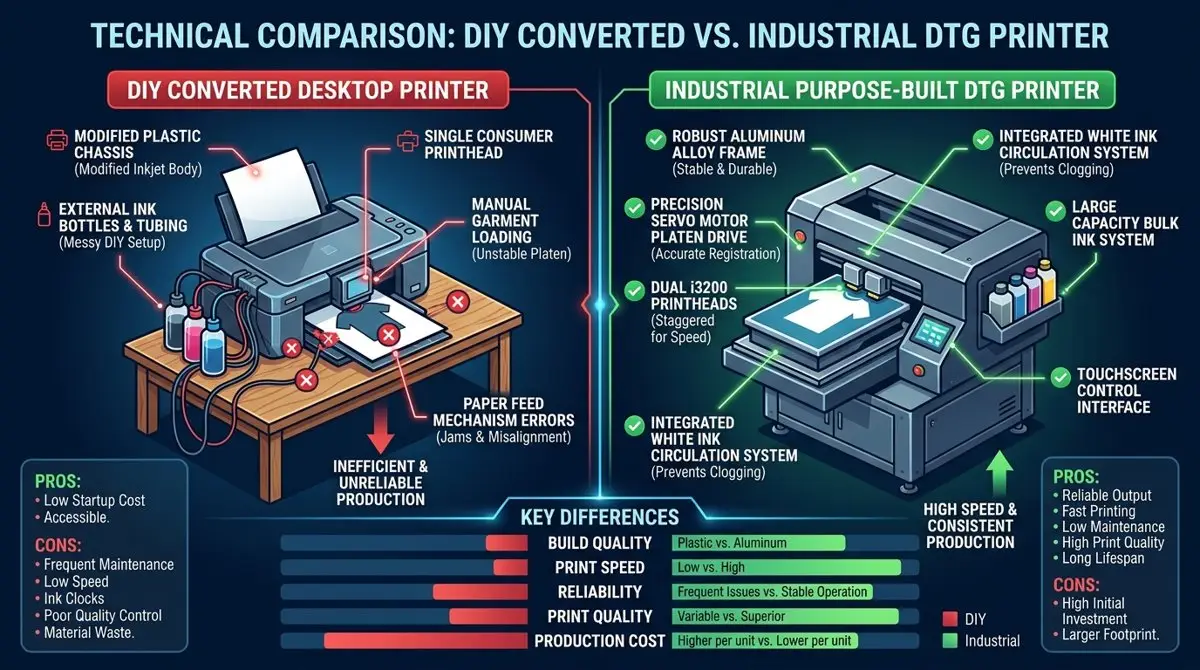
The engineering difference between a converted paper printer and an industrial DTG machine is night and day. Here are the 10 structural and mechanical differences that dictate real-world reliability:
1. Chassis Rigidity & Frame Material
Desktop printers use thin, flexible injection-molded ABS plastic that flexes under vibrations. Industrial DTG machines use heavy aircraft-grade aluminum alloy and CNC steel chassis, eliminating micro-vibrations and maintaining 0.02 mm print accuracy.
2. Printhead Technology & Droplet Volume
Desktop conversions use consumer heads (e.g. DX5 or XP600) designed for dye paper ink with narrow nozzle channels. Industrial DTG uses dual Epson i3200-A1 heads featuring 3,200 nozzles, firing up to 43.2 kHz frequency with high-viscosity textile pigment tolerance.
3. Platen Drive System: Friction vs. Ball Screw
Paper printers use small rubber pinch rollers designed for 80 gsm paper. Forcing them to pull a 500-gram platen and heavy wet cotton sweatshirt causes constant stepping motor skipped steps. Industrial DTG uses precision lead ball-screws driven by digital servo motors.
4. White Ink Management System (WIMS)
Standard paper printers have zero circulation. Dense titanium dioxide (TiO2) particles settle in damper cavities and lines within 2 hours, permanently clogging heads. Industrial DTG features continuous timer-controlled white ink circulation and peristaltic agitators.
5. Tubing & Damper Material Resistance
Desktop paper printers use cheap PVC tubes that harden, oxidize, and leach plasticizers into textile inks. Industrial DTG utilizes Teflon (PTFE) and solvent-resistant fluoro-elastomer lines that never degrade or contaminate pigment chemistries.
6. Height Adjustment & Laser Anti-Collision Sensors
Desktop conversions rely on manual thumb-screws or guesswork to set platen height, causing frequent head strikes against fabric folds. Industrial DTG integrates optical infrared/laser height detection with automatic auto-stop safety collision gates.
7. Capping Station & Vacuum Pump Mechanism
Consumer capping stations use small plastic peristaltic pumps incapable of drawing thick textile ink. Industrial DTG employs heavy-duty diaphragms, solvent-resistant silicone capping seals, and automated wet-capping sleep modes.
8. Mainboard Firmware & Motor Driver Power
Desktop mainboards easily overheat and burn motor driver chips when pushing heavy platens. Industrial DTG utilizes dedicated industrial motion control boards with closed-loop optical encoders and independent 24V/48V power supplies.
9. RIP Software Integration & Color Control
Converted desktop printers rely on pirated or patched generic RIP drivers that struggle with white underbase density. Industrial DTG comes with professional OEM RIP software calibrated specifically for ICC color profiles and precise droplet control.
10. Daily Production Speed & Longevity
A converted desktop printer takes 6–10 minutes to print a dark shirt and typically fails within 3–6 months. An industrial DTG with dual i3200 heads prints a dark shirt in 60–90 seconds and lasts 5–10 years under daily operation.
Architecture Comparison Diagram
Comparison Summary: Converted Desktop vs. Industrial DTG
| Feature / Specification | Converted Desktop (e.g. L1800 / R2000) | Industrial Purpose-Built (GNFEI F85G3) |
|---|---|---|
| Base Construction | Plastic desktop chassis on DIY frame | Full CNC aluminum alloy & steel gantry |
| Printhead Setup | Single modified consumer head (XP600/DX5) | Dual Epson i3200 industrial printheads |
| Drive Mechanism | Friction belt / repurposed paper stepper | Precision lead ball screw + servo motor |
| White Ink System | Static gravity feed (constant settling) | Active WIMS circulation & peristaltic pump |
| Dark Shirt Print Speed | 6 to 10 minutes per shirt | 60 to 90 seconds per shirt |
| Height Sensor | Manual visual check (head strike risk) | Infrared laser auto-height anti-collision |
| Max Print Area | A3 (approx. 28×40 cm) | Industrial (40×60 cm oversized platen) |
| Daily Output Capacity | 5–15 shirts / day before overheating | 100–300+ shirts / day continuous duty |
| Expected Machine Lifespan | 3 to 6 months of inconsistent use | 5 to 10 years with standard maintenance |
Why Buying a Cheap Converted DTG Printer Usually Ends in Regret
Many newcomers are tempted by converted desktop DTG printers on marketplace sites selling for \$1,500–\$3,000. While the low price is attractive, over 90% of buyers abandon these units within 90 days due to:
- Continuous Nozzle Dropout: Without white ink circulation, you spend more time cleaning nozzles and wasting ink than printing salable garments.
- Ghosting & Misalignment: Weak stepper motors lose tracking steps midway through printing, misaligning the CMYK colors over the white underbase.
- Frequent Head Strikes: The absence of automated laser height sensors means thick garment seams will hit the delicate printhead surface, delaminating nozzle plates.
GNFEI F85G3 — Purpose-Built Industrial DTG Printer
Dual Epson i3200 Printheads | Full CNC Aluminum Frame | Active WIMS System
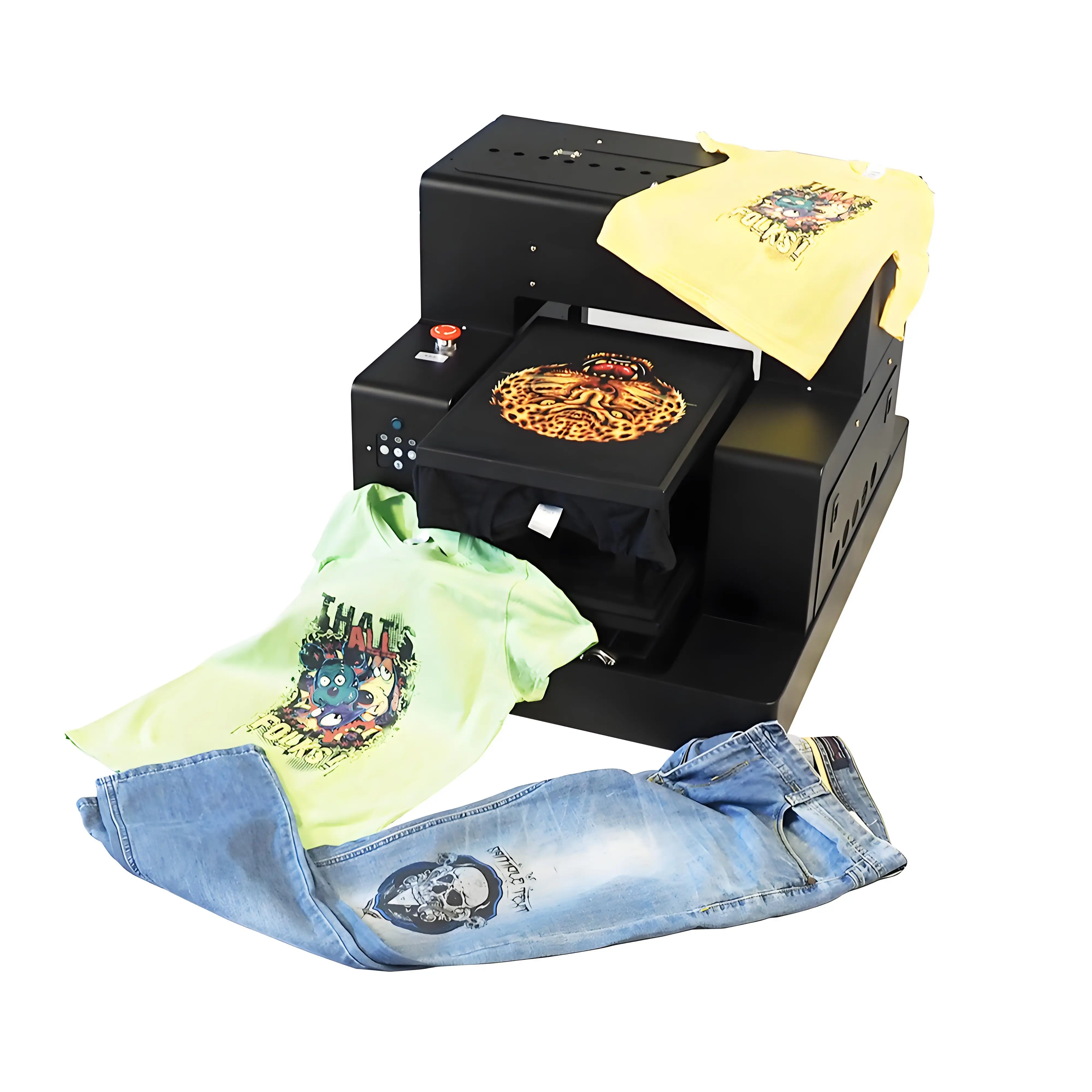
- ✓Dual Epson i3200 Printheads — Dedicated white & CMYK heads for single-pass high-speed printing
- ✓Integrated WIMS Circulation — Automated timed circulation eliminates white ink settling
- ✓Servo Ball Screw Platen Drive — Zero backlash, flawless registration on heavy garments
- ✓40×60 cm Industrial Platen — Oversized prints on hoodies, jackets, and XXL tees
- ✓Laser Auto-Height Sensor — Protects expensive printheads from fabric collisions
Frequently Asked Questions: DTG Printer Engineering
Upgrade from DIY Frustration to Industrial Reliability
Discover the GNFEI F85G3 purpose-built industrial DTG printer with dual Epson i3200 heads, active WIMS white ink circulation, and factory-direct pricing.