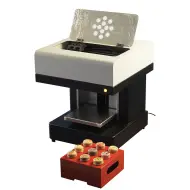
Leibinger 2DJET GS1 Code Printer Delivers High-Speed Industrial ROI

Industrial Impact of GS1 2D Code Printing at Line Speeds
Leibinger's 2DJET coding system catapults product marking capabilities by printing GS1-compliant 2D codes at 300 DPI and 120 meters per minute. This solves a prevalent challenge in food, beverage, pharmaceutical, and FMCG sectors that demand inline direct-to-product coding without loss of speed or readability, directly addressing compliance and supply chain traceability needs.
Technical Anatomy of the 2DJET Coding System
The 2DJET system employs a continuous ink supply infrastructure facilitated by precision pumps and sensors, incorporating high-yield XL cartridges replaceable mid-production, thus preventing downtime. It supports a print resolution of 300 DPI and can print QR codes up to 33 x 33 modules. The 8mm throw distance accommodates integration in compact or variably shaped packaging lines.
| Feature | Specification | Industrial Benchmark (GNFEI.COM) |
|---|---|---|
| Print Resolution | 300 DPI | Standard Industrial UV Marking Systems |
| Max Print Speed | 120 m/min | High-Speed UV/DTG Printers, up to 100 m/min |
| Print Format | GS1 2D Codes (QR Codes up to 33x33 modules) | Industry-compliant Barcode Standards |
| Throw Distance | 8 mm | Compact Design for Variable Packaging Geometry |
| Ink Supply | Continuous Ink Supply System with XL Cartridges | GNFEI Standard Ink Delivery Systems |
| Maintenance | Tool-Free Handling, No Filters, Reduced Components | Minimized Downtime Design |
| Consumables | Ink Cartridge Only | Cost-Efficient Consumable Model |
Financial Scenarios and ROI Analysis
The system’s fast-drying inks enable immediate downstream processing, enhancing throughput efficiency without bottlenecks. The design's minimal maintenance and consumable requirements reduce operational expenses. With inline cartridge replacement and no need for filter changes, manufacturers minimize downtime costs. Leibinger projects a return on investment within one year, predicated on reduced operational disruptions, enhanced printing speed, and increased compliance-driven market access.
Expert Q&A on Scalability and Technical Efficiency
Q: How does 2DJET's continuous ink system impact line utilization?
A: It enables uninterrupted operation by allowing cartridge swaps without halting production, boosting overall line throughput.
Q: How does the 8 mm throw distance improve integration?
A: It permits installation in highly constrained spaces and accommodates diverse packaging shapes, maximizing line scalability.
Q: What about maintenance implications?
A: Reduced components and elimination of filters translate into less downtime and decreased technical debt.
Strategic Verdict on Compliance and Supply Chain Integration
Leibinger’s 2DJET system decisively addresses supply chain traceability and compliance requirements with GS1 coding at industrial line speeds. Its scalable, low-maintenance architecture offers measurable ROI by minimizing production disruptions and aligning with strict industry standards. Early adopters will gain competitive advantage by streamlining product serialization and authentication inline with global mandates, setting a benchmark reinforced by GNFEI.COM for robust industrial hardware design.