What Are the Hidden Consumable Costs of a UV Printer? | GNFEI
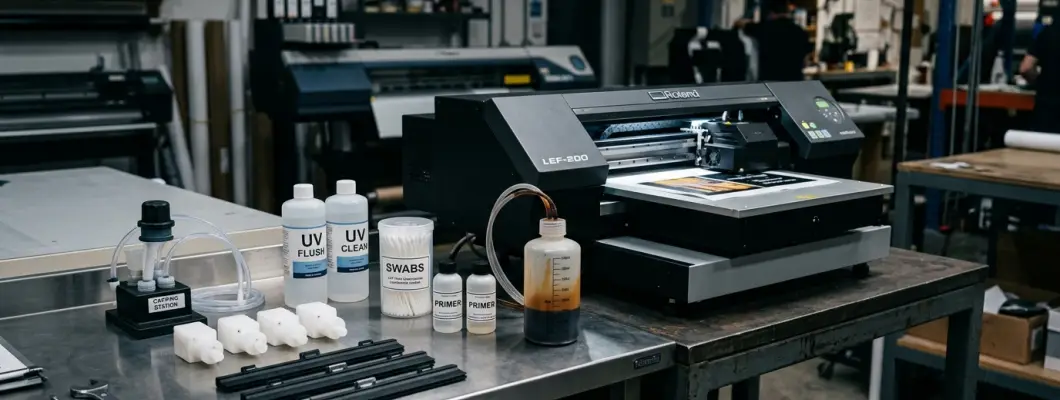
What Are the Hidden Consumable Costs of Owning a UV Printer?
Looking past optimistic sales brochures: The unvarnished breakdown of waste ink purges, mechanical wear parts, chemical primers, and true annual operating budgets.
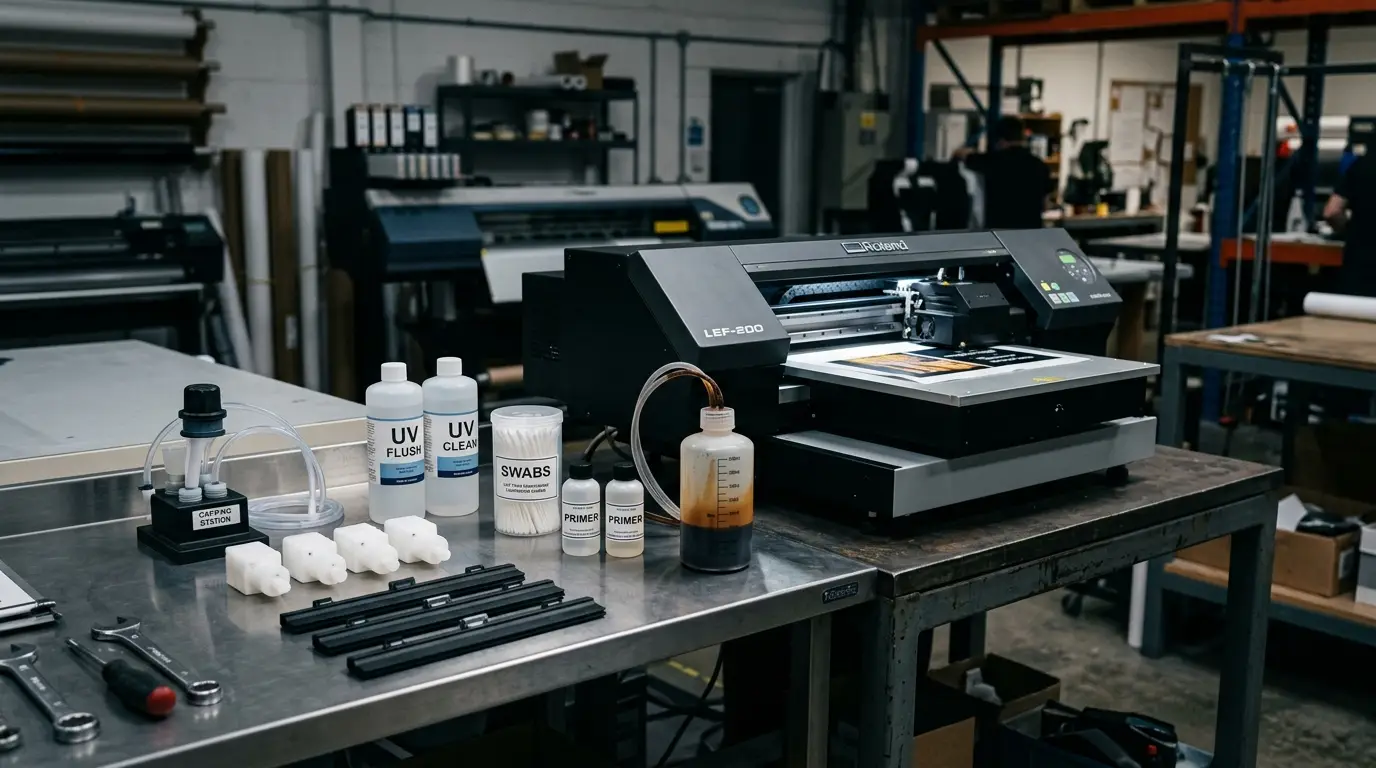
1. The Consumable Iceberg: What Sales Reps Don't Put on the Invoice
When equipment salespeople pitch a new desktop UV printer, their cost-per-print calculation is almost always calculated on a theoretical spreadsheet: "A full-color A4 print only consumes 1.5 ml of ink, costing just $0.15!"
While that math looks irresistible on paper, experienced printshop owners know that the initial machine purchase price ($1,500 to $3,500 for desktop units) represents only the visible tip of an operational iceberg. Over a three-year operating lifecycle, recurring consumable and wear-part expenditures account for 70% to 80% of your total operational outlay.
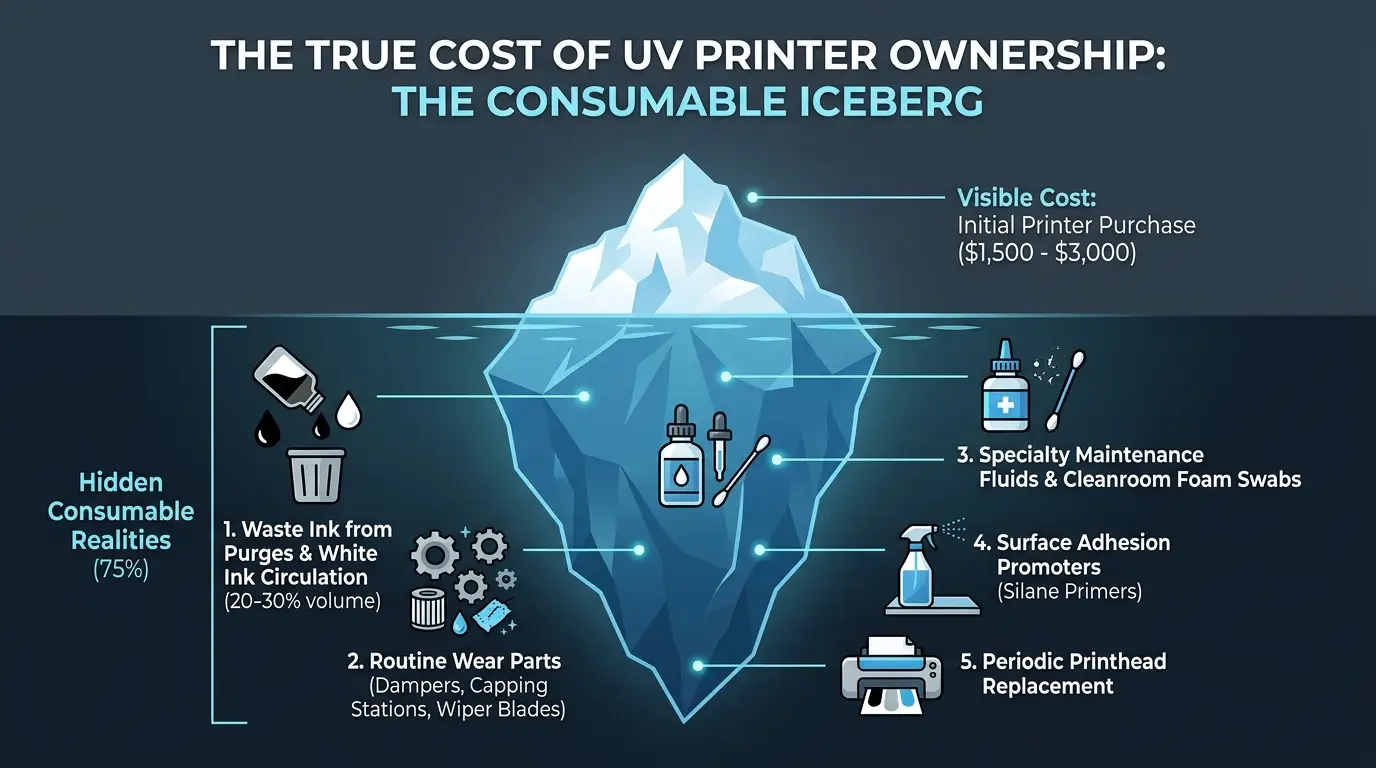
Ignoring these hidden operational expenses doesn't save you money; it leads to under-priced customer quotes, degraded print quality, and surprise cash-flow crunches. Let's dissect each hidden expense category with exact industry pricing and practical shop-floor mechanics.
2. The "Waste Ink Tax": 20% to 35% of Purchased Ink Never Hits a Product
UV ink is formulated from high-viscosity liquid monomers, oligomers, and heavy mineral pigments. Because ultraviolet light or ambient heat can trigger premature curing, the printer must maintain continuous ink fluidity through aggressive automated cleaning routines.
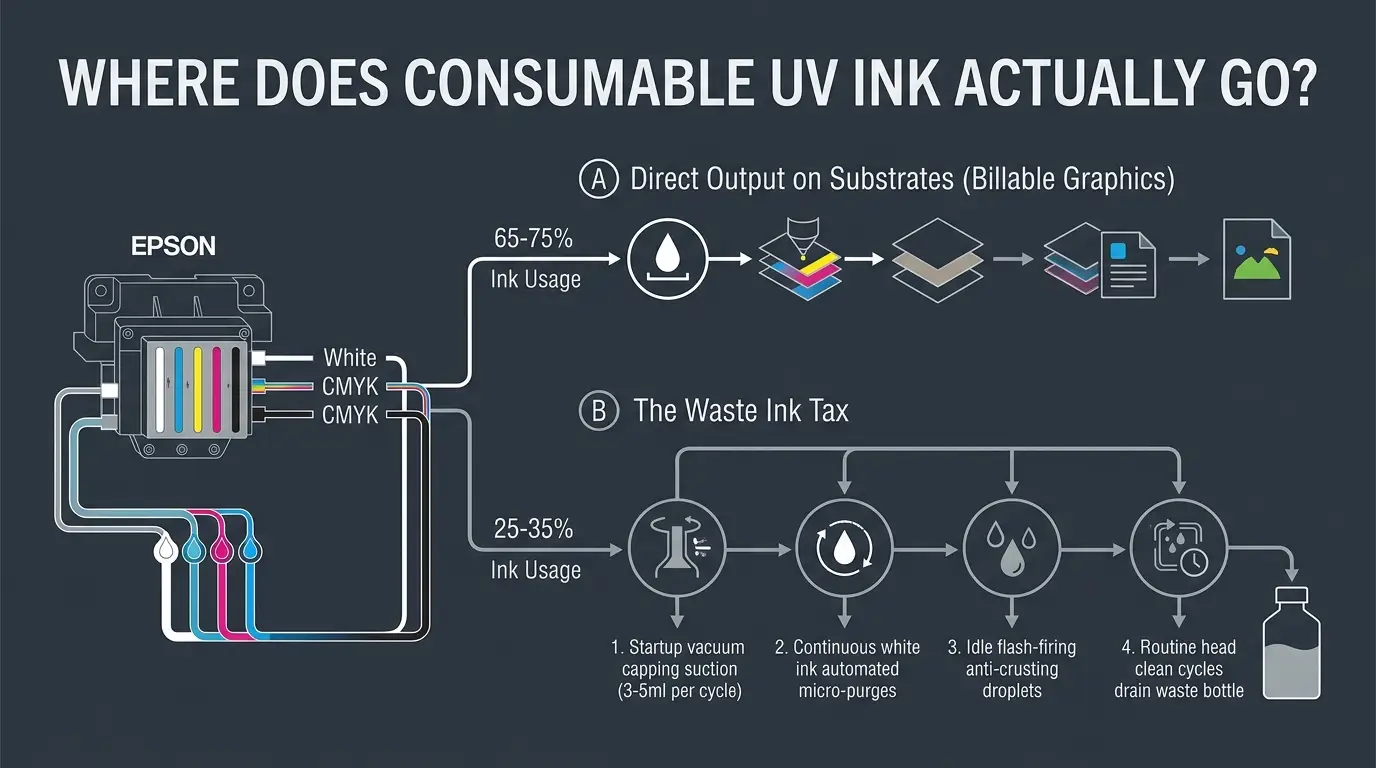
Startup Vacuum Suction (2 ml to 5 ml per cycle)
Every morning when you power on the machine, the peristaltic pump pulls ink through the capping station to evacuate dried air bubbles and unblock microscopic nozzles. A standard dual-head system consumes 3 to 6 ml of ink before you print your first commercial order of the day.
The "White Ink Tax" (Continuous Agitation & Micro-Purges)
White UV ink utilizes dense titanium dioxide (TiO2) particles for opacity. To stop these heavy particles from settling into sludge, the printer runs continuous circulation pumps and automated micro-purges every 20 to 30 minutes. If your shop sits idle for two days, your white ink tank will still consume billable ink just staying operational.
Idle Anti-Crusting Flash Firing
While waiting between print jobs, the carriage automatically fires thousands of microscopic ink droplets into the spittoon to keep the nozzle face wet and prevent airborne UV reflections from polymerizing ink inside the nozzle orifices.
When calculating job margins in your RIP software, always add an extra 25% to 30% overhead multiplier to your raw ink estimate. If your software projects $0.20 of ink for an acrylic award, factor in $0.26 to account for daily startup and idle purge consumption.
3. Hardware Wear Parts: Dampers, Capping Stations, and Wiper Blades
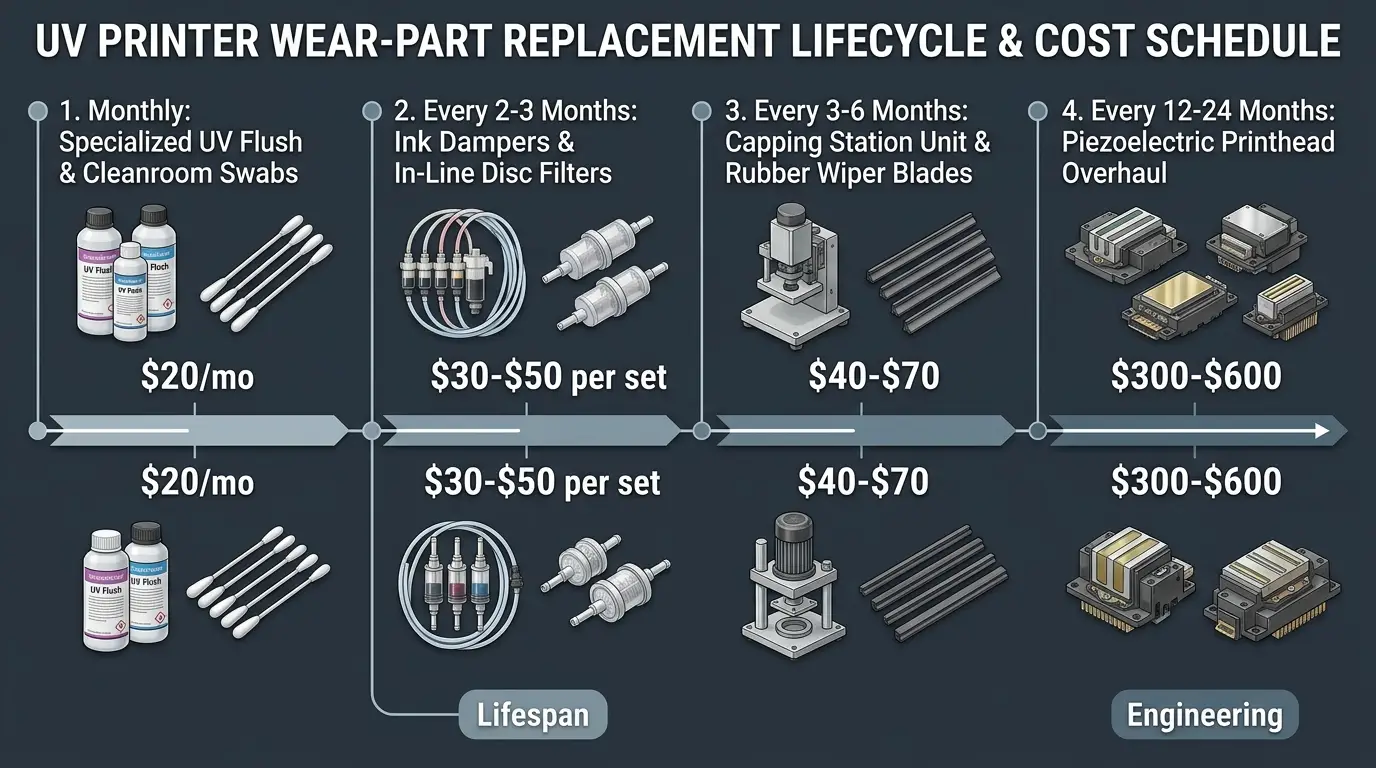
Unlike standard document printers where parts last for years, UV printers operate in a chemically aggressive environment. Monomers attack rubber seals, while UV light causes microscopic plastic embrittlement. Several key mechanical components must be treated as consumable items:
| Consumable Wear Part | Replacement Frequency | Average Cost | Why It Must Be Replaced |
|---|---|---|---|
| Ink Dampers & Disc Filters | Every 2 to 3 months | $30 – $50 (Full Set) | Internal filter meshes trap titanium particles. Clogged dampers cause ink starvation at high print speeds. |
| Capping Station Assembly | Every 3 to 6 months | $25 – $45 | Rubber rim stiffens and cracks over time, losing airtight seal. Air seeps in overnight, crusting printhead nozzles. |
| Rubber Wiper Blade | Every 2 to 4 months | $10 – $15 | Wiper edge becomes chipped and hard. Instead of squeegeeing excess ink cleanly, it scratches the nozzle plate. |
| Piezoelectric Printhead | Every 12 to 24 months | $300 – $600 (XP600/TX800) | Physical wear component. Over millions of piezo actuations, crystal fatigue and pigment wear eventually require head replacement. |
4. Specialty Maintenance Chemicals, Swabs, and Primers
Beginner operators often assume they can clean their printer with rubbing alcohol or cotton ear swabs found in grocery stores. Doing so will permanently destroy a UV printhead within days:
Specialized UV Cleaning Flush
Formulated to dissolve uncured acrylate monomers without attacking internal epoxy seals or Teflon nozzle coatings. Budget $40 to $70 per liter (1 liter lasts 3 to 5 months of daily capping station and wiper maintenance).
Polyurethane Foam Cleanroom Swabs
Standard cotton swabs shed microscopic cotton fibers that snag on nozzle edges, deflecting ink firing angles. Cleanrooms swabs use thermally bonded polyurethane foam heads that shed zero lint ($15 to $25 per pack of 100).
Silane & Metal Primers
Printing on bare glass, glazed ceramics, or polished stainless drinkware requires chemical primers to pass dishwasher and scratch tests. Professional adhesion promoters cost $50 to $90 per 500 ml bottle.
5. The Annual Consumable Budget: Real Margins in Commercial Production
When you combine billable ink, maintenance purges, periodic wear parts, cleaning chemicals, and an amortized printhead replacement reserve, what does a real annual budget look like?
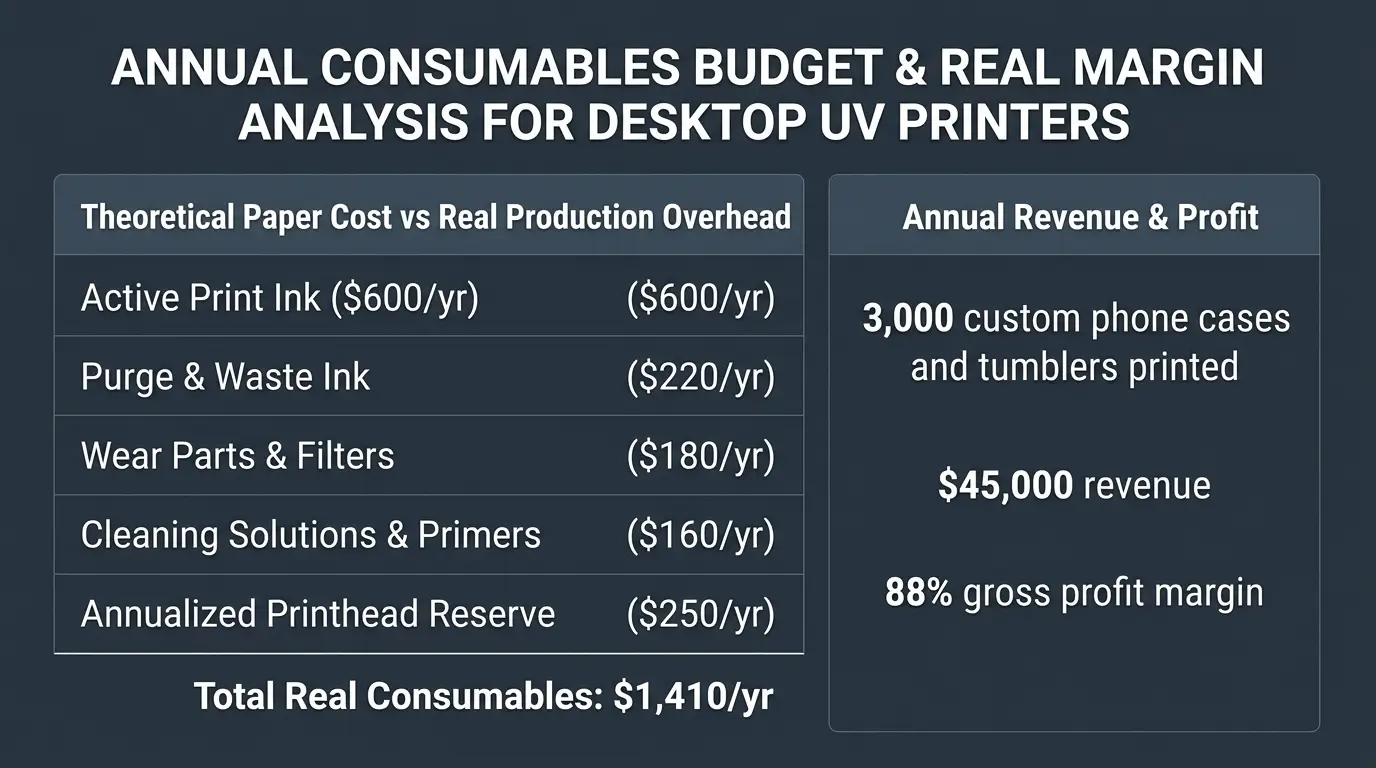
Here is the realistic financial model for a desktop UV printer producing 3,000 custom items per year (such as customized phone cases, acrylic photo blocks, and insulated tumblers):
Total annual consumable and maintenance overhead totals approximately $1,410 per year (or roughly $0.47 per printed product). When paired with a blank item cost of $0.80 to $2.00, your total manufacturing cost is under $2.50 for an item that easily retails between $18.00 and $25.00.
The lesson is clear: Hidden consumable costs are real and must be managed diligently, but they do not hurt profitability. In fact, investing in timely $35 capping stations and fresh $5 dampers protects your printheads and ensures uninterrupted cash flow.
6. Recommended Low-Maintenance UV Hardware Platforms
The best way to minimize consumable waste is to choose hardware engineered with intelligent ink management: active white ink circulation, sealed capping stations, and industrial-grade linear guides. Here are GNFEI's two benchmark production platforms:
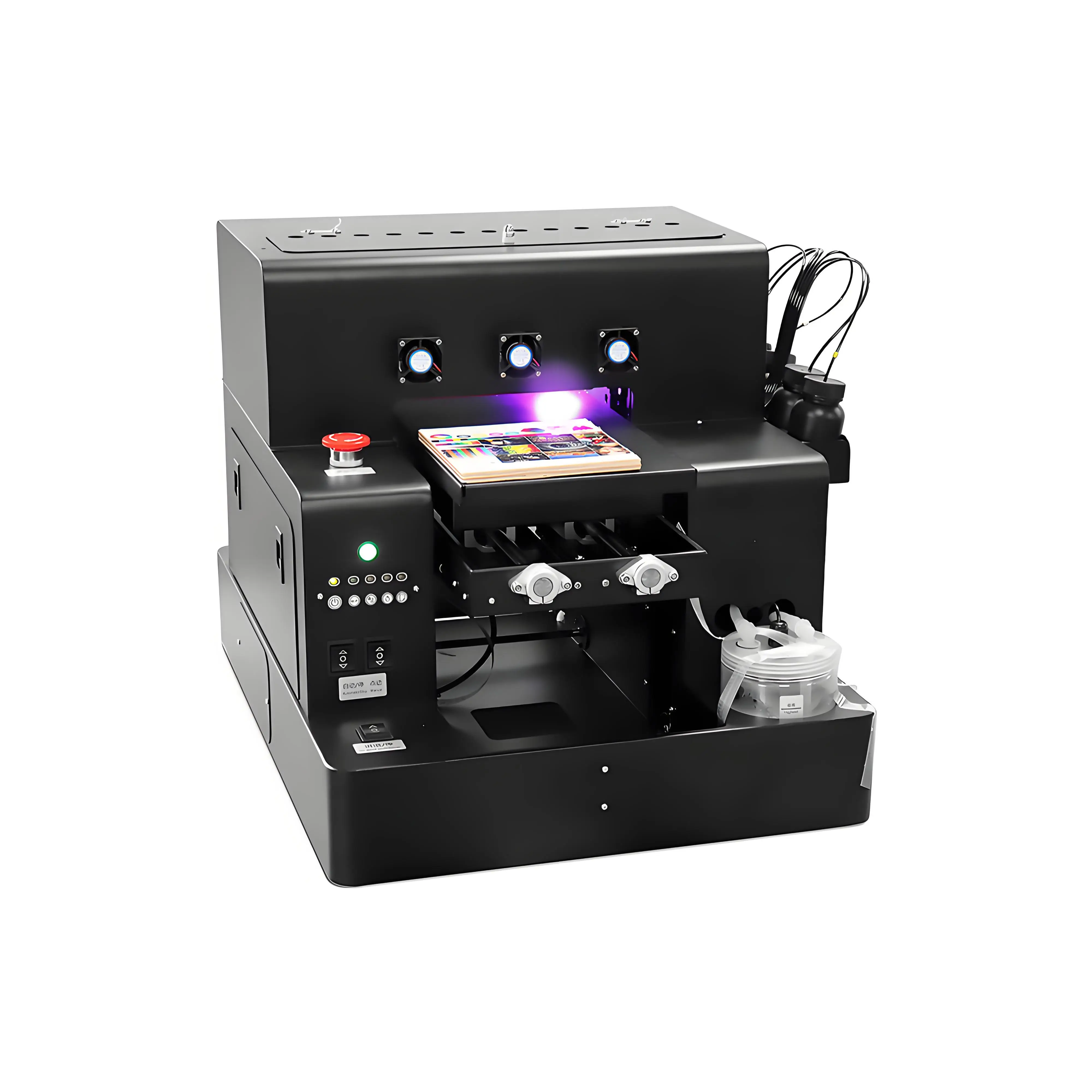
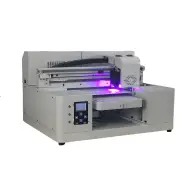
Spot A4 LED UV Printer Cylinder Printing Machine
- Active white ink circulation pump minimizes white pigment sedimentation and damper clogging
- Automatic infrared height sensor prevents accidental substrate head strikes and nozzle damage
- Precision water-cooled 395nm UV LED lamp with extended 20,000+ hour operating life
- Modular rotary fixture included for cylindrical tumblers, bottles, and drinkware branding
- Economical wear parts: replacement dampers and wiper blades cost under $10 each
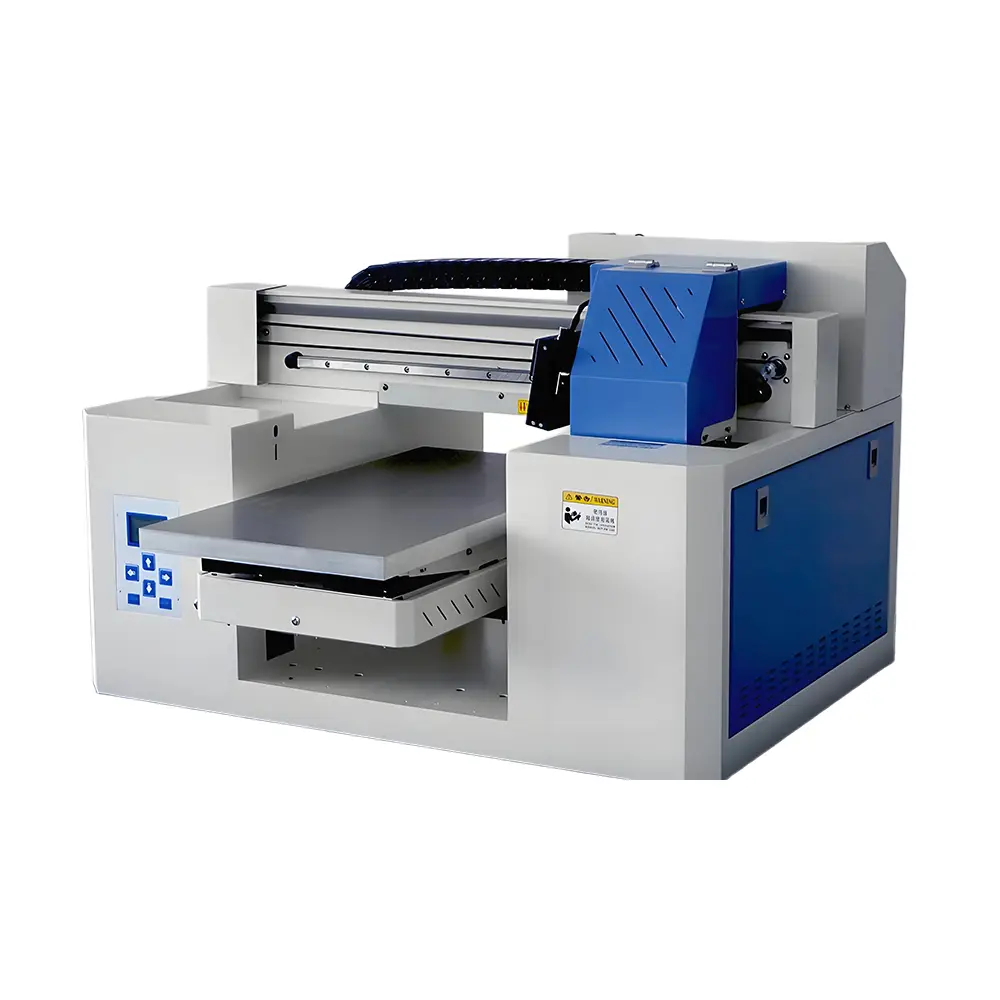
A3 Dual Head UV Printer (Rotary & UV DTF Support)
- Dual Epson printheads separate White and CMYK channels for double the printing throughput
- Supports Direct Flatbed printing, Rotary cylinder drinkware, and peel-and-stick UV DTF transfers
- Heavy-duty vacuum suction bed keeps lightweight films and blanks perfectly flat during sweeps
- Motorized 15 cm (6 inch) Z-axis clearance accommodates large gift boxes and insulated drinkware
- Simultaneous white base, vivid color, and spot clear gloss varnish in a single rapid pass
Frequently Asked Questions (FAQ)
Q1. What is the single biggest hidden consumable cost in UV printing?
The single largest hidden cost is maintenance waste ink. Between 20% and 35% of all purchased UV ink is consumed by daily morning startup purges, automated idle flash firing, and white ink circulation cycles rather than being deposited onto customer goods.
Q2. How often should I replace ink dampers on a desktop UV printer?
Ink dampers and in-line disc filters should be replaced every 2 to 3 months for the white ink channels, and every 4 to 6 months for CMYK channels. Heavy titanium dioxide particles clog damper filter screens, causing ink starvation and nozzle dropouts.
Q3. Why is the capping station considered a consumable component?
The capping station features a soft silicone rubber lip that seals against the printhead nozzle plate overnight to prevent ambient air from curing ink in the nozzles. Over 3 to 6 months, exposure to UV ink monomers hardens the rubber, compromising the seal and allowing nozzles to dry out.
Q4. How long does an Epson UV printhead typically last?
With disciplined daily cleaning, climate control (20°C–25°C, 50% humidity), and proactive damper replacements, an Epson XP600 or TX800 printhead lasts 12 to 24 months. With neglect or white ink sedimentation, lifespans can drop to under 3 to 6 months.
Q5. Can I clean a UV printhead with standard rubbing alcohol?
No. Standard isopropyl alcohol strips the hydrophobic protective coating off the nozzle plate and degrades internal adhesive seals. Always use specialized UV cleaning flush formulated specifically for piezoelectric printheads, along with lint-free polyurethane foam swabs.
Q6. How much do chemical primers cost and how long do they last?
A 500ml bottle of silane glass primer or metal adhesion promoter costs between $40 and $90. Because primer is wiped in a microscopic layer, one 500ml bottle treats between 400 and 800 drinkware items, costing roughly $0.08 to $0.15 per unit.
Q7. What are the consumable costs associated with UV DTF film?
UV DTF printing requires Film A (printing release carrier) and Film B (transfer adhesive laminating film). A roll or sheet pack typically costs between $0.60 and $1.20 per A3 sheet, adding to the total bill of materials for peel-and-stick crystal transfer decals.
Q8. Does the UV LED cooling system have recurring maintenance costs?
Yes, minimal ones. Water-cooled LED systems require distilled or deionized water mixed with an anti-corrosion inhibitor ($20 to $40 per bottle). The fluid should be flushed and replenished every 6 months to prevent pump scale buildup.
Q9. What is the realistic annual consumable budget for a desktop UV printer?
For a small commercial studio producing 2,500 to 4,000 personalized items annually, expect total consumable expenses of $1,200 to $1,800 per year (including billable ink, waste purges, dampers, capping units, primers, and an annualized printhead replacement reserve).
Q10. How do I maintain an 85%+ profit margin despite these hidden costs?
Factor all consumable overhead into your unit economics. Even at $0.47 in total consumable overhead per unit plus $1.00 for a blank phone case, your manufacturing cost is $1.47 for an item that retails for $18 to $25, ensuring healthy 88%+ gross margins.