UV LED vs Mercury Arc Lamps: Ultimate Printing Guide | GNFEI
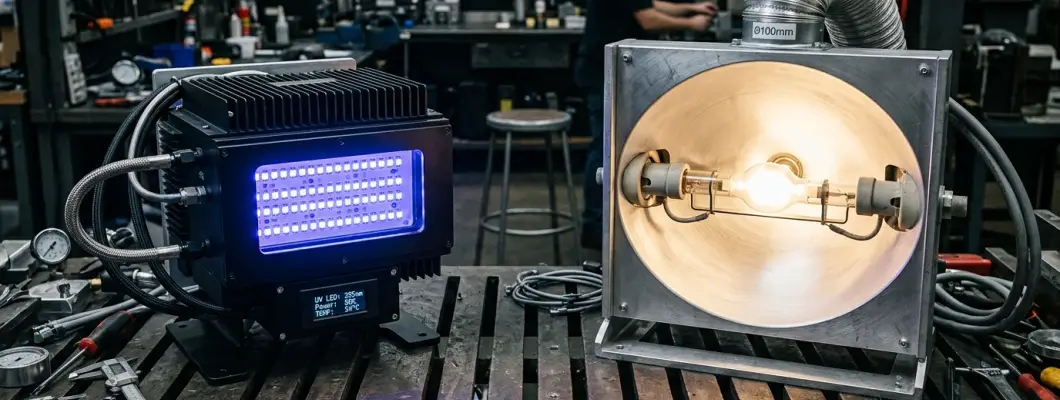
What Is the Difference Between UV LED Lamps and Mercury UV Lamps?
A deep-dive engineering comparison of spectral wavelengths, substrate thermal stress, photopolymerization mechanics, operating lifespans, and real-world printshop economics.
1. The Generational Leap: From Arc Discharge Tubes to Solid-State Diodes
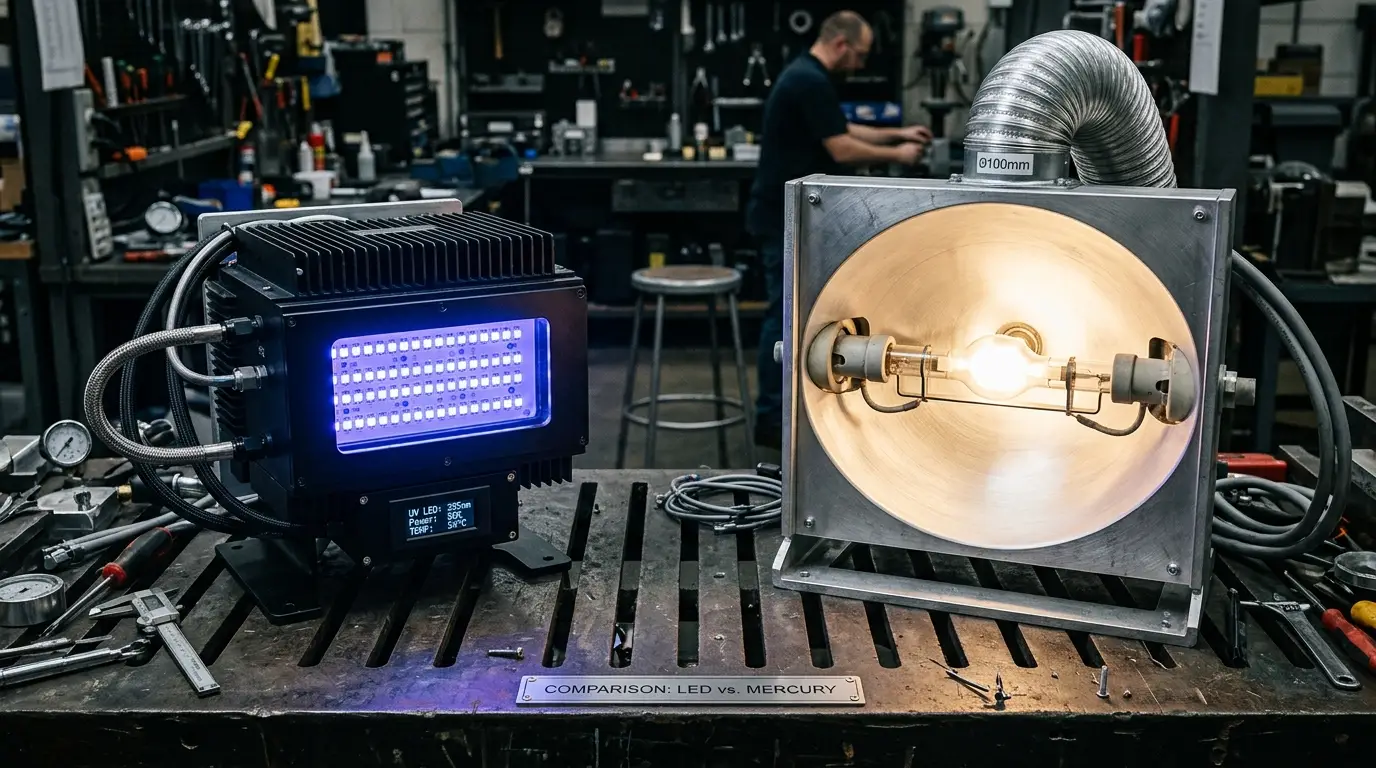
For more than four decades, the commercial printing industry relied almost exclusively on medium-pressure mercury arc lamps to crosslink UV-curable inks, coatings, and adhesives. These high-voltage quartz tubes served their purpose well: they delivered tremendous radiant energy capable of curing heavy ink films at blistering press speeds.
However, traditional mercury curing came with severe engineering liabilities: staggering power consumption, massive infrared heat generation, toxic ozone emissions, short bulb life (1,000 to 1,500 hours), and significant downtime during warm-up cycles.
Over the past decade, UV LED (Ultraviolet Light Emitting Diode) technology has fundamentally transformed flatbed and rotary printing. By replacing gaseous arc discharges with solid-state semiconductor chips, UV LED systems deliver targeted, monochromatic UV light with zero direct infrared heat, instant digital switching, and a maintenance-free operating lifespan exceeding 25,000 hours.
2. Spectral Distribution: Broad Multi-Spike vs. Targeted Monochromatic Output
The most fundamental technical distinction between the two technologies lies in their emission spectrum. How light energy is distributed across the electromagnetic spectrum dictates everything from chemical photoinitiator selection to operator safety.
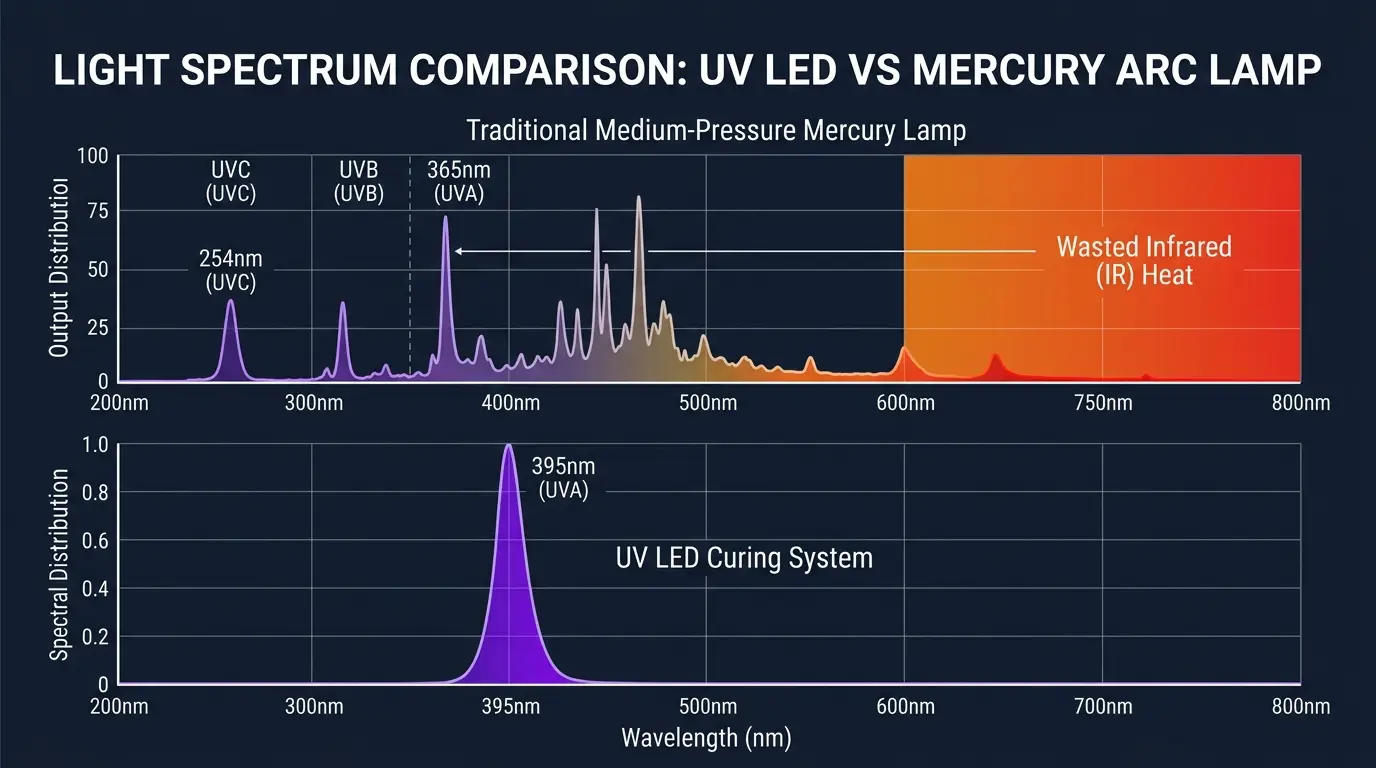
The Mercury Arc Emission Spectrum
When an electrical arc vaporizes mercury droplets inside a sealed quartz tube, it creates a broad, multi-line emission profile spanning UV-C (200–280nm), UV-B (280–315nm), UV-A (315–400nm), visible light (400–700nm), and substantial Infrared (750–2,500nm) radiation. Crucially, only 20% to 30% of the electrical energy is converted into usable UV light; the remaining 70%+ is wasted as heat and blinding white light.
The UV LED Emission Spectrum
UV LEDs are semiconductor p-n junctions engineered from gallium nitride (GaN) or aluminum gallium nitride (AlGaN). When electric current flows forward through the chip, electrons drop across the bandgap, emitting a narrow, quasi-monochromatic Gaussian distribution typically centered at 385nm, 395nm, or 405nm with a full-width at half-maximum (FWHM) of only 10 to 15nm. UV LEDs emit zero UV-C, zero UV-B, and zero direct infrared radiant heat in the optical path.
3. Photopolymerization Dynamics: Surface Cure vs. Through-Cure
In free-radical UV printing, liquid ink monomers and oligomers crosslink into a solid polymer matrix when triggered by photoinitiator radicals. However, atmospheric oxygen presents a persistent hurdle known as oxygen inhibition: ambient O2 diffuses into the uncured ink surface and scavenges free radicals, terminating polymer chains prematurely and leaving a greasy, tacky residue.
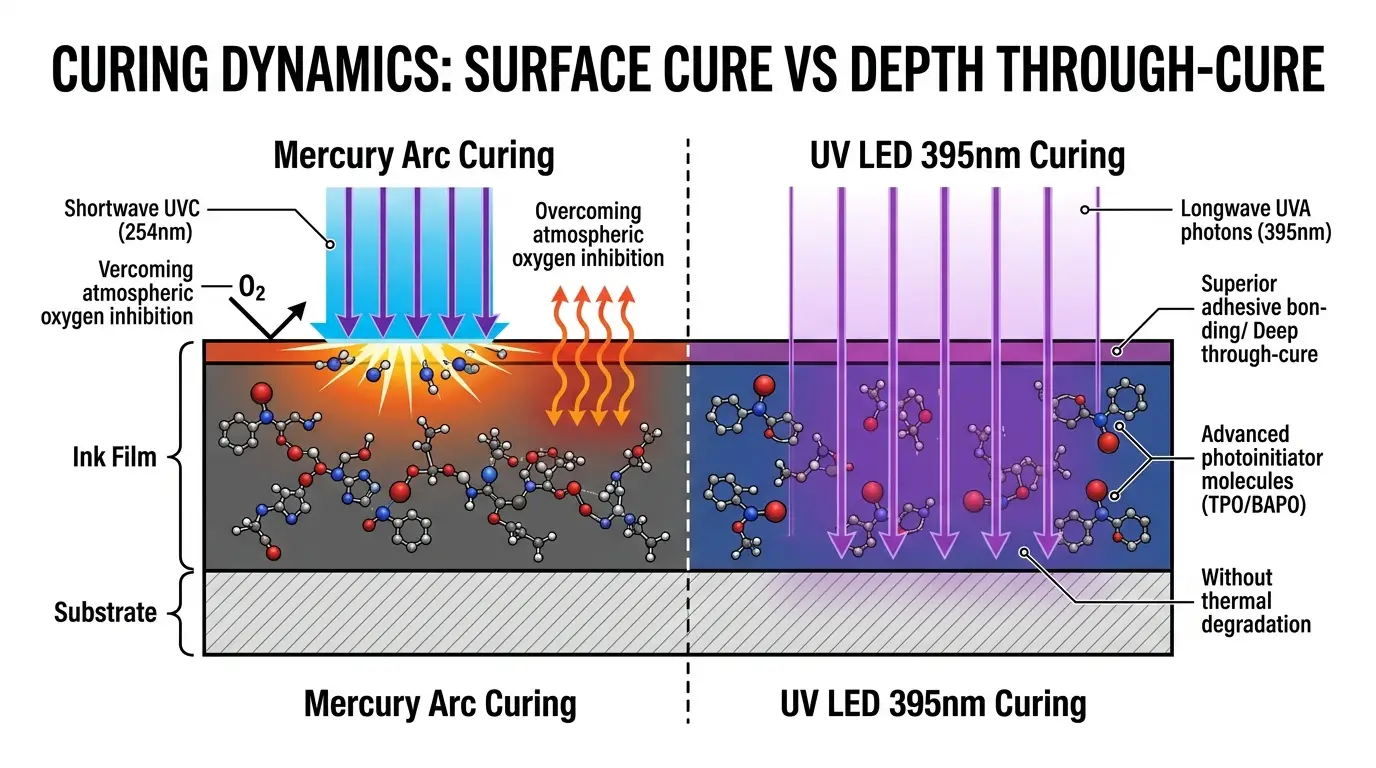
Instant Surface Hardness via UV-C
Mercury lamps emit high-energy 254nm shortwave UV-C photons. Because organic monomers absorb 254nm light with extreme optical density, nearly all UV-C energy is absorbed within the top 0.5 to 1.5 microns of the ink layer. This floods the ink surface with a radical density high enough to outpace oxygen diffusion, resulting in immediate, rock-hard scratch resistance on top. However, highly pigmented inks (like dense black or white) can block UV-C from reaching the substrate interface.
Deep Through-Cure & High Peak Irradiance
Longwave 395nm UVA photons possess superior optical transmission through heavy pigment loadings (especially titanium dioxide white and carbon black), penetrating straight to the substrate to achieve outstanding crosslinking and substrate adhesion. Modern UV LED inks overcome surface oxygen inhibition by incorporating advanced acylphosphine oxide photoinitiators (such as TPO, TPO-L, and BAPO) paired with high peak irradiance (>8 to 14 W/cm²), ensuring complete surface and through-cure without tacky residue.
4. Substrate Thermal Stress: High Heat vs. "Cold Light" Curing
One of the greatest operational advantages of UV LED systems is thermal control. In traditional mercury systems, the heavy infrared component radiates down onto the print platen, generating severe thermal stress on printed media.
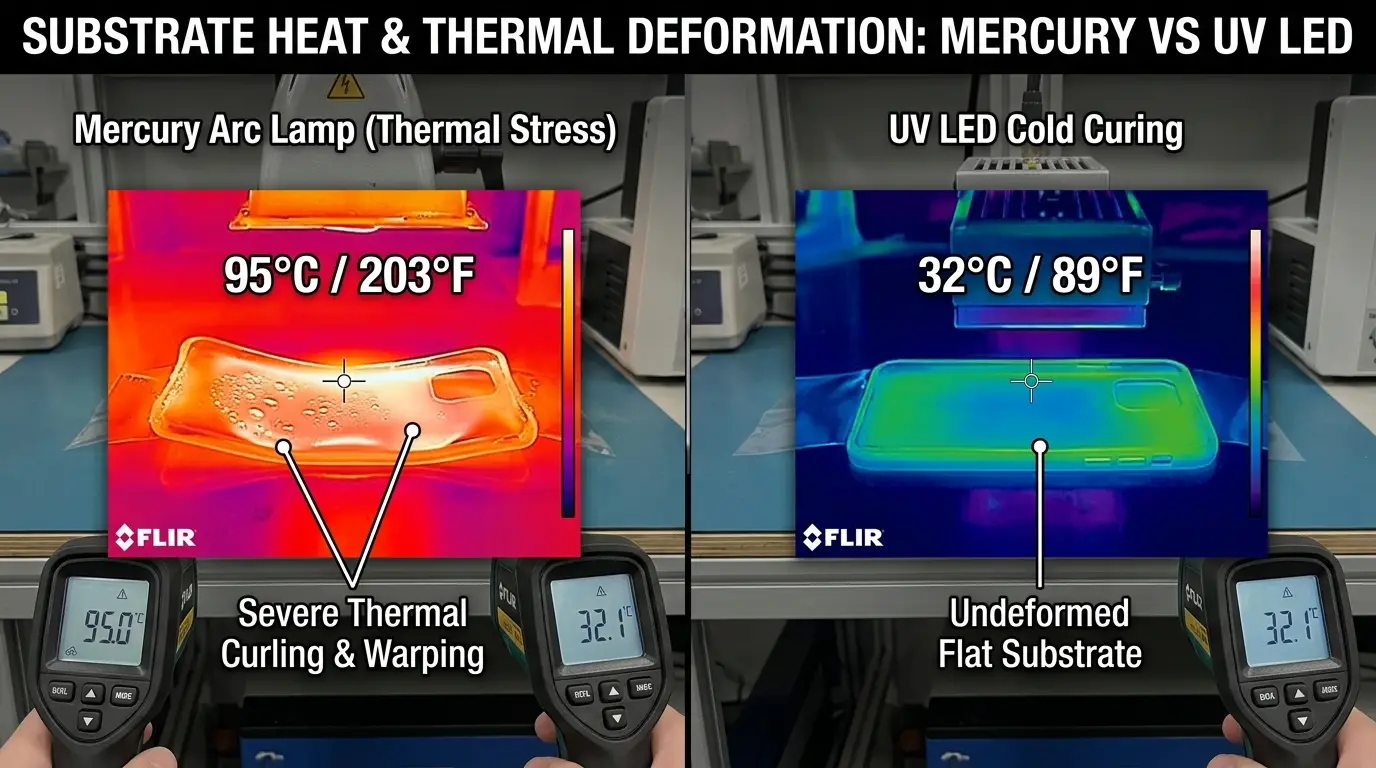
Under a medium-pressure mercury lamp, surface temperatures on the print bed routinely exceed 80°C to 110°C (176°F–230°F). This intense heat causes thin PVC vinyl, polyethylene films, delicate acrylic sheets, and polystyrene phone cases to warp, melt, bubble, or undergo thermal expansion that misaligns registration passes.
UV LED lamps, by contrast, emit zero infrared radiation toward the substrate. While the LED semiconductor chips do generate heat, that heat is conducted backward through copper core boards into closed-loop water-cooling chillers or forced-air aluminum heat sinks. Substrate surface temperature rises by only 3°C to 8°C above ambient room temperature, unlocking a massive universe of thermo-sensitive media:
0.05mm Shrink Films & PET
Print ultra-thin packaging films, heat-shrink sleeves, and PE/BOPP labels without wrinkling, edge curl, or dimensional distortion during multi-layer passes.
Custom Cases & Acrylic Blanks
Print full-bleed graphics on thin polycarbonate smartphone cases, extruded acrylic sheets, foam PVC board, and thermoformed blister packs without softening or warping.
Leather, Wood & Confectionery
Decorate genuine leather goods, wood veneers, cardboard cartons, and sensitive electronic enclosures without scorching, moisture loss, or discoloration.
5. Operational Economics: Lifespan, Warm-up Cycles, and Power Bills
From a printshop owner's financial perspective, the maintenance and operating cost differences between UV LED and mercury lamps are overwhelming:
25,000+ Hours vs. 1,000–1,500 Hours Service Life
Mercury arc electrodes erode rapidly, and their quartz tubes undergo solarization and devitrification. Within 200 hours, mercury UV output drops by 15% to 20%, requiring operators to slow down print speeds to maintain full cure. By 1,000 to 1,500 hours, the bulb must be scrapped. An industrial UV LED module operates reliably for 20,000 to 30,000+ hours—translating to 8 to 12 years of continuous single-shift production without lamp replacement.
Instant Digital On/Off vs. 15-Minute Warm-Up Cycles
Mercury lamps require 10 to 15 minutes of electrical ballast warm-up to reach proper operating vapor pressure, plus a mandatory cool-down period before restarting. Because frequent cycling destroys mercury bulbs, they must stay ignited all day behind motorized mechanical shutters even when the printer is idling between jobs. UV LEDs turn on and off instantly in microseconds; they illuminate only when the print carriage is actively traversing the media, consuming zero electricity on idle.
65% to 80% Electricity Savings
A typical mercury arc system draws between 4,000 and 8,000 Watts per lamp, plus several kilowatts for high-pressure exhaust fans and HVAC cooling. A comparable water-cooled UV LED module draws only 200 to 800 Watts. Over an operating year, this disparity saves small and medium commercial print studios between $1,800 and $4,500 per printer in electricity costs alone.
6. Workplace Safety & Regulations: Ozone, Mercury, and the Minamata Convention
Workplace air quality and environmental compliance represent another critical divide between the two systems:
Ozone Ducting & Toxic Heavy Metals
Shortwave 185nm UV light from mercury lamps ionizes atmospheric oxygen into ozone (O3)—a potent respiratory irritant regulated strictly by OSHA. Facilities running mercury lamps must install expensive, dedicated exhaust blowers, roof penetrations, and galvanized metal ductwork to vent toxic ozone outdoors. Furthermore, medium-pressure lamps contain elemental mercury vapor; broken bulbs require hazardous waste spill protocols, and burned-out tubes face strict disposal bans under the UNEP Minamata Convention on Mercury.
Zero Ozone & 100% Solid-State Safety
Because UV LEDs emit exclusively at 395nm or 385nm and produce zero light below 365nm, they generate zero ozone. Printshops do not need high-CFM external exhaust ducting or EPA air permits, allowing machines to operate safely in standard office, retail, or studio environments. UV LEDs contain no toxic heavy metals, are fully RoHS compliant, and can be recycled as standard electronic scrap at end-of-life.
7. Side-by-Side Technical Comparison Matrix
Here is the complete engineering and operational scorecard comparing UV LED curing systems against traditional medium-pressure mercury arc lamps:
| Performance Metric | Modern UV LED System | Traditional Mercury Arc Lamp |
|---|---|---|
| Light Spectrum | Monochromatic UVA (385nm, 395nm, or 405nm) | Broad multi-peak (UVC 254nm, UVB 313nm, UVA 365nm) |
| Radiant Heat on Substrate | Cold light (substrate temp +3°C to +8°C) | High infrared heat (substrate temp 80°C–110°C) |
| Substrate Compatibility | All media (PET films, phone cases, wood, acrylic, glass) | Rigid, heat-tolerant media only (warps thin plastics) |
| Ozone Generation | Zero ozone (no exhaust ducting needed) | Substantial ozone (requires high-CFM exhaust ducting) |
| Operational Lifespan | 20,000 to 30,000+ operating hours | 1,000 to 1,500 hours (rapid degradation) |
| Warm-Up & Restrike Time | Instant (0 seconds on/off switching) | 10 to 15 minutes warm-up; cool-down required |
| Energy Consumption | Low (65%–80% electricity savings) | High (runs continuously on idle behind shutters) |
| Environmental & Regulatory | RoHS compliant, non-hazardous, safe disposal | Regulated hazardous mercury waste (Minamata phase-out) |
| Through-Cure Penetration | Exceptional (longwave 395nm penetrates thick pigments) | Strong surface cure; pigments can block deep UV-C |
8. Recommended High-Performance UV LED Production Platforms
If you are investing in a commercial flatbed or rotary printer, choosing a dedicated 395nm water-cooled UV LED platform guarantees maximum substrate versatility, lower electric bills, and zero lamp replacement headaches. Here are GNFEI's two flagship UV LED systems:
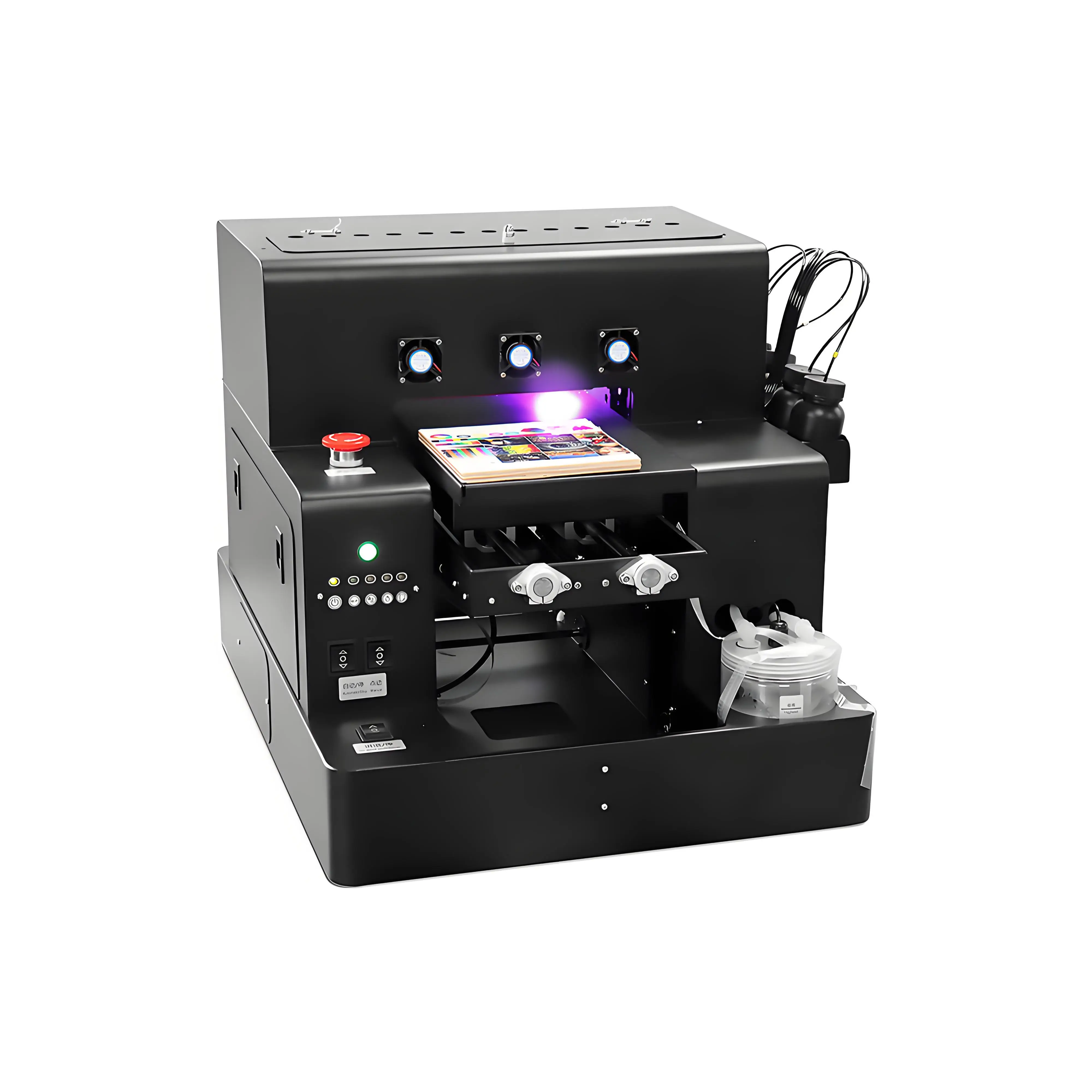
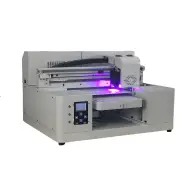
Spot A4 LED UV Printer Cylinder Printing Machine
- Equipped with an advanced water-cooled 395nm UV LED lamp with 25,000+ hour service life
- Cold-curing system prints safely onto delicate phone cases, acrylic, plastic pens, and leather
- Active white ink circulation system prevents heavy titanium dioxide pigment sedimentation
- Modular cylinder rotary attachment included for tumblers, drinkware, and cylindrical bottles
- Automatic infrared height detection prevents accidental media collisions and nozzle strikes
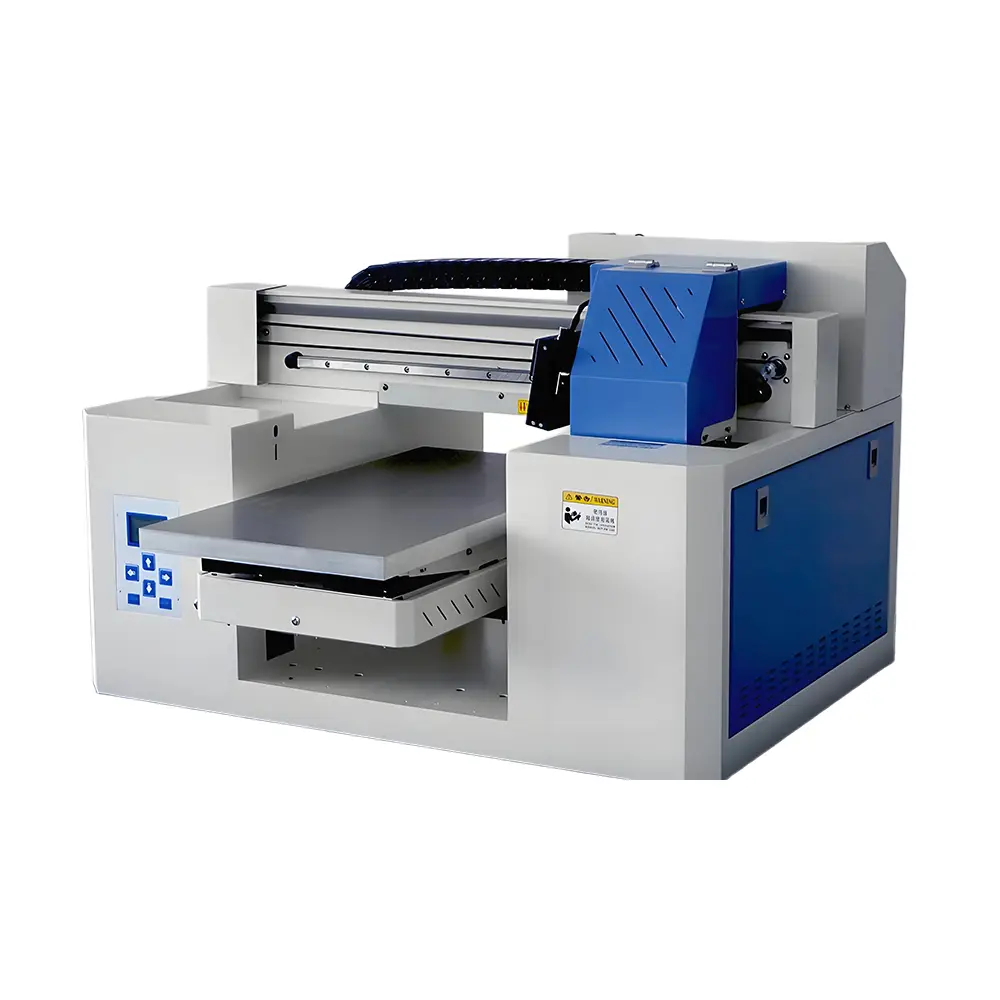
A3 Dual Head UV Printer (Rotary & UV DTF Support)
- High-intensity dual water-cooled UV LED curing modules with multi-level power calibration
- Dual Epson printheads separate White, CMYK, and Gloss Varnish for double the print speed
- Heavy-duty vacuum suction platen secures lightweight films, cards, and acrylic blanks flat
- Motorized 15 cm (6-inch) Z-axis clearance accommodates bulky gift boxes and insulated drinkware
- Supports Direct Flatbed printing, Rotary cylinder tumblers, and peel-and-stick UV DTF decals
Frequently Asked Questions (FAQ)
Q1. What is the biggest difference between UV LED and Mercury UV lamps?
The biggest difference is spectral precision and thermal output. Mercury arc lamps emit broad-spectrum UV-C, UV-B, and UV-A along with massive infrared heat, warming substrates to 80°C–110°C. UV LED lamps emit a precise monochromatic 395nm UVA wavelength with zero infrared light, delivering true 'cold light' curing on heat-sensitive materials.
Q2. Why don't UV LED lamps warp plastic phone cases or thin films?
UV LED semiconductor diodes emit light photons without emitting radiant infrared heat forward into the substrate. The heat generated internally by the diode chips is conducted backward into liquid water chillers or aluminum heat sinks. Substrate temperatures rise only 3°C–8°C above room temperature, preventing any thermal deformation.
Q3. Can I use standard traditional UV ink in a UV LED printer?
No. Traditional UV inks contain broad-spectrum photoinitiators designed to react to shortwave UV-C and UV-B light. UV LED printers require specifically formulated LED UV inks enriched with longwave photoinitiators (such as TPO or BAPO) that absorb concentrated 385nm–405nm photons.
Q4. Do UV LED lamps produce hazardous ozone gas?
No. Atmospheric ozone (O3) is generated only when shortwave ultraviolet light below 240nm breaks oxygen molecules. Because UV LED lamps emit solely in the UVA spectrum (above 365nm) and produce zero UV-C, they generate zero ozone, eliminating the need for exterior exhaust ductwork.
Q5. How long does a UV LED curing lamp last compared to a Mercury tube?
Mercury quartz arc tubes last only 1,000 to 1,500 hours before suffering steep power degradation and electrode failure. Quality water-cooled UV LED modules are rated for 20,000 to 30,000+ hours of operation, lasting more than 10 to 15 years in typical commercial production.
Q6. Do UV LED lamps require a warm-up period before printing?
No. UV LEDs switch on and off instantaneously with microsecond digital response. Mercury lamps require 10 to 15 minutes of preheating to vaporize liquid mercury into an arc, and must stay powered continuously on standby behind mechanical shutters.
Q7. How does UV LED cure through thick white or black ink layers?
Longwave 395nm UVA photons have significantly higher optical transmission through dense pigments like titanium dioxide (white) and carbon black than shortwave UV-C. This provides deep through-cure right down to the substrate, creating superior mechanical adhesion.
Q8. How much electricity do UV LED printers save?
UV LED systems achieve between 65% and 80% electrical power reduction compared to mercury arc setups. LEDs consume power only during active print sweeps and require no high-voltage ballasts or heavy exhaust blowers, saving $1,500 to $4,000 annually per production machine.
Q9. What is the Minamata Convention on Mercury, and why does it affect printers?
The Minamata Convention is a UN environmental treaty banning the production, import, and export of products containing elemental mercury. Industrial mercury vapor lamps are subject to strict regulatory phase-outs, hazardous waste manifests, and increasing replacement bulb costs.
Q10. Can I retrofit an existing Mercury printer with UV LED lamps?
Yes, many industrial presses can be retrofitted with UV LED curing systems. However, retrofitting requires switching to LED-curable ink formulations and installing appropriate power drivers and liquid chillers. Most shops find it more cost-effective to invest in a purpose-built UV LED printer like the GNFEI F85V4 or F35V3.