Why Do DTG Printers Need a White Underbase on Dark Shirts?
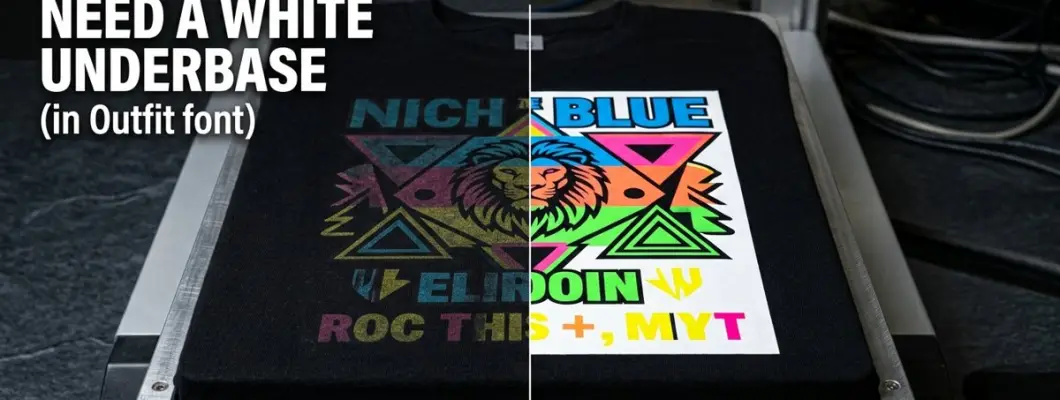
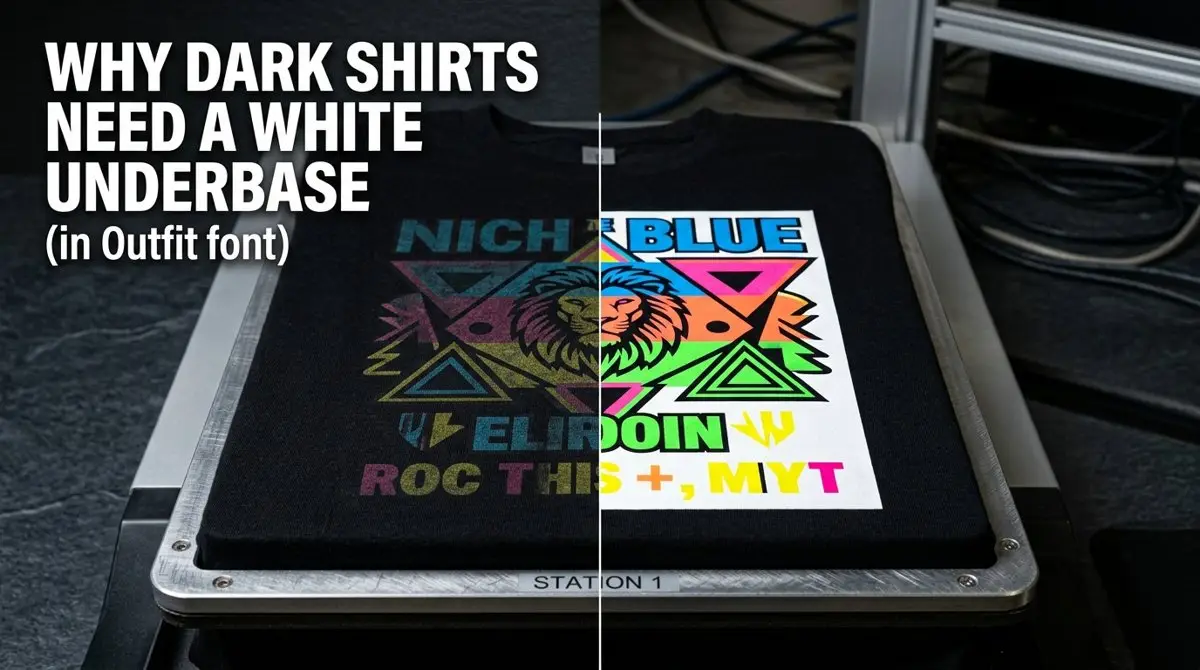
The simple truth is: CMYK inks are translucent, not opaque. If you take a yellow highlighter marker and draw on white paper, you see brilliant fluorescent yellow. If you draw that same yellow line on black construction paper, the yellow vanishes into blackness. The ink hasn't disappeared — the light has.
In this guide, we explore the optical physics, pigment chemistry, and RIP software engineering behind why a white underbase is mandatory for direct-to-garment printing on dark apparel.
The Physics of Color: Subtractive CMYK vs. Background Absorption
To understand the white underbase, we must examine how our eyes perceive color in print. Printing operates on a subtractive color model (CMYK), which relies entirely on reflected ambient light:
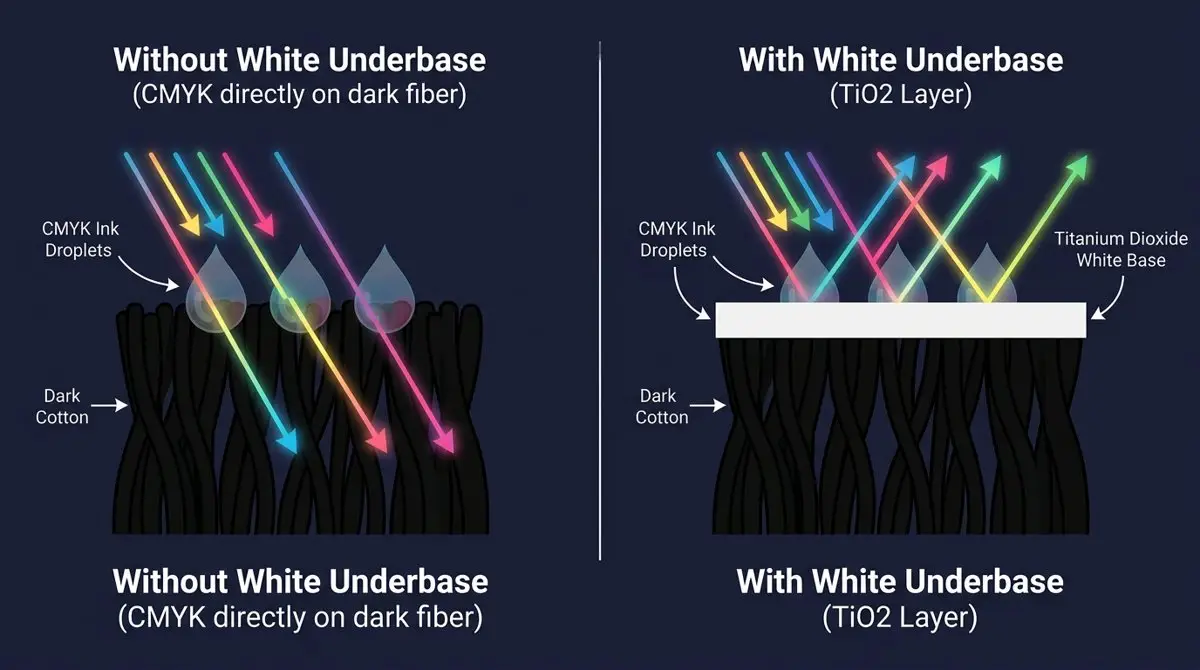
When ambient white light hits a printed white T-shirt, the translucent CMYK ink filters out specific wavelengths (absorbing some colors) and allows the rest to reflect off the bright white cotton fibers behind it directly into your eyes.
Dark cotton garments are dyed with deep black/navy reactive dyes that absorb virtually 100% of visible light. When translucent CMYK inks are sprayed directly onto dark fabric, the incoming light passes through the ink and is completely swallowed by the black fibers. No light reflects back, making the print look muddy, dingy, and nearly invisible.
White DTG ink is loaded with nanoscale titanium dioxide particles — one of the highest refractive index materials on earth (n ≈ 2.6). When cured, it creates an opaque, pure white reflective canvas directly underneath the artwork.
Optical Comparison: With vs. Without White Underbase
The difference between printing with and without a white underbase is illustrated in this optical cross-section:
Light Reflectance & Absorption Diagram
How RIP Software Generates the White Underbase Channel
Modern DTG printing does not simply print a solid white rectangle under your design. Sophisticated RIP (Raster Image Processor) software calculates variable white ink density pixel by pixel:
1. 100% Solid White Mask (High Opacity)
For pure white text, bright yellow highlights, and vivid neon graphics, the RIP commands the printer to deposit 100% white ink density to ensure maximum light bounce.
2. Gradient & Highlight Choking (Halftone Underbase)
Under dark shadows, rich burgundy, or deep forest green, 100% white ink is unnecessary and would make the artwork look chalky. The RIP applies a graduated halftone underbase, dropping white volume to 30%–60%.
3. Black Shirt Knockout (Ink Saving)
In smart RIP software, true black areas within the artwork (RGB 0,0,0) are 'knocked out' entirely — zero white ink and zero CMYK ink are printed in those zones, allowing the natural black shirt fabric to act as the shadow. This saves 20%–40% in white ink costs while keeping the hand feel soft.
4. White Choke (Border Inset)
Because ink droplets spread slightly when landing on fabric, the white underbase is automatically 'choked' (shrunk by 1–3 pixels inward). This prevents an unsightly white halo from peeking out around the colored edges.
Comparison: White Underbase across Apparel Printing Technologies
| Printing Method | White Underbase Technique | Ink Chemistry | Hand Feel Impact | Cost Factor |
|---|---|---|---|---|
| DTG (Direct To Garment) | Digital pixel-by-pixel inkjet deposition via RIP | Water-based Titanium Dioxide (TiO2) dispersion | Soft, flexible, breathable | Moderate (approx. $0.50–$1.50 per dark shirt) |
| Screen Printing | Screen-printed white plastisol or discharge ink mesh layer | High-solids PVC plastisol or zinc formaldehyde sulfoxylate | Heavy, thick rubber layer (unless discharge) | High setup cost / low per-unit ink cost |
| DTF (Direct To Film) | Full white backing ink printed on PET transfer film | Aqueous TiO2 white ink backed with TPU hot-melt glue powder | Slightly raised, flexible film sheet | Economical for multi-garment gang sheets |
| Dye Sublimation | No white ink capability (cannot print dark shirts) | Disperse dye gas molecules (translucent only) | Zero hand feel (fabric only) | Restricted to white 100% polyester only |
GNFEI F85G3 — Master Dark Garments with Dual i3200 Heads
Dedicated White Printhead | Integrated WIMS Circulation | Single-Pass Speed
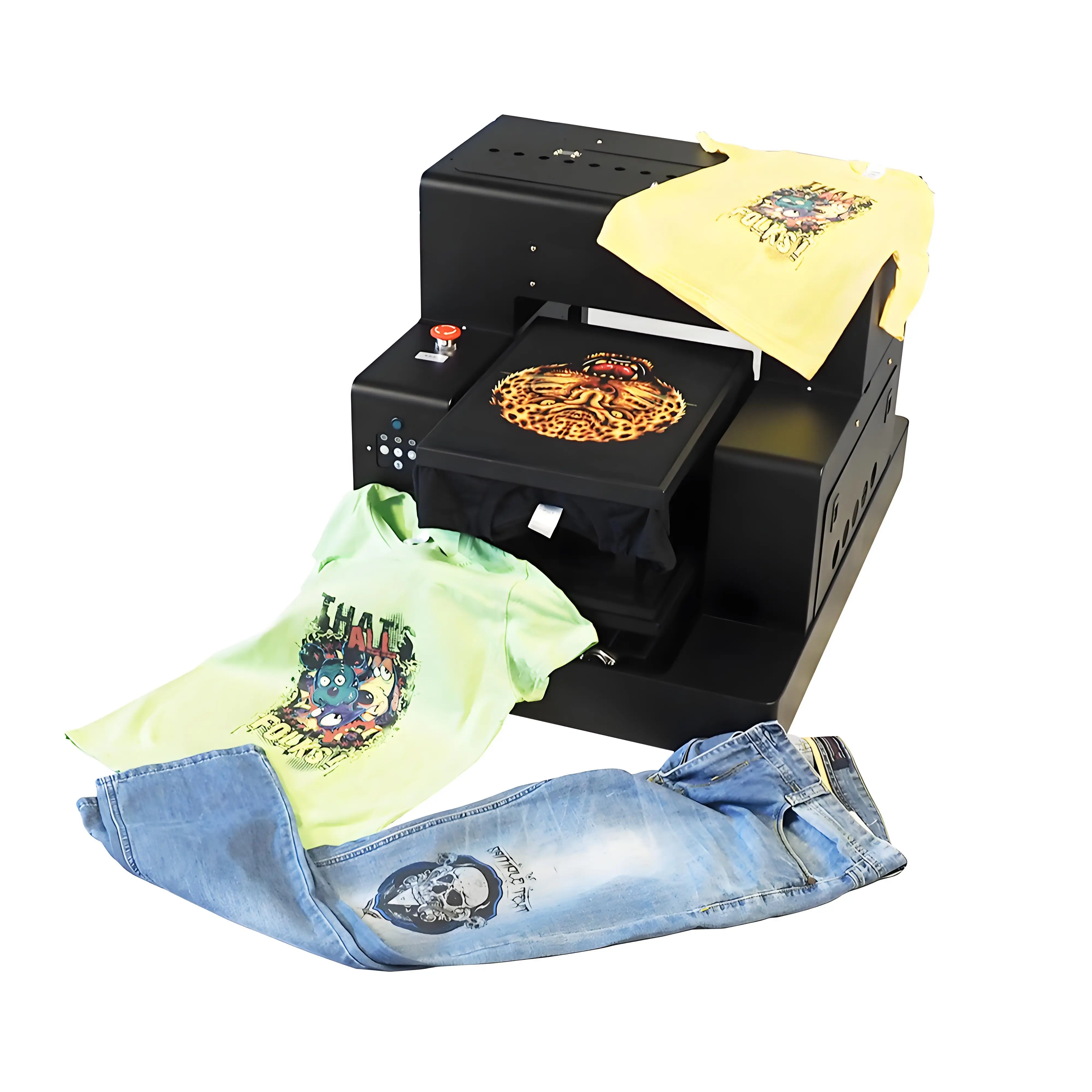
- ✓Dual Epson i3200 Printheads — Dedicated white head lays down high-opacity underbase simultaneously with CMYK
- ✓Integrated WIMS Circulation — Keeps heavy TiO2 white ink in continuous motion to prevent settling and clogging
- ✓High-Precision RIP Software Included — Advanced white choke, black knockout, and density gradients built in
- ✓40×60 cm Maximum Platen — Flawless opaque prints on oversized black hoodies and jackets
- ✓Laser Auto-Height Sensor — Ensures optimal 1.5 mm head clearance for crisp white-to-CMYK registration
Frequently Asked Questions: DTG White Underbase
Unlock Vibrant Full-Color Printing on Dark Apparel
Equip your shop with the GNFEI F85G3 industrial DTG printer. Experience flawless single-pass white underbase opacity with factory-direct pricing.